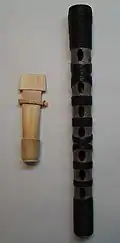
篳篥

See also: 觱篥 and 筚篥

Chinese

phonetic
trad. (篳篥) 篳 篥
simp. (筚篥) 筚 篥
alternative forms
 
觱篥
觱栗
𥷑篥
箄篥
悲栗
悲篥
悲慄/悲栗

Etymology

Borrowed from a language in the Western Regions. Compare Khotanese *pīlī (“pipe?”) (as in pīlīrūvī (“clyster-pipe”)).

Pronunciation


Rime
Character 篳 篥
Reading # 1/1 1/1
Initial (聲) 幫 (1) 來 (37)
Final (韻) 質 (48) 質 (48)
Tone (調) Checked (Ø) Checked (Ø)
Openness (開合) Open Open
Division (等) III III
Fanqie 卑吉切 力質切
Baxter pjit lit
Reconstructions
Zhengzhang
Shangfang
/piɪt̚/ /liɪt̚/
Pan
Wuyun
/pit̚/ /lit̚/
Shao
Rongfen
/pjet̚/ /ljet̚/
Edwin
Pulleyblank
/pit̚/ /lit̚/
Li
Rong
/piĕt̚/ /liĕt̚/
Wang
Li
/pĭĕt̚/ /lĭĕt̚/
Bernard
Karlgren
/pi̯ĕt̚/ /li̯ĕt̚/
Expected
Mandarin
Reflex
bi lì
Expected
Cantonese
Reflex
bat1 lat6

Noun

篳篥

  1. (music) bili (a cylindrical double reed wind instrument used in the court and ritual music of China since ancient times)

Descendants

  • → Korean: 피리 (piri, “reed wind instrument”)

Japanese

Kanji in this term
篳 篥
ひち
Hyōgaiji
りき
Hyōgaiji
on’yomi
篳篥 (hichiriki)

Pronunciation

  • (Tokyo) ひちりき [hìchíríkí] (Heiban – [0])[1]
  • (Tokyo) ひち​りき [hìchíꜜrìkì] (Nakadaka – [2])[1]
  • IPA(key): [çit͡ɕiɾʲikʲi]

Noun

篳(ひち)篥(りき) • (hichiriki) 

  1. a cylindrical double reed wind instrument used in the gagaku music of Japan

References

  1. Matsumura, Akira, editor (2006), 大辞林 [Daijirin] (in Japanese), Third edition, Tōkyō: Sanseidō, →ISBN
This article is issued from Wiktionary. The text is licensed under Creative Commons - Attribution - Sharealike. Additional terms may apply for the media files.