蒜
| ||||||||
Translingual
Han character
蒜 (Kangxi radical 140, 艸+10, 13 strokes, cangjie input 廿一火火 (TMFF), four-corner 44991, composition ⿱艹祘)
References
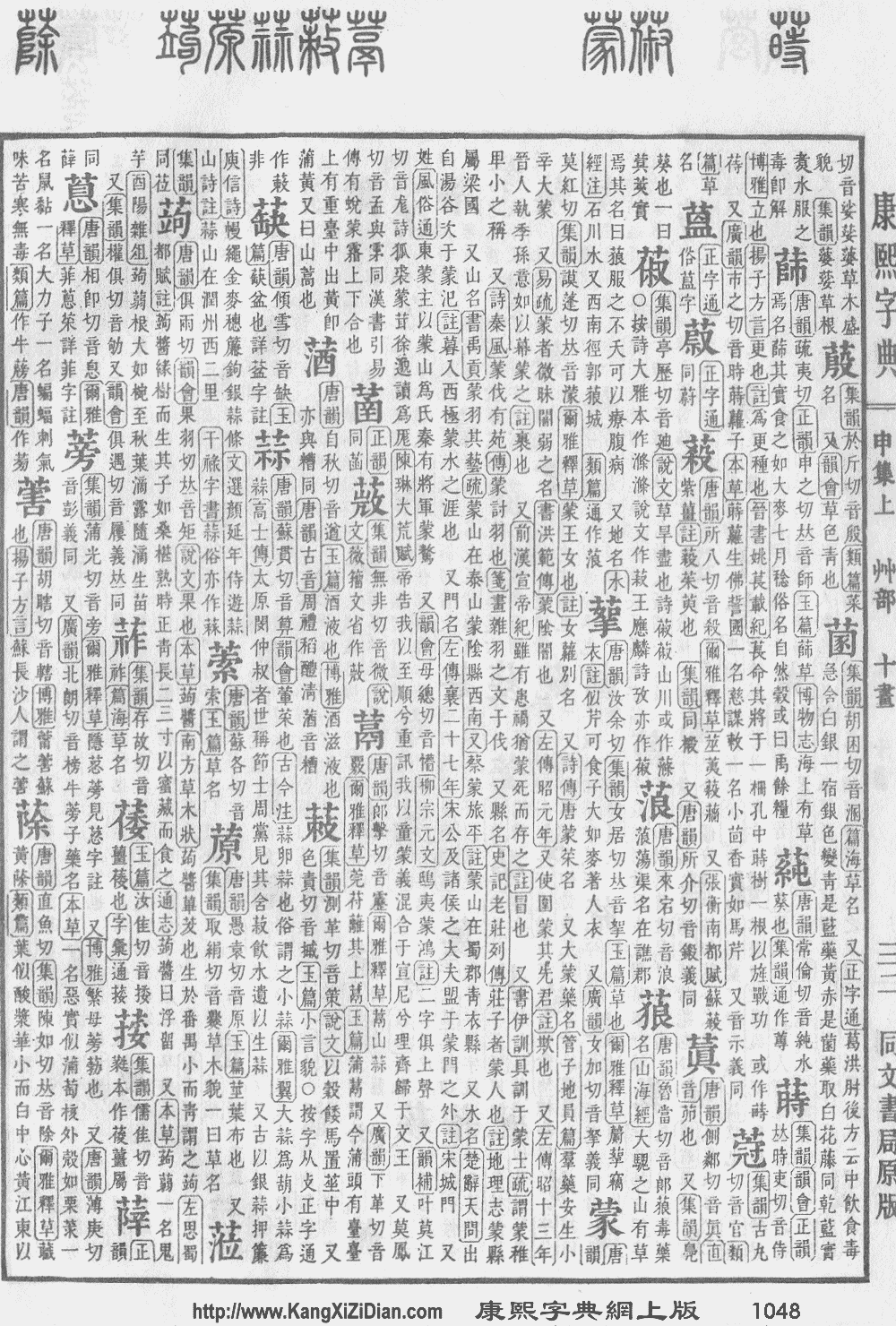
- Kangxi Dictionary: page 1048, character 22
- Dai Kanwa Jiten: character 31562
- Dae Jaweon: page 1510, character 4
- Hanyu Da Zidian (first edition): volume 5, page 3259, character 13
- Unihan data for U+849C
Chinese
| trad. | 蒜 | |
|---|---|---|
| simp. # | 蒜 | |
| 2nd round simp. | 祘 | |
Etymology
Matisoff considers this to be derived from Proto-Sino-Tibetan *swa-n (“garlic”), but more likely this may be a plant imported from the Western Regions in the Qin–Han era. The relatively late attestation and the earlier form of 卵蒜 (luǎnsuàn) attest to the latter theory.
Compare Sanskrit लशुन (laśuna), Pali lasuṇa, lasuna. The Old Chinese reconstruction was revised to a *-or rhyme in the Baxter–Sagart system, akin to its homophone 算 (“to calculate”). Hence compare Persian سیر (sir, “garlic”), Khotanese sārmā- (“the plant Basella cordifolia or B. lucida or B. rubra”), Hungarian sárma (“Ornithogalum sp.”), as well as Turkish sarımsak, Mongolian саримс (sarims).
Either way this word is cognate with the second syllable of Burmese ကြက်သွန် (krakswan, “onion”), ကြက်သွန်ဖြူ (krakswanhpru, “garlic”).
Pronunciation
Synonyms
- (Hokkien) 蒜仔
Compounds
- 凍蒜/冻蒜 (dòngsuàn)
- 卵蒜 (luǎnsuàn)
- 大蒜 (dàsuàn)
- 大蒜效應/大蒜效应
- 小蒜
- 拌蒜 (bànsuàn)
- 拌蒜加蔥/拌蒜加葱
- 搗蒜/捣蒜 (dǎosuàn)
- 擣蒜/捣蒜
- 朱蒜
- 牙蒜
- 猴蒜
- 番蒜
- 石蒜
- 砂鍋搗蒜/砂锅捣蒜
- 砂鍋砸蒜/砂锅砸蒜
- 砸薑磨蒜/砸姜磨蒜
- 耐儲大蒜/耐储大蒜
- 胡蒜
- 臘八蒜/腊八蒜
- 蒜丁
- 蒜仔
- 蒜台
- 蒜子
- 蒜押
- 蒜果
- 蒜條/蒜条
- 蒜條金/蒜条金
- 蒜毫 (suànháo)
- 蒜氣/蒜气
- 蒜泥 (suànní)
- 蒜球精
- 蒜瓣 (suànbàn)
- 蒜瓣兒/蒜瓣儿
- 蒜瓣骨朵
- 蒜絨/蒜绒
- 蒜絨枝/蒜绒枝
- 蒜缽子/蒜钵子
- 蒜腦藷/蒜脑薯
- 蒜苔 (suàntái)
- 蒜苗 (suànmiáo)
- 蒜茸 (suànróng)
- 蒜蓉 (suànróng)
- 蒜蔥/蒜葱
- 蒜薹 (suàntái)
- 蒜辮子/蒜辫子
- 蒜酪
- 蒜醬/蒜酱
- 蒜頭/蒜头 (suàntóu)
- 蒜顆/蒜颗
- 蒜髮/蒜发
- 蒜黃/蒜黄 (suànhuáng)
- 血蒜羹
- 裝蒜/装蒜 (zhuāngsuàn)
- 裝蔥賣蒜/装葱卖蒜
- 豆蒜
- 銀蒜/银蒜
- 雅蒜
- 雞毛蒜皮/鸡毛蒜皮 (jīmáosuànpí)
- 青蒜 (qīngsuàn)
Descendants
- → Lisu: ꓢꓪꓮꓠꓸ (swɑ́n)
Japanese
Etymology 1
| Kanji in this term |
|---|
| 蒜 |
| にんにく Hyōgaiji |
| kun’yomi |
| Alternative spellings |
|---|
| 大蒜 葫 忍辱 |
Origin uncertain. There are two leading theories.
- Deriving ultimately from some compound and shift of 匂い (nioi, “smell, scent”) + 憎い (nikui, “hateful; bitter”).[1] Possible progression:
- ⟨nipopi1⟩ + ⟨niku⟩ → */nipopi niku/ → */nipniku/ → /ninniku/
- Deriving as a shift in meaning from Buddhist term 忍辱 (ninniku, “patience, forbearance, forgiveness”). Apparently garlic was seen as stimulating, and as such it was a forbidden food and monks would have to forbear from eating it, possibly giving rise to use of the term as a euphemism.[2][1]
Usage notes
As with many terms that name organisms, this term is often spelled in katakana, especially in biological contexts (where katakana is customary), as ニンニク.
Derived terms
- 行者葫 (gyōjaninniku)
- 浜蒜 (hamaninniku)
Etymology 2
| Kanji in this term |
|---|
| 蒜 |
| ひる Hyōgaiji |
| kun’yomi |
| Alternative spelling |
|---|
| 葫 |
From Old Japanese, from Proto-Japonic *peru (“garlic”). First attested in the Kojiki of 712 CE.[5]
References
- “ニンニク/大蒜/葫/にんにく”, in 語源由来辞典 (Gogen Yurai Jiten, “Etymology Derivation Dictionary”) (in Japanese), 2003–2024.
- “ニンニク・大蒜”, in 日本辞典 (Nihon Jiten, “Japan Dictionary”) (in Japanese), 2007–2017.
- Matsumura, Akira, editor (2006), 大辞林 [Daijirin] (in Japanese), Third edition, Tōkyō: Sanseidō, →ISBN
- NHK Broadcasting Culture Research Institute, editor (1998), NHK日本語発音アクセント辞典 [NHK Japanese Pronunciation Accent Dictionary] (in Japanese), Tōkyō: NHK Publishing, →ISBN
- “蒜・葫”, in 日本国語大辞典 (Nihon Kokugo Daijiten, “Nihon Kokugo Daijiten”) (in Japanese), concise edition, Tōkyō: Shogakukan, 2000
Kikai
References
- “ふぃる【蒜・葫】” in JLect - Japonic Languages and Dialects Database Dictionary, 2019.
Korean
Hanja
蒜 • (san) (hangeul 산, revised san, McCune–Reischauer san, Yale san)
- This term needs a translation to English. Please help out and add a translation, then remove the text
{{rfdef}}.
Okinawan
Etymology
| Kanji in this term |
|---|
| 蒜 |
| Hyōgaiji |
| Alternative spelling |
|---|
| 葫 |
Attested in the 沖縄語典 (Okinawa Goten, “Okinawan Dictionary”) as ひる.[1]
References
- 1896: 沖縄語典 (Okinawa Goten, “Okinawan Dictionary”). In Japanese. http://kindai.ndl.go.jp/info:ndljp/pid/992016/77
Yoron
References
- “ぴる【蒜・葫】” in JLect - Japonic Languages and Dialects Database Dictionary, 2019.