衍
| ||||||||
Translingual
Han character
衍 (Kangxi radical 144, 行+3, 9 strokes, cangjie input 竹人水一弓 (HOEMN), four-corner 21103, composition ⿴行氵 or ⿲彳氵亍)
References
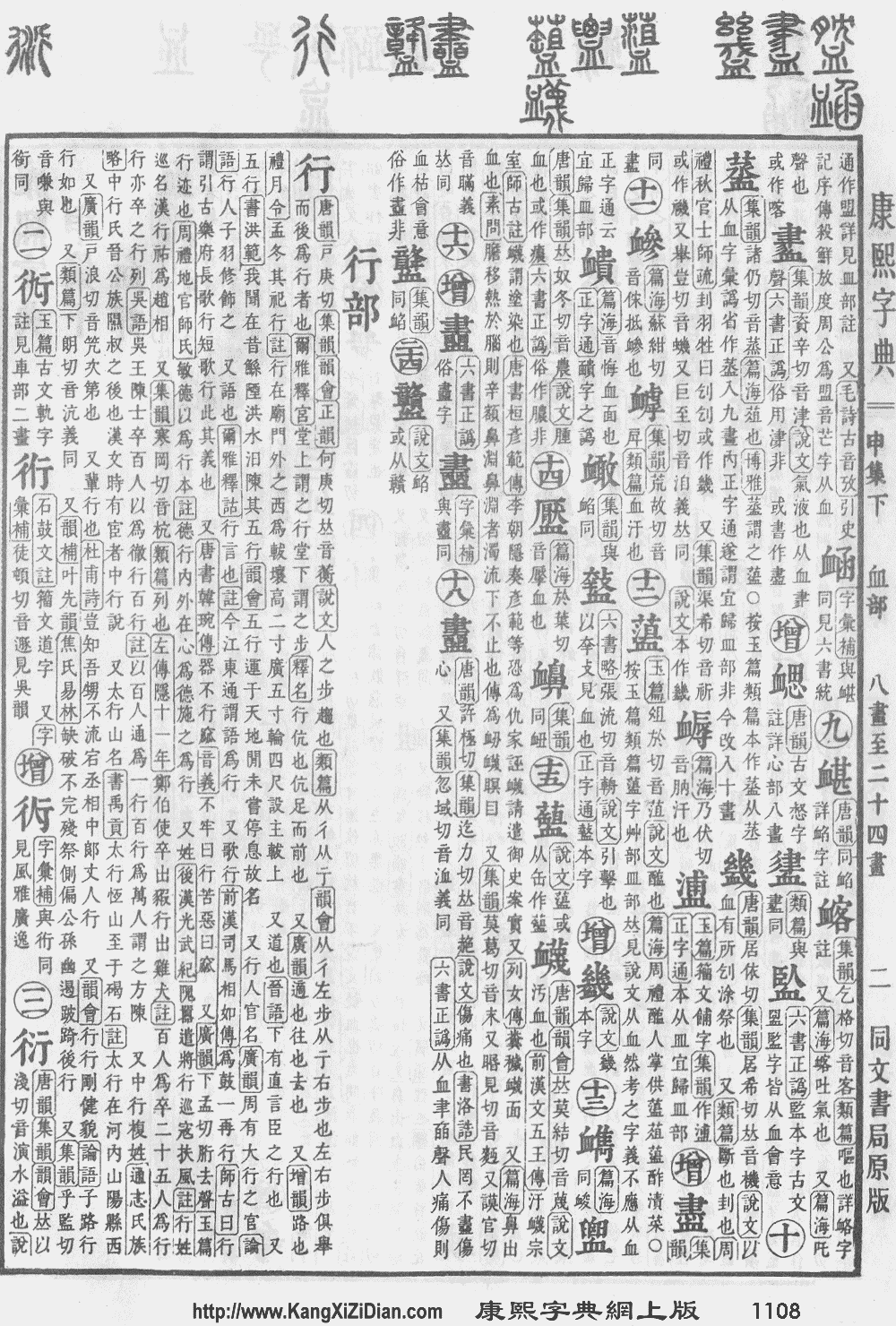
- Kangxi Dictionary: page 1108, character 35
- Dai Kanwa Jiten: character 34033
- Dae Jaweon: page 1573, character 4
- Hanyu Da Zidian (first edition): volume 2, page 820, character 4
- Unihan data for U+884D
Chinese
| simp. and trad. |
衍 | |
|---|---|---|
Glyph origin
| Historical forms of the character 衍 | |||
|---|---|---|---|
| Shang | Western Zhou | Shuowen Jiezi (compiled in Han) | Liushutong (compiled in Ming) |
| Oracle bone script | Bronze inscriptions | Small seal script | Transcribed ancient scripts |
 |
 |
 |
 |
Ideogrammic compound (會意/会意) : 行 (“path; way; to go; to move”) + 水 (“water”).
Etymology
(This etymology is missing or incomplete. Please add to it, or discuss it at the Etymology scriptorium.)
Pronunciation 1
Definitions
衍
- to overflow; to spill over
- to spread out; to extend; to develop
- superfluous; unnecessary
- characters mistakenly added during the copying of a text
- (obsolete) lowland; flatland
- (obsolete) marsh; bog
- (obsolete) mountain slope; hillside
- (obsolete) bamboo basket
- a surname
Compounds
- 上岸衍生物
- 信貸衍生產品/信贷衍生产品
- 取代衍生物
- 平衍
- 推衍
- 敷衍 (fūyǎn)
- 敷衍了事 (fūyǎnliǎoshì)
- 敷衍塞責/敷衍塞责 (fūyǎnsèzé)
- 沃衍
- 篋衍/箧衍
- 繁衍 (fányǎn)
- 羅摩衍那/罗摩衍那 (Luómóyǎnnà)
- 胄裔繁衍
- 蕃衍 (fányǎn)
- 衍伸
- 衍化 (yǎnhuà)
- 衍化物
- 衍射 (yǎnshè)
- 衍射儀/衍射仪
- 衍射光學/衍射光学
- 衍射學/衍射学
- 衍射格子
- 衍射波
- 衍射線/衍射线
- 衍射角
- 衍文 (yǎnwén)
- 衍生 (yǎnshēng)
- 衍生構造/衍生构造
- 衍生物 (yǎnshēngwù)
- 衍生產品/衍生产品 (yǎnshēng chǎnpǐn)
- 衍生蛋白
- 衍生複詞/衍生复词
- 衍生金融工具
- 衍聖公/衍圣公
- 衍變/衍变 (yǎnbiàn)
- 衍進/衍进
- 金融衍生工具
- 金融衍生產品/金融衍生产品
- 鋪衍/铺衍
Pronunciation 2
References
- “衍”, in 漢語多功能字庫 (Multi-function Chinese Character Database), 香港中文大學 (the Chinese University of Hong Kong), 2014–
Japanese
Readings
Compounds
- 衍溢 (en'itsu)
- 衍盈 (en'ei)
- 衍繹 (en'eki)
- 衍衍 (en'en)
- 衍奥 (en'ō)
- 衍凱 (engai)
- 衍義 (engi)
- 衍字 (enji)
- 衍処 (ensho)
- 衍羨 (ensen)
- 衍忒 (entoku)
- 衍入 (ennyū)
- 衍蕃 (enban)
- 衍文 (enbun)
- 衍変 (enpen)
- 衍曼, 衍漫 (enman)
- 衍裕 (en'yū)
- 衍漾 (en'yō)
- 衍沃 (en'yoku)
- 衍乱 (enran)
- 怡衍 (ien)
- 螾衍 (in'en)
- 盈衍 (eien)
- 奥衍 (ōen)
- 煥衍 (kan'en)
- 広衍, 曠衍 (kōen)
- 閎衍 (kōen)
- 慈衍 (jien)
- 饒衍 (jōen)
- 推衍 (suien)
- 大衍 (taien)
- 登衍 (tōen)
- 蕃衍, 繁衍 (han'en)
- 肥衍 (hien)
- 布衍 (fuen)
- 富衍 (fuen)
- 敷衍 (fuen)
- 紛衍 (fun'en)
- 墳衍 (fun'en)
- 平衍 (heien)
- 曼衍 (man'en) (曼延)
- 蔓衍 (man'en) (蔓延)
- 漫衍 (man'en)
- 游衍, 遊衍 (yūen)
- 優衍 (yūen)
- 余衍 (yoen)
- 沃衍 (yokuen)
- 流衍 (ryūen)
Korean
Hanja
衍 (eum 연 (yeon))
- This term needs a translation to English. Please help out and add a translation, then remove the text
{{rfdef}}.
Vietnamese
This article is issued from Wiktionary. The text is licensed under Creative Commons - Attribution - Sharealike. Additional terms may apply for the media files.