雌黄
See also: 雌黃
Chinese
| For pronunciation and definitions of 雌黄 – see 雌黃 (“gamboge; orpiment”). (This term is the simplified form of 雌黃). |
Notes:
|
Japanese
Etymology 1
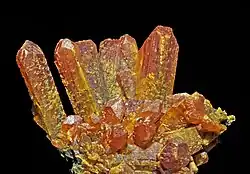
雌黄 (shiō, kini): a sample of the mineral orpiment.
| Kanji in this term | |
|---|---|
| 雌 | 黄 |
| し Grade: S |
おう Grade: 2 |
| on’yomi | |
| Alternative spelling |
|---|
| 雌黃 (kyūjitai) |
/siːwau/ → /ɕiːwɔː/ → /ɕiːoː/
From Middle Chinese compound 雌黄 (tsiɛ hwang, literally “female + yellow”), indicating the mineral orpiment, in contrast to 雄黃/雄黄 (hjuwng hwang, literally “male + yellow”), indicating the mineral realgar.
Cognate and homophone of 雄黄 (kini, “realgar”). Only differentiated by spelling.
Usage notes
This is the most common reading for this kanji compound.
Synonyms
- 石黄 (sekiō) (more common)
- 雄黄 (yūō) (rare)
Etymology 2
| Kanji in this term | |
|---|---|
| 雌 | 黄 |
| きに | |
| Grade: S | Grade: 2 |
| jukujikun | |
| Alternative spelling |
|---|
| 雌黃 (kyūjitai) |
Probably from Old Japanese [Term?]. Compound of 黄 (ki, “yellow”) + 丹 (ni, “earth, reddish earth”).
The spelling is jukujikun (熟字訓), ultimately from Middle Chinese 雌黃.
Pronunciation
- IPA(key): [kʲiɲ̟i]
Synonyms
- 石黄 (sekiō) (more common)
References
- Matsumura, Akira, editor (2006), 大辞林 [Daijirin] (in Japanese), Third edition, Tōkyō: Sanseidō, →ISBN
This article is issued from Wiktionary. The text is licensed under Creative Commons - Attribution - Sharealike. Additional terms may apply for the media files.