丹
| ||||||||
| ||||||||
Translingual
| Stroke order | |||
 | |||
Han character
丹 (Kangxi radical 3, 丶+3, 4 strokes, cangjie input 月卜 (BY), four-corner 77440, composition ⿻⺆亠 or ⿻⺆⿱丶一)
References
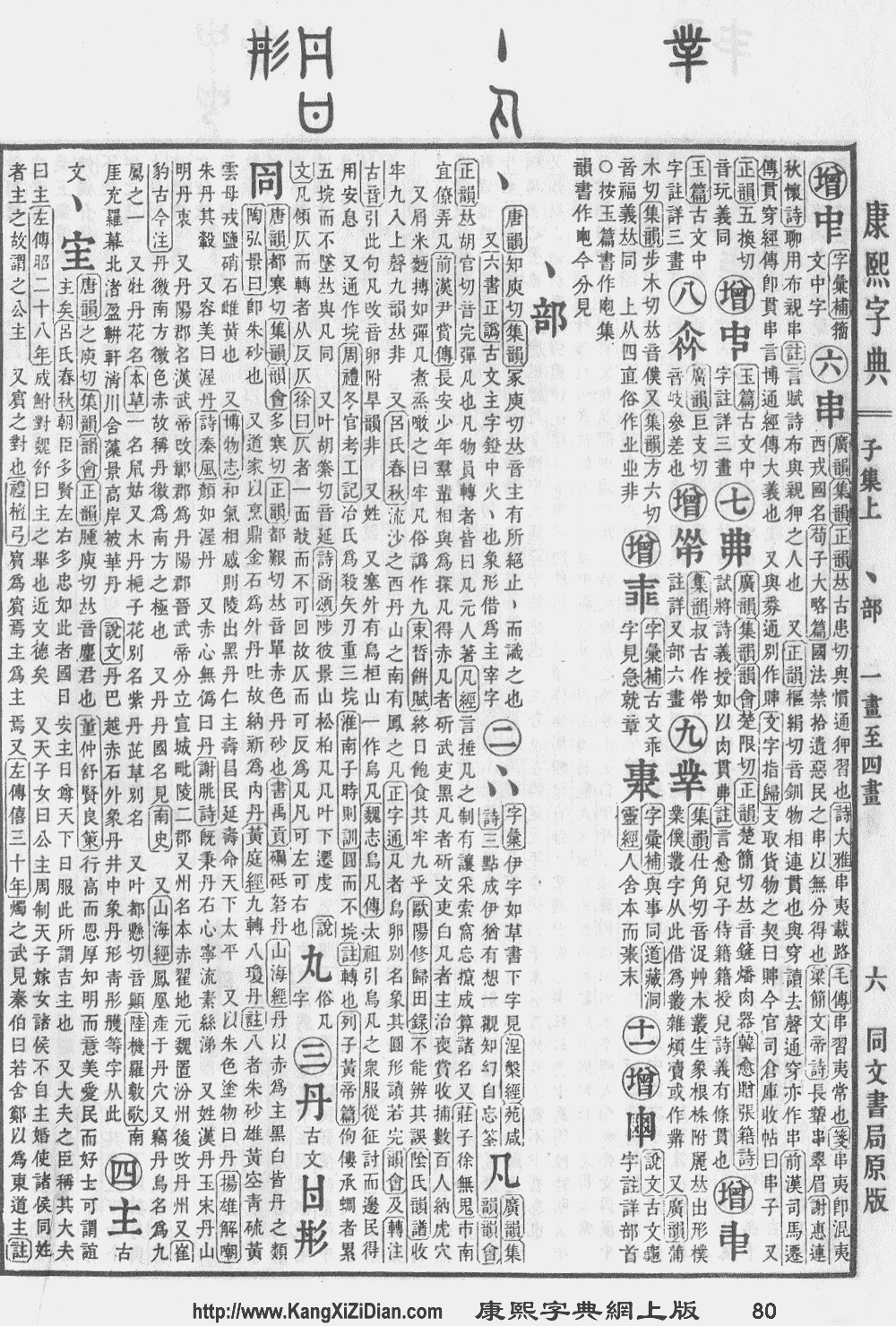
- Kangxi Dictionary: page 80, character 16
- Dai Kanwa Jiten: character 99
- Dae Jaweon: page 162, character 22
- Hanyu Da Zidian (first edition): volume 1, page 44, character 1
- Unihan data for U+4E39
- Unihan data for U+F95E
Chinese
| simp. and trad. |
丹 | |
|---|---|---|
| alternative forms | ||
Glyph origin
| Historical forms of the character 丹 | |||||||||||||||||
|---|---|---|---|---|---|---|---|---|---|---|---|---|---|---|---|---|---|
| Shang | Western Zhou | Shuowen Jiezi (compiled in Han) | Liushutong (compiled in Ming) | ||||||||||||||
| Oracle bone script | Bronze inscriptions | Small seal script | Transcribed ancient scripts | ||||||||||||||
 |
 |
 |
 | ||||||||||||||
|||
|
References: Mostly from Richard Sears' Chinese Etymology site (authorisation),
| |||||||||||||||||


Etymology 1
Schuessler (2007) suggests a Kam-Tai origin, comparing it to Proto-Kam-Sui *h-lanꟲ (“red”). 矸, as in 丹矸, may be a variant; see there for more.
Alternatively, it may be from Proto-Sino-Tibetan *t(j)a-n ~ *tsa-n (“red”), whence Burmese တာ (ta, “very red”) (Matisoff, 2003; Hill, 2014); however, STEDT currently does not compare this to 丹.
Possibly related to 旃 (OC *tjan, “a plain red flag”), as well as 袒 (OC *daːnʔ, “to bare; to strip oneself naked to the waist”), as skin color is often associated with "red". See these entries for more.
Pronunciation
Compounds
- 一寸丹心
- 一片丹心
- 不丹 (Bùdān)
- 不丹王國/不丹王国 (Bùdān Wángguó)
- 丹丘
- 丹佛 (Dānfó)
- 丹參/丹参 (dānshēn)
- 丹墀
- 丹客
- 丹山
- 丹川
- 丹干
- 丹徒布衣
- 丹心 (dānxīn)
- 丹心碧血
- 丹忱 (dānchén)
- 丹房
- 丹方 (dānfāng)
- 丹旐
- 丹曦
- 丹書/丹书
- 丹書鐵券/丹书铁券 (dānshūtiěquàn)
- 丹書鐵契/丹书铁契
- 丹東/丹东 (Dāndōng)
- 丹桂 (dānguì)
- 丹楓/丹枫 (dānfēng)
- 丹楹刻桷
- 丹款
- 丹毒 (dāndú)
- 丹氣/丹气
- 丹江口 (Dānjiāngkǒu)
- 丹溜
- 丹灶
- 丹珠爾/丹珠尔
- 丹甑
- 丹田 (dāntián)
- 丹皮
- 丹砂 (dānshā)
- 丹砂井
- 丹禁
- 丹穴
- 丹筆/丹笔
- 丹經/丹经
- 丹脣/丹唇
- 丹脣啟秀/丹唇启秀
- 丹臺/丹台
- 丹荑
- 丹葩
- 丹藥/丹药
- 丹衷
- 丹訣/丹诀
- 丹詔/丹诏
- 丹誠/丹诚 (dānchéng)
- 丹誠不泯/丹诚不泯
- 丹誠相許/丹诚相许
- 丹趙路/丹赵路 (Dānzhàolù)
- 丹輪/丹轮
- 丹鉛/丹铅
- 丹闕/丹阙 (dānquè)
- 丹陛 (dānbì)
- 丹陽/丹阳 (dānyáng)
- 丹雘
- 丹霄
- 丹霞 (dānxiá)
- 丹青 (dānqīng)
- 丹青妙手
- 丹青手
- 丹頂鶴/丹顶鹤 (dāndǐnghè)
- 丹頭/丹头
- 丹魄 (dānpò)
- 丹鳥/丹鸟
- 丹鳳/丹凤 (dānfèng)
- 丹鳳城/丹凤城
- 丹鳳眼/丹凤眼 (dānfèngyǎn)
- 丹麥/丹麦 (Dānmài)
- 丹麥人/丹麦人 (dānmàirén)
- 丹麥學派/丹麦学派
- 丹麥王國/丹麦王国 (Dānmài Wángguó)
- 丹麥語/丹麦语 (Dānmàiyǔ)
- 丹黃/丹黄
- 丹鼎
- 九轉丹/九转丹
- 九轉金丹/九转金丹
- 九還丹/九还丹
- 仁丹 (réndān)
- 仙丹 (xiāndān)
- 內丹/内丹
- 內丹功/内丹功
- 八卦丹
- 加里曼丹 (Jiālǐmàndān)
- 壽丹/寿丹
- 外丹
- 外丹功
- 大丹狗
- 契丹 (Qìdān)
- 好丹非素
- 妙手丹青
- 定坤丹 (dìngkūn dān)
- 山丹 (shāndān)
- 巴丹半島/巴丹半岛 (Bādān Bàndǎo)
- 施丹傅粉
- 書丹/书丹 (shūdān)
- 朱丹
- 松葉牡丹/松叶牡丹
- 楓丹白露/枫丹白露 (Fēngdānbáilù)
- 氯丹 (lǜdān)
- 水丹
- 浮翠流丹
- 渥丹
- 煉丹/炼丹 (liàndān)
- 煉丹術/炼丹术 (liàndānshù)
- 燕丹
- 燒丹鍊汞/烧丹炼汞
- 燕太子丹
- 牡丹 (mǔdān)
- 牡丹亭
- 牡丹江 (Mǔdānjiāng)
- 牡丹花
- 白牡丹 (báimǔdān)
- 眉橫丹鳳/眉横丹凤
- 碧血丹心
- 視丹如綠/视丹如绿
- 萬丹/万丹 (Wàndān)
- 萬靈丹/万灵丹 (wànlíngdān)
- 秋牡丹
- 紅毛丹/红毛丹 (hóngmáodān)
- 蔻丹 (kòudān)
- 蘇丹/苏丹 (sūdān)
- 赤血丹心
- 還丹/还丹
- 野牡丹
- 金丹 (jīndān)
- 鉛丹/铅丹
- 鍊丹/炼丹 (liàndān)
- 阿姆斯特丹 (Āmǔsītèdān)
- 阿巴丹
- 陰丹士林/阴丹士林 (yīndānshìlín)
- 陰丹布/阴丹布
- 雅丹 (yǎdān)
- 靈丹/灵丹 (língdān)
- 靈丹妙藥/灵丹妙药 (língdānmiàoyào)
- 靈丹聖藥/灵丹圣药 (língdānshèngyào)
- 靈寶護心丹/灵宝护心丹
- 青丹
- 馬纓丹/马缨丹
- 鹿特丹 (Lùtèdān)
Pronunciation
Synonyms
| Branch | Words |
|---|---|
| Protestant | 但 |
| Roman Catholic | 丹 |
References
- “丹”, in 漢語多功能字庫 (Multi-function Chinese Character Database), 香港中文大學 (the Chinese University of Hong Kong), 2014–
Japanese
Kanji
- cinnabar
- red
- elixir made with cinnabar (e.g. Chinese elixir of life)
- improvised medicine
- devotion
- Short for 丹波国 (Tanba-koku, “Tanba Province”)
Readings
Compounds
- 丹桂 (tankei): golden osmanthus (Osmanthus fragrans)
- 丹花 (tanka)
- 丹後 (Tango)
- 丹砂 (tansa), 丹砂 (tansha)
- 丹朱 (tanshu)
- 丹州 (Tanshū)
- 丹精, 丹誠 (tansei)
- 丹青 (tansei)
- 丹前 (tanzen)
- 丹頂 (tanchō)
- 丹田 (tanden)
- 丹毒 (tandoku)
- 丹念 (tannen)
- 丹波 (Tanba)
- 丹碧 (tanpeki)
- 丹薬 (tan'yaku)
- 黄丹 (ōtan), 黄丹 (ōdan)
- 仙丹 (sentan)
- 曽丹集 (Sotan-shū)
- 反魂丹 (hangontan)
- 牡丹 (botan)
- 万金丹 (mankintan)
- 練丹, 煉丹 (rentan)
- 雲丹 (uni)
- 甲比丹, 甲必丹 (kapitan)
- 吉利支丹, 切支丹 (Kirishitan)
- 牡丹餅 (botamochi)
Etymology 1
| Kanji in this term |
|---|
| 丹 |
| に Grade: S |
| kun’yomi |
From Old Japanese, also used as 借音 (shakuon) kana for ⟨ni⟩.
Derived terms
Etymology 2
| Kanji in this term |
|---|
| 丹 |
| たん Grade: S |
| on’yomi |
From Middle Chinese 丹 (MC tan).
Used in the Man'yōshū (c. 759 CE) as 借音 (shakuon) kana for ⟨ta⟩.
Noun
丹 • (tan)
Derived terms
- 丹緑本 (Tanrokubon), 丹緑本 (Tanryokubon)
References
- Matsumura, Akira (1995) 大辞泉 [Daijisen] (in Japanese), First edition, Tōkyō: Shogakukan, →ISBN
- Matsumura, Akira, editor (2006), 大辞林 [Daijirin] (in Japanese), Third edition, Tōkyō: Sanseidō, →ISBN
Korean
Etymology 1
From Middle Chinese 丹 (MC tan).
Compounds
Hanja
丹 (eumhun 정성스러울 란 (jeongseongseureoul ran), South Korea 정성스러울 난 (jeongseongseureoul nan))
References
- 국제퇴계학회 대구경북지부 (國際退溪學會 大邱慶北支部) (2007). Digital Hanja Dictionary, 전자사전/電子字典.
- Naver Hanja Dictionary: 丹
Vietnamese
Han character
丹: Hán Việt readings: đan (
丹: Nôm readings: đơn[2][6][5][4][7], đan[1][2][3][6]
References
- Nguyễn (2014).
- Nguyễn et al. (2009).
- Trần (2004).
- Génibrel (1898).
- Bonet (1899).
- Hồ (1976).
- Taberd & Pigneau de Béhaine (1838).