기러기
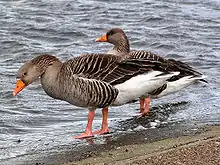
기러기 (greylag goose)
Korean
Alternative forms
- 기례기 (giryegi) (Koryo-mar)
Etymology
First attested in the Hunminjeong'eum haerye (訓民正音解例 / 훈민정음해례), 1446, as Middle Korean 그력 (Yale: kùlyèk). Subsequently passed through the forms 그려기 (geuryeogi) and 기려기 (giryeogi). Equivalent to 기럭 (gireok) + 이 (-i, noun suffix), the unsuffixed form surviving in the vocative.
Possibly related to Japanese 雁 (kari, “goose”) and Mongolian галуу (galuu, “goose”).
Pronunciation
- (SK Standard/Seoul) IPA(key): [kiɾʌ̹ɡi]
- Phonetic hangul: [기러기]
| Romanizations | |
|---|---|
| Revised Romanization? | gireogi |
| Revised Romanization (translit.)? | gileogi |
| McCune–Reischauer? | kirŏgi |
| Yale Romanization? | kileki |
South Gyeongsang (Busan) pitch accent: 기러기의 / 기러기에 / 기러기까지
Syllables in red take high pitch. This word always takes high pitch on the second syllable, and lowers the pitch of subsequent suffixes.
See also
- 거위 (geowi, “domesticated goose that would not fly”)
- 고니 (goni, “swan that also flies in a wedge”)
This article is issued from Wiktionary. The text is licensed under Creative Commons - Attribution - Sharealike. Additional terms may apply for the media files.