雁
| ||||||||
Translingual
Han character
雁 (Kangxi radical 172, 隹+4, 12 strokes, cangjie input 一人人土 (MOOG), four-corner 71214, composition ⿸厂倠)
References
- Kangxi Dictionary: page 1364, character 24
- Dai Kanwa Jiten: character 41960
- Dae Jaweon: page 1868, character 22
- Hanyu Da Zidian (first edition): volume 6, page 4093, character 2
- Unihan data for U+96C1
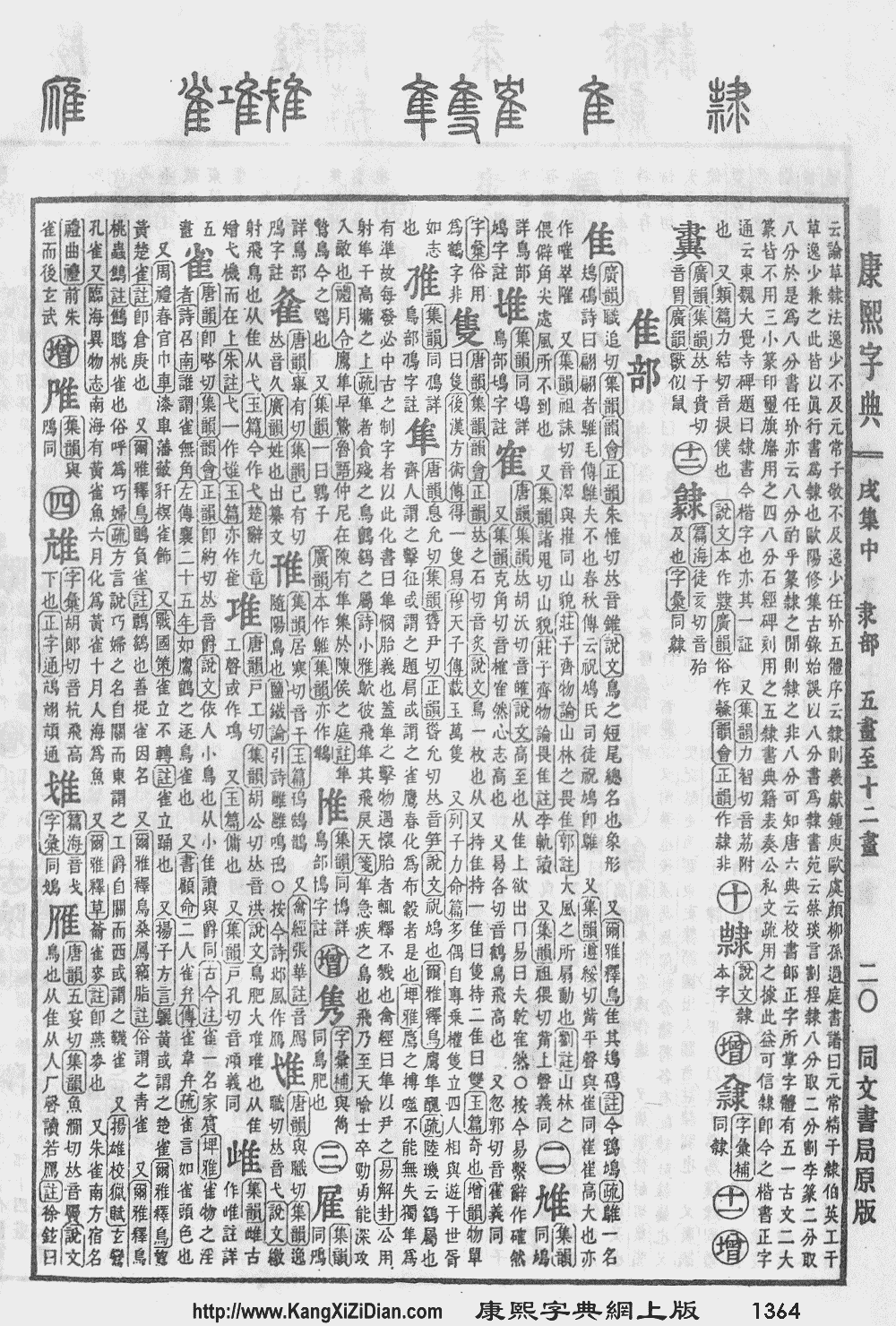
Chinese
| trad. | 雁/鴈 | |
|---|---|---|
| simp. | 雁 | |
| alternative forms | 鳫 | |
Glyph origin
Phono-semantic compound (形聲/形声, OC *ŋraːns) : phonetic 厂 (OC *hŋaːnʔ, *hŋaːns) + semantic 人 + semantic 隹.
Etymology
Ultimately from Proto-Sino-Tibetan *ŋa-n (“goose”) (tentatively reconstructed); cognate with Tibetan ངང་པ (ngang pa), Burmese ငန်း (ngan:).
Related to 鵝 (OC *ŋaːl, “domestic goose”); both 鵝 and 雁 likely reflect an earlier liquid final (Schuessler, 2007; cf. Baxter and Sagart's reconstruction). Alternatively, it may derive from 鵝 with nominalizing suffix *-n, but this Chinese-internal derivation is problematic in light of the cognates in Tibeto-Burman (Schuessler, 2007; Alves, 2015b); but see Hill (2019) also, as noted in the etymology of 鵝.
Possible relationship with Proto-Indo-European *ǵʰh₂éns (“goose”) has been noted by some (Mayrhofer, 1976; Alves, 2015b).
Pronunciation
Definitions
雁
Synonyms
Compounds
- 名標雁塔/名标雁塔
- 大雁 (dàyàn)
- 大雁塔
- 奠雁
- 孔雁
- 平沙落雁
- 指雁為羹/指雁为羹
- 斷雁孤鴻/断雁孤鸿
- 木雁
- 沉魚落雁/沉鱼落雁 (chényúluòyàn)
- 燕雁代飛/燕雁代飞
- 白額雁/白额雁
- 空弦落雁
- 落雁沉魚/落雁沉鱼
- 蠶頭雁尾/蚕头雁尾
- 衡陽雁去/衡阳雁去
- 豆雁
- 雁來紅/雁来红 (yànláihóng)
- 雁去魚來/雁去鱼来
- 雁塔
- 雁塔題名/雁塔题名
- 雁奴
- 雁字
- 雁帛
- 雁幣/雁币
- 雁序
- 雁形目
- 雁影分飛/雁影分飞
- 雁戶/雁户
- 雁書/雁书
- 雁杳魚沉/雁杳鱼沉 (yànyǎoyúchén)
- 雁柱
- 雁皮
- 雁翅
- 雁翎刀 (yànlíngdāo)
- 雁蕩山/雁荡山 (Yàndàngshān)
- 雁行
- 雁行折翼
- 雁足
- 雁足傳書/雁足传书
- 雁門關/雁门关 (Yànménguān)
- 雁陣/雁阵 (yànzhèn)
- 雁鴨科/雁鸭科
- 雁齒/雁齿
- 頭雁/头雁
- 魚沉雁杳/鱼沉雁杳 (yúchényànyǎo)
- 魚沉雁渺/鱼沉雁渺
- 魚沉雁落/鱼沉雁落
- 魚雁/鱼雁
- 魚雁不絕/鱼雁不绝
- 魚雁沉沉/鱼雁沉沉
- 鳧雁/凫雁
- 鴻雁/鸿雁 (hóngyàn)
- 鴻雁傳書/鸿雁传书 (hóngyànchuánshū)
- 鴻雁哀鳴/鸿雁哀鸣 (hóngyàn'āimíng)
- 鴻雁河/鸿雁河 (Hóngyànhé)
- 鵰心雁爪/雕心雁爪
Descendants
Others:
References
- “雁”, in 漢語多功能字庫 (Multi-function Chinese Character Database), 香港中文大學 (the Chinese University of Hong Kong), 2014–
Japanese
Etymology 1
| Kanji in this term |
|---|
| 雁 |
| がん Jinmeiyō |
| on’yomi |
| Alternative spelling |
|---|
| 鴈 |
From Middle Chinese 雁 (ngænH, “wild goose”).
Usage notes
- As with many terms that name organisms, this term is often spelled in katakana, especially in biological contexts (where katakana is customary).
Derived terms
References
- Matsumura, Akira, editor (2006), 大辞林 [Daijirin] (in Japanese), Third edition, Tōkyō: Sanseidō, →ISBN
- NHK Broadcasting Culture Research Institute, editor (1998), NHK日本語発音アクセント辞典 [NHK Japanese Pronunciation Accent Dictionary] (in Japanese), Tōkyō: NHK Publishing, →ISBN
Korean
Hanja
- wild goose, whose skein flies in wedge or cuneiform, in contrast with 鵝 (거위 아, geowi-a), the domestic goose that would not fly at all.
Compounds
- 家雁 (가안, ga-an) domestic goose, literally, house goose.