dó
Catalan
Usage notes
The Algherese imperative form dó is an optional reduced form of the imperative form dona that can see use when the pronouns -me or -mos attach to the end of the verb.
References
El Català de l'Alguer : un model d'àmbit restringit, Barcelona, 2003, →ISBN, page 47
Galician
Etymology 1
From Old Galician-Portuguese doo, from Latin dolus. Cognate with Portuguese dó, Spanish duelo, Catalan dol, French deuil, Italian duolo.
Pronunciation
- IPA(key): [ˈdɔ]
Pronunciation
- IPA(key): [ˈdɔ]
References
- “doo” in Dicionario de Dicionarios do galego medieval, SLI - ILGA 2006–2022.
- “doo” in Xavier Varela Barreiro & Xavier Gómez Guinovart: Corpus Xelmírez - Corpus lingüístico da Galicia medieval. SLI / Grupo TALG / ILG, 2006–2018.
- “dó” in Dicionario de Dicionarios da lingua galega, SLI - ILGA 2006–2013.
- “dó” in Tesouro informatizado da lingua galega. Santiago: ILG.
- “dó” in Tesouro informatizado da lingua galega. Santiago: ILG.
Hungarian
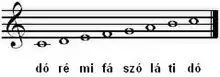
Pronunciation
- IPA(key): [ˈdoː]
Audio (file) - Rhymes: -doː
Noun
dó (plural dók)
Declension
| Inflection (stem in long/high vowel, back harmony) | ||
|---|---|---|
| singular | plural | |
| nominative | dó | dók |
| accusative | dót | dókat |
| dative | dónak | dóknak |
| instrumental | dóval | dókkal |
| causal-final | dóért | dókért |
| translative | dóvá | dókká |
| terminative | dóig | dókig |
| essive-formal | dóként | dókként |
| essive-modal | dóul | — |
| inessive | dóban | dókban |
| superessive | dón | dókon |
| adessive | dónál | dóknál |
| illative | dóba | dókba |
| sublative | dóra | dókra |
| allative | dóhoz | dókhoz |
| elative | dóból | dókból |
| delative | dóról | dókról |
| ablative | dótól | dóktól |
| non-attributive possessive - singular |
dóé | dóké |
| non-attributive possessive - plural |
dóéi | dókéi |
| Possessive forms of dó | ||
|---|---|---|
| possessor | single possession | multiple possessions |
| 1st person sing. | dóm | dóim |
| 2nd person sing. | dód | dóid |
| 3rd person sing. | dója | dói |
| 1st person plural | dónk | dóink |
| 2nd person plural | dótok | dóitok |
| 3rd person plural | dójuk | dóik |
Further reading
- (Hungarian) An article on solfège with hand signs
- dó in Bárczi, Géza and László Országh. A magyar nyelv értelmező szótára (‘The Explanatory Dictionary of the Hungarian Language’, abbr.: ÉrtSz.). Budapest: Akadémiai Kiadó, 1959–1962. Fifth ed., 1992: →ISBN
- dó in Ittzés, Nóra (ed.). A magyar nyelv nagyszótára (‘A Comprehensive Dictionary of the Hungarian Language’). Budapest: Akadémiai Kiadó, 2006–2031 (work in progress; published A–ez as of 2024)
Irish
Etymology 1
| < 1 | 2 | 3 > |
|---|---|---|
| Cardinal : dó Ordinal : dara Personal : beirt Attributive : dhá, dá | ||
From Old Irish dáu, from Proto-Celtic *dwau, from Proto-Indo-European *dwóh₁.
Usage notes
- This form is used independently, not before a noun it modifies. It is always preceded by the particle a:
- a haon, a dó, a trí... ― one, two, three...
- bus a dó ― bus number two
- a dó a chlog ― two o’clock
Derived terms
- dó dhéag
- dóú (ordinal)
See also
Pronoun
dó (emphatic dósan)
- third-person singular masculine of do
- (Cois Fharraige) third-person singular masculine of de
Etymology 3
From Old Irish dóüd, dód.
Pronunciation
Noun
dó m (genitive singular as substantive dó, genitive as verbal noun dóite, nominative plural dónna)
Declension
- As verbal noun
Alternative forms
- dóghadh (obsolete)
Derived terms
- aibhleog dhóite
- ball dóite (“burn”)
- boladh dóite (“smell of burning”)
- dó gréine (“sunburn”)
- dó laidhre (“inflammation between toes”)
- dó neantóige (“nettle sting”)
- dó seaca (“frostbite”)
- dó talún (“soil-burning”)
- dódhíonach
- griandó
- iarann dóite (“branding iron”)
- lorg dóite (“brand of burning”)
Etymology 4
See the etymology of the corresponding lemma form.
Alternative forms
- dóighe (obsolete)
Mutation
| Irish mutation | ||
|---|---|---|
| Radical | Lenition | Eclipsis |
| dó | dhó | ndó |
| Note: Some of these forms may be hypothetical. Not every possible mutated form of every word actually occurs. | ||
References
- Quiggin, E. C. (1906) A Dialect of Donegal, Cambridge University Press, page 15

Further reading
- Ó Dónaill, Niall (1977) “dó”, in Foclóir Gaeilge–Béarla, Dublin: An Gúm, →ISBN
- G. Toner, M. Ní Mhaonaigh, S. Arbuthnot, D. Wodtko, M.-L. Theuerkauf, editors (2019), “dá”, in eDIL: Electronic Dictionary of the Irish Language
- G. Toner, M. Ní Mhaonaigh, S. Arbuthnot, D. Wodtko, M.-L. Theuerkauf, editors (2019), “1 dáu”, in eDIL: Electronic Dictionary of the Irish Language
- G. Toner, M. Ní Mhaonaigh, S. Arbuthnot, D. Wodtko, M.-L. Theuerkauf, editors (2019), “dóüd, dód”, in eDIL: Electronic Dictionary of the Irish Language
- Finck, F. N. (1899) Die araner mundart (in German), volume II, Marburg: Elwert’sche Verlagsbuchhandlung, page 68
- Sjoestedt, M. L. (1931) Phonétique d’un parler irlandais de Kerry (in French), Paris: Librairie Ernest Leroux, page 64
Old Irish
Pronunciation
- IPA(key): [doː]
Pronoun
dó
- third-person singular masculine/neuter of do (“to, for”)
- c. 800, Würzburg Glosses on the Pauline Epistles, published in Thesaurus Palaeohibernicus (reprinted 1987, Dublin Institute for Advanced Studies), edited and with translations by Whitley Stokes and John Strachan, vol. I, pp. 499–712, Wb. 15a20
- Ní foí⟨l⟩sitis déicsin a gnúsa íar mbid dó oc accaldim Dé, oc tindnacul recto dó.
- They would not have endured the beholding of his face after he had been conversing with God, at the bestowing of the law to him.
- c. 800, Würzburg Glosses on the Pauline Epistles, published in Thesaurus Palaeohibernicus (reprinted 1987, Dublin Institute for Advanced Studies), edited and with translations by Whitley Stokes and John Strachan, vol. I, pp. 499–712, Wb. 15a20
Adverb
dó
- for this reason
- c. 800, Würzburg Glosses on the Pauline Epistles, published in Thesaurus Palaeohibernicus (reprinted 1987, Dublin Institute for Advanced Studies), edited and with translations by Whitley Stokes and John Strachan, vol. I, pp. 499–712, Wb. 20c21
- Is dó da·gníat: maith leu indocbál apstal doib et ní fodmat ingreimm ar chroich Críst.
- It is for this they do it: they like to have the glory of apostles, and they do not endure persecution for the cross of Christ.
- c. 800, Würzburg Glosses on the Pauline Epistles, published in Thesaurus Palaeohibernicus (reprinted 1987, Dublin Institute for Advanced Studies), edited and with translations by Whitley Stokes and John Strachan, vol. I, pp. 499–712, Wb. 20c21
Old Norse
Verb
dó
- inflection of deyja:
- first/third-person singular past active indicative
- third-person plural past active indicative
Portuguese
Etymology 1
Inherited from Old Galician-Portuguese doo, from Late Latin dolus, from Latin dolor (“pain”). Compare Spanish duelo.
Noun
dó m or (nonstandard) f (plural dós)