ré
French
Pronunciation
- IPA(key): /ʁe/
Audio (Paris) (file)
Further reading
- “ré”, in Trésor de la langue française informatisé [Digitized Treasury of the French Language], 2012.
Hungarian
Pronunciation
- IPA(key): [ˈreː]
Audio (file) - Rhymes: -reː
Noun
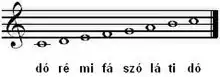
ré (plural rék)
Declension
Its inflected forms are uncommon.
| Inflection (stem in long/high vowel, front unrounded harmony) | ||
|---|---|---|
| singular | plural | |
| nominative | ré | rék |
| accusative | rét | réket |
| dative | rének | réknek |
| instrumental | rével | rékkel |
| causal-final | réért | rékért |
| translative | révé | rékké |
| terminative | réig | rékig |
| essive-formal | réként | rékként |
| essive-modal | réül | — |
| inessive | rében | rékben |
| superessive | rén | réken |
| adessive | rénél | réknél |
| illative | rébe | rékbe |
| sublative | rére | rékre |
| allative | réhez | rékhez |
| elative | réből | rékből |
| delative | réről | rékről |
| ablative | rétől | réktől |
| non-attributive possessive - singular |
réé | réké |
| non-attributive possessive - plural |
rééi | rékéi |
| Possessive forms of ré | ||
|---|---|---|
| possessor | single possession | multiple possessions |
| 1st person sing. | rém | réim |
| 2nd person sing. | réd | réid |
| 3rd person sing. | réje | réi |
| 1st person plural | rénk | réink |
| 2nd person plural | rétek | réitek |
| 3rd person plural | réjük | réik |
Further reading
- (Hungarian) An article on solfège with hand signs
Anagrams
Irish
Pronunciation
- IPA(key): /ɾˠeː/[1]
Etymology 1
From Old Irish roe, rói (“plain”), from Proto-Celtic *rowos. Cognate with Latin rūs. Akin to raon.
Declension
Alternative forms
Etymology 2
From Old Irish ré, possibly from Proto-Celtic *rowis.
Alternative forms
Noun
ré f or m (genitive singular ré, nominative plural réanna)
Declension
Alternative forms
Etymology 3
From Latin resonāre (“to resound”), from the first word of the second line of Ut queant laxis, the medieval hymn which solfège was based on because its lines started on each note of the scale successively.
Declension
References
- Quiggin, E. C. (1906) A Dialect of Donegal, Cambridge University Press, page 101

Further reading
- Ó Dónaill, Niall (1977) “ré”, in Foclóir Gaeilge–Béarla, Dublin: An Gúm, →ISBN
- Entries containing “ré” in English-Irish Dictionary, An Gúm, 1959, by Tomás de Bhaldraithe.
- Entries containing “ré” in New English-Irish Dictionary by Foras na Gaeilge.
Lashi
Pronunciation
- IPA(key): /ɹe˥/
Synonyms
Pronunciation
- IPA(key): /ɹḛ˥/
Particle
ré
- Used to create yes-or-no questions
- Nang ngá bá ri se ré? ― Do you know your father?
Mandarin
Old Irish
Etymology
From Proto-Celtic *ɸrīs (compare Gaulish ris), from Proto-Indo-European *per-. Cognate with English first and Latin prīscus (“former”). The eclipsis trigger is analogical to íar (“after”). The inflected forms in -m, as well as the cognate prefix rem-, are from the superlative *ɸrīsamos (compare Latin prīmus (“first”)).[1]
Pronunciation
- IPA(key): [r͈ʲeː]
Preposition
ré (with the dative; triggers eclipsis)
- before
- c. 800–825, Diarmait, Milan Glosses on the Psalms, published in Thesaurus Palaeohibernicus (reprinted 1987, Dublin Institute for Advanced Studies), edited and with translations by Whitley Stokes and John Strachan, vol. I, pp. 7–483, Ml. 111c13
- Is hé ru·fiastar cumachtae inna díglae do·mbi{u}r-siu húa londas, intí du·écigi{gi} is ar trócairi ⁊ censi du·bir-siu forunni siu innahí fo·daimem ré techt innúnn.
- He who will know the power of the punishment which you sg inflict by means of wrath, it is he who will see that it is for the sake of mercy and gentleness that you inflict on us here the things that we suffer before going there.
- c. 800–825, Diarmait, Milan Glosses on the Psalms, published in Thesaurus Palaeohibernicus (reprinted 1987, Dublin Institute for Advanced Studies), edited and with translations by Whitley Stokes and John Strachan, vol. I, pp. 7–483, Ml. 111c13
Inflection
Combined with a definite article:
- resin(d) (“before the sg”)
Combined with a possessive determiner:
Combined with a relative pronoun:
References
- Thurneysen, Rudolf (1940, reprinted 2017) D. A. Binchy and Osborn Bergin, transl., A Grammar of Old Irish, Dublin Institute for Advanced Studies, →ISBN, page 528
Further reading
- G. Toner, M. Ní Mhaonaigh, S. Arbuthnot, D. Wodtko, M.-L. Theuerkauf, editors (2019), “6 ré, ría”, in eDIL: Electronic Dictionary of the Irish Language
- Thurneysen, Rudolf (1940, reprinted 2017) D. A. Binchy and Osborn Bergin, transl., A Grammar of Old Irish, Dublin Institute for Advanced Studies, →ISBN, pages 275, 527–28
- Pedersen, Holger (1913) Vergleichende Grammatik der keltischen Sprachen (in German), volume II, Göttingen: Vandenhoeck und Ruprecht, →ISBN, page 299
Portuguese
Pronunciation
- (Brazil) IPA(key): /ˈʁɛ/ [ˈhɛ]
- (Rio de Janeiro) IPA(key): /ˈʁɛ/ [ˈχɛ]
- (Portugal) IPA(key): /ˈʁɛ/
- Rhymes: -ɛ
- Hyphenation: ré
Etymology 1
From Latin re[sonāre] in the hymn for St. John the Baptist.[1]
Noun
ré f (plural rés)
- (nautical) stern (rear part of a ship or vessel)
- (Brazil) reverse (gear setting of an automobile that makes it travel backwards)
- Synonyms: (Brazil) marcha à ré, (Brazil) marcha a ré, (Portugal) marcha-atrás
References
- “ré” in Dicionário infopédia da Língua Portuguesa. Porto: Porto Editora, 2003–2024.
Vietnamese
Pronunciation
- (Hà Nội) IPA(key): [zɛ˧˦]
- (Huế) IPA(key): [ʐɛ˨˩˦]
- (Hồ Chí Minh City) IPA(key): [ɹɛ˦˥]