pá
See also: Appendix:Variations of "pa"
Czech
Pronunciation
- IPA(key): [ˈpaːtɛk]
Declension
This noun needs an inflection-table template.
Faroese
Pronunciation
- IPA(key): [pʰɔɑː]
- Rhymes: -ɔaː
Synonyms
Derived terms
- gera pá
Hokkien
| For pronunciation and definitions of pá – see 飽 (“full; full; replete; abounding; etc.”). (This term is the pe̍h-ōe-jī form of 飽). |
Hungarian
Etymology
(This etymology is missing or incomplete. Please add to it, or discuss it at the Etymology scriptorium.)
Pronunciation
- IPA(key): [ˈpaː]
Audio (file) - Hyphenation: pá
Further reading
- pá in Bárczi, Géza and László Országh. A magyar nyelv értelmező szótára (‘The Explanatory Dictionary of the Hungarian Language’, abbr.: ÉrtSz.). Budapest: Akadémiai Kiadó, 1959–1962. Fifth ed., 1992: →ISBN
Irish
Alternative forms
- pádh (obsolete)
- páí (Cois Fharraige)
Etymology
From Old French paie (“payment, recompense”), from paiier (“to pay”), from Latin pācō (“I settle, satisfy, pacify”), from pāx (“peace”).
Noun
Declension
Mutation
| Irish mutation | ||
|---|---|---|
| Radical | Lenition | Eclipsis |
| pá | phá | bpá |
| Note: Some of these forms may be hypothetical. Not every possible mutated form of every word actually occurs. | ||
Further reading
- Ó Dónaill, Niall (1977) “pá”, in Foclóir Gaeilge–Béarla, Dublin: An Gúm, →ISBN
- Entries containing “pá” in English-Irish Dictionary, An Gúm, 1959, by Tomás de Bhaldraithe.
- Entries containing “pá” in New English-Irish Dictionary by Foras na Gaeilge.
Mandarin
Pronunciation
audio (file)
Romanization
- Hanyu Pinyin reading of 扒
- Hanyu Pinyin reading of 掭
- Hanyu Pinyin reading of 杷
- Hanyu Pinyin reading of 潖
- Hanyu Pinyin reading of 爬
- Hanyu Pinyin reading of 琶
- Hanyu Pinyin reading of 筢, 耙
- Hanyu Pinyin reading of 跁
- Hanyu Pinyin reading of 鈀/钯
- Hanyu Pinyin reading of 钭
Old Norse
Old Tupi
Alternative forms
- pa (obsolete)
Pronunciation
- IPA(key): /ˈpa/
- Rhymes: -a
- Hyphenation: pá
Particle
pá
Further reading
- Eduardo de Almeida Navarro (2013) “pá”, in Dicionário de tupi antigo: a língua indígena clássica do Brasil (in Portuguese), São Paulo: Global, →ISBN, page 367, column 1
Portuguese
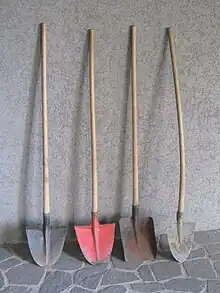
pás

Pá (3) - cut of meat - in Portugal
Etymology 1
Inherited from Old Galician-Portuguese paa, from Latin pālam (“shovel”). Doublet of pala. Compare Galician pa and Spanish pala.
Noun
pá f (plural pás)
Noun
pá m (uncountable)
Usage notes
Although derived from the masculine rapaz the word is used for any gender.
Tupinambá
This article is issued from Wiktionary. The text is licensed under Creative Commons - Attribution - Sharealike. Additional terms may apply for the media files.