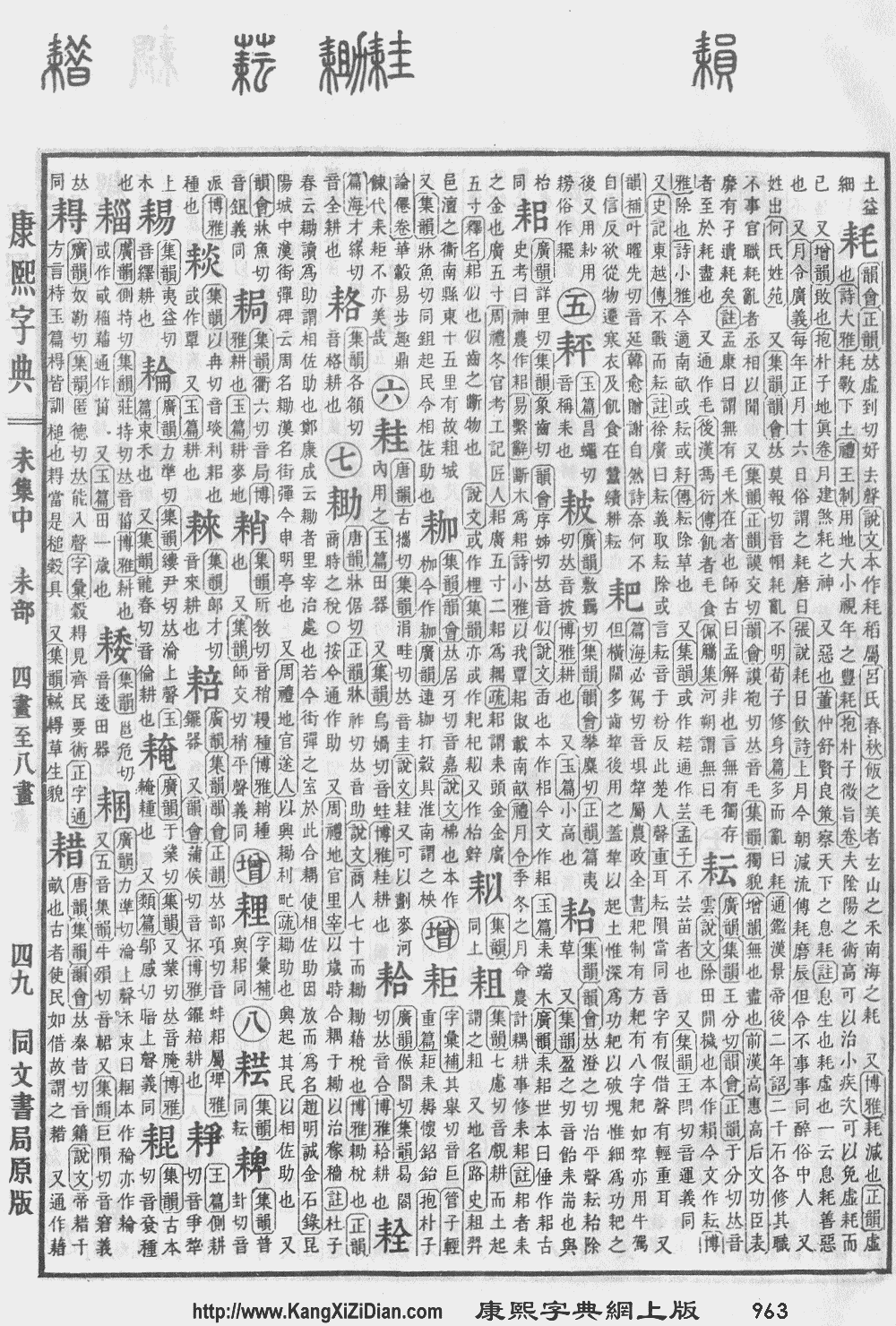
耙

耙 U+8019, 耙
CJK UNIFIED IDEOGRAPH-8019
← 耘
[U+8018]
CJK Unified Ideographs 耚 →
[U+801A]

Translingual

Han character

耙 (Kangxi radical 127, 耒+4, 10 strokes, cangjie input 手木日山 (QDAU), four-corner 57917, composition ⿰耒巴)

Further reading

  • Kangxi Dictionary: page 963, character 3
  • Dai Kanwa Jiten: character 28911
  • Dae Jaweon: page 1411, character 6
  • Hanyu Da Zidian (first edition): volume 4, page 2771, character 4
  • Unihan data for U+8019

Chinese

trad. 耙
simp. # 耙
alternative forms 䎬
䎱/䎬

Glyph origin

Phono-semantic compound (形聲/形声, OC *braːs) : semantic 耒 (“plow”) + phonetic 巴 (OC *praː)

Pronunciation 1


Note:
  • pê/pēe/pē - vernacular;
  • pâ - literary.

    Zhengzhang system (2003)
    Character 耙
    Reading # 1/1
    No. 121
    Phonetic
    component
    巴
    Rime
    group
    魚
    Rime
    subdivision
    0
    Corresponding
    MC rime
    𤝡
    Old
    Chinese
    /*braːs/
    Notes 杷分化字

    Definitions

    耙

    1. harrow
    2. to draw a harrow over (a field); to harrow

    Pronunciation 2


    Note:
    • pê/pêe - vernacular;
    • pâ/phâ - literary.
      • Wu
        • (Shanghai):
          • Wugniu: 6bo
          • MiniDict: bo去
          • Wiktionary Romanisation (Shanghai): 3bo
          • Sinological IPA (Shanghai): /bo²³/

    Baxter–Sagart system 1.1 (2014)
    Character 耙
    Reading # 1/1
    Modern
    Beijing
    (Pinyin)
    pá
    Middle
    Chinese
    ‹ bæ ›
    Old
    Chinese
    /*[b]ˁra/
    English rake (n.)

    Notes for Old Chinese notations in the Baxter–Sagart system:

    * Parentheses "()" indicate uncertain presence;
    * Square brackets "[]" indicate uncertain identity, e.g. *[t] as coda may in fact be *-t or *-p;
    * Angle brackets "<>" indicate infix;
    * Hyphen "-" indicates morpheme boundary;

    * Period "." indicates syllable boundary.

    Definitions

    耙

    1. rake
      木耙  ―  mùpá  ―  wooden rake
    2. to make smooth with a rake; to rake
      把地耙平  ―  bǎ dì pápíng  ―  to rake the soil level

    Compounds

    Japanese

    Kanji

    耙

    (uncommon “Hyōgai” kanji)

    1. This term needs a translation to English. Please help out and add a translation, then remove the text {{rfdef}}.

    Readings

    • Go-on: べ (be)
    • Kan-on: は (ha)

    Compounds

    Korean

    Hanja

    耙 (eumhun 써레 파 (sseore pa))

    1. Hanja form? of 파 (“harrow; rake”).

    Compounds

    References

    • 국제퇴계학회 대구경북지부 (國際退溪學會 大邱慶北支部) (2007). Digital Hanja Dictionary, 전자사전/電子字典.

    Vietnamese

    Han character

    耙: Hán Việt readings: bá[1][2], bà[3], bả[2]
    耙: Nôm readings: bừa[3][1][2][4], bá[5], bồ[5]

    1. Nôm form of bừa (“harrow; rake”).

    Compounds

    References

    1. Bonet (1899).
    2. Génibrel (1898).
    3. Trần (2004).
    4. Taberd & Pigneau de Béhaine (1838).
    5. Hồ (1976).
    This article is issued from Wiktionary. The text is licensed under Creative Commons - Attribution - Sharealike. Additional terms may apply for the media files.