ķermenis
Latvian
| Picture dictionary | |
|---|---|
| |
|
Etymology
Borrowed from Old Prussian kērmens (“flesh, body”), from Proto-Indo-European *(s)ker- (“to cut off”), see also Proto-Slavic *kora (“bark”).
Introduced by Atis Kronvalds to replace the Germanism ķerpers (compare German Körper) used by many other Latvian authors. Kronvalds introduced the word as ķermens; the current form only appeared and became popular in the 20th century.[1]
Pronunciation
- IPA(key): [cɛ̄ɾmɛnis]
Noun
ķermenis m (2nd declension)
- (physics) body (physical object, material entity)
- liels, smags ķermenis ― large, heavy body
- cieti, šķidri, gāzveida ķermeņi ― solid, liquid, gaseous bodies
- ķermeņa forma ― body shape
- debess ķermeņi ― heavenly bodies
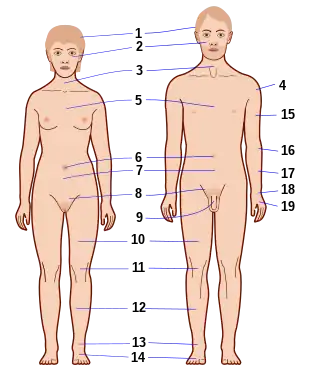
- (anatomy) body (of a living being), organism
- spēcīgs, slaids ķermenis ― a strong, slender body
- ķermeņa daļas ― parts of the body
- ķermeņa garums, lielums ― body length, size
- ķermeņa temperatūra ― body temperature
- (mathematics) part of space bound by a closed surface
- sfērisks ķermenis ― geometric body
- ģeometrisks ķermenis ― spherical body
- the main part of something
- mēles ķermenis ― body of the tongue
- ķermeņa piedevas ― body appendages (e.g., wing)
Declension
Declension of ķermenis (2nd declension)
| singular (vienskaitlis) | plural (daudzskaitlis) | |
|---|---|---|
| nominative (nominatīvs) | ķermenis | ķermeņi |
| accusative (akuzatīvs) | ķermeni | ķermeņus |
| genitive (ģenitīvs) | ķermeņa | ķermeņu |
| dative (datīvs) | ķermenim | ķermeņiem |
| instrumental (instrumentālis) | ķermeni | ķermeņiem |
| locative (lokatīvs) | ķermenī | ķermeņos |
| vocative (vokatīvs) | ķermeni | ķermeņi |
Derived terms
References
- Karulis, Konstantīns (1992) “ķermenis”, in Latviešu Etimoloģijas Vārdnīca (in Latvian), Rīga: AVOTS, →ISBN
This article is issued from Wiktionary. The text is licensed under Creative Commons - Attribution - Sharealike. Additional terms may apply for the media files.