黽
| ||||||||
| ||||||||
Translingual
| Traditional | 黽 |
|---|---|
| Shinjitai (extended) |
⿻日电 |
| Simplified | 黾 |
| Stroke order | |||
|---|---|---|---|
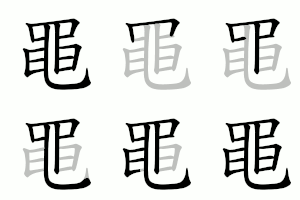 | |||
Han character
黽 (Kangxi radical 205, 黽+0, 13 strokes, cangjie input 口難山 (RXU), four-corner 77717, composition ⿹⿷⿻冂⿰一⿺乚⺊彐𰀄)
- Kangxi radical #205, ⿌.
Derived characters
References
- Kangxi Dictionary: page 1523, character 9
- Dai Kanwa Jiten: character 48257
- Dae Jaweon: page 2058, character 20
- Hanyu Da Zidian (first edition): volume 7, page 4768, character 1
- Unihan data for U+9EFD

Chinese
| trad. | 黽 | |
|---|---|---|
| simp. | 黾 | |
| alternative forms | 𪓑 | |
Glyph origin
| Historical forms of the character 黽 | ||||
|---|---|---|---|---|
| Shang | Western Zhou | Shuowen Jiezi (compiled in Han) | Liushutong (compiled in Ming) | |
| Bronze inscriptions | Oracle bone script | Bronze inscriptions | Small seal script | Transcribed ancient scripts |
 |
 |
 |
 |
 |
Characters in the same phonetic series (黽) (Zhengzhang, 2003)
Pictogram (象形) .
Pronunciation 1
Pronunciation 2
Pronunciation 3
Pronunciation 4
Definitions
黽
- Only used in 黽塞/黾塞 and 黽隘/黾隘.
Japanese
| ⿻日电 | |
| 黽 |
Kanji
黽
(uncommon “Hyōgai” kanji, kyūjitai kanji, shinjitai form ⿻日电)
- This term needs a translation to English. Please help out and add a translation, then remove the text
{{rfdef}}.
Korean
Etymology 1
From Middle Chinese 黽 (MC meangX). Recorded as Middle Korean 며ᇰ〯 (myěng) (Yale: myěng) in Hunmong Jahoe (訓蒙字會 / 훈몽자회), 1527.
Pronunciation
- (SK Standard/Seoul) IPA(key): [mɛŋ] ~ [me̞ŋ]
- Phonetic hangul: [맹/멩]
Etymology 2
From Middle Chinese 黽 (MC mjinX). Recorded as Middle Korean 민〯 (Yale: mǐn) in Dongguk Jeongun (東國正韻 / 동국정운), 1448.
Pronunciation
- (SK Standard/Seoul) IPA(key): [min]
- Phonetic hangul: [민]
Hanja
Etymology 3
From Middle Chinese 黽 (MC mjienX). Recorded as Middle Korean 면〯 (Yale: myěn) in Dongguk Jeongun (東國正韻 / 동국정운), 1448.
Pronunciation
- (SK Standard/Seoul) IPA(key): [mjʌ̹n]
- Phonetic hangul: [면]
Hanja
Compounds
Compounds
- 면지 (黽池, myeonji)
References
- 국제퇴계학회 대구경북지부 (國際退溪學會 大邱慶北支部) (2007). Digital Hanja Dictionary, 전자사전/電子字典.
- Supreme Court of the Republic of Korea (대한민국 대법원, Daehanmin'guk Daebeobwon) (2018). Table of hanja for personal names (인명용 한자표 / 人名用漢字表, Inmyeong-yong hanja-pyo), page 17.
Vietnamese
Han character
黽: Hán Nôm readings: mãnh
- This term needs a translation to English. Please help out and add a translation, then remove the text
{{rfdef}}.
This article is issued from Wiktionary. The text is licensed under Creative Commons - Attribution - Sharealike. Additional terms may apply for the media files.