武
| ||||||||
Translingual
| Stroke order | |||
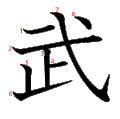 | |||
Han character
武 (Kangxi radical 77, 止+4, 8 strokes, cangjie input 一心卜中一 (MPYLM), four-corner 13140, composition ⿹⿽弋一止 or ⿻一⿹弋止 or ⿻㱐㇂)
Derived characters
Descendants
- む (Hiragana character derived from Man'yōgana)
References
- Kangxi Dictionary: page 575, character 9
- Dai Kanwa Jiten: character 16273
- Dae Jaweon: page 965, character 8
- Hanyu Da Zidian (first edition): volume 2, page 1439, character 5
- Unihan data for U+6B66

Chinese
| simp. and trad. |
武 | |
|---|---|---|
Glyph origin
| Historical forms of the character 武 | ||||
|---|---|---|---|---|
| Shang | Western Zhou | Warring States | Shuowen Jiezi (compiled in Han) | Liushutong (compiled in Ming) |
| Oracle bone script | Bronze inscriptions | Chu slip and silk script | Small seal script | Transcribed ancient scripts |
 |
 |
 |
 |
 |
Ideogrammic compound (會意/会意) : 戈 (“blade”) + 止 (“foot; to walk; to stop”) – army going on an expedition. In the character 武, the 戈 component is written above the 止 component.
The graphical origin of 武 as “to stop violence” — the ultimate state of just warfare — is traditionally attributed to King Zhuang of Chu [597 BCE]:
- 楚子曰:「非爾所知也。夫文,止戈為武。」 [Classical Chinese, trad.]
- From: Commentary of Zuo, c. 4th century BCE
- Chǔ Zǐ yuē: “Fēi ěr suǒ zhī yě. Fú wén, zhǐ gē wéi wǔ.” [Pinyin]
- Said Lord "Chǔ" (楚): “Not exactly as what you might have believed. The term itself means: stopping ("止") the blades ("戈") thus martiality ("武").”
楚子曰:「非尔所知也。夫文,止戈为武。」 [Classical Chinese, simp.]
Linguistically, this was likely a misinterpretation, as 止 always means “to walk” (趾) when used as a radical, compare 步 (bù), 歷/历 (lì) and 歧 (qí).
Etymology
From Proto-Sino-Tibetan *d-mak (“war, army, soldier”). Cognate with Tibetan དམག (dmag, “army”), Burmese မက် (mak) (as in ရဲမက် (rai:mak, “soldier”) (STEDT; Schuessler, 2007; Sagart, 2017d).
Pronunciation
Definitions
武
- military (related to warfare, fighting)
- martial arts; wushu
- valiant; brave; courageous
- 勇武 ― yǒngwǔ ― valiant; courageous
- soldier; warrior
- 玄武 ― Xuánwǔ ― Black Turtle (lit. "Black Warrior") (one of the Four Symbols among the constellations in Chinese astronomy)
- 夫死生同域,不可脅陵,勇武一人,為三軍雄。 [Classical Chinese, trad.]
- From: Huainanzi, 2nd century BCE
- Fú sǐshēng tóng yù, bùkě xiélíng, yǒngwǔ yīrén, wéi sānjūn xióng. [Pinyin]
- One for whom death and life are the same territory, who cannot be threatened, such a single brave warrior is the hero of the Three Armies.
夫死生同域,不可胁陵,勇武一人,为三军雄。 [Classical Chinese, simp.]
- footstep; footprint
- Classifier for half steps.
- (obsolete) to inherit
- a surname
Compounds
- 一元大武
- 下武
- 不文不武
- 乃文乃武
- 乃武乃文
- 仁武 (Rénwǔ)
- 修文偃武
- 修武 (Xiūwǔ)
- 偃武修文
- 偃武興文/偃武兴文
- 允文允武
- 光武 (Guāngwǔ)
- 光武中興/光武中兴
- 克繩祖武/克绳祖武
- 全武行 (quánwǔháng)
- 努納武特/努纳武特 (Nǔnàwǔtè)
- 勇武 (yǒngwǔ)
- 動武/动武 (dòngwǔ)
- 勝之不武/胜之不武 (shèngzhībùwǔ)
- 化學武器/化学武器 (huàxué wǔqì)
- 化武 (huàwǔ)
- 右武
- 周武王
- 圓桌武士/圆桌武士
- 大武 (Dàwǔ)
- 大武壠族/大武垅族 (Dàwǔlóngzú)
- 太武山
- 太空武器
- 奮武揚威/奋武扬威
- 威武 (wēiwǔ)
- 威武不屈
- 孔武有力 (kǒngwǔyǒulì)
- 宮本武藏/宫本武藏
- 寒武系
- 寒武紀/寒武纪 (Hánwǔ Jì)
- 寧武/宁武 (Níngwǔ)
- 寧武關/宁武关 (Níngwǔguān)
- 尚武 (shàngwǔ)
- 常武
- 常規武器/常规武器 (chángguī wǔqì)
- 廣武/广武
- 廣武嘆/广武叹
- 弄文輕武/弄文轻武
- 我武維揚/我武维扬
- 才兼文武
- 捷武
- 揚威耀武/扬威耀武
- 攜手接武/携手接武
- 整軍經武/整军经武
- 文修武偃
- 文修武備/文修武备
- 文德武功
- 文恬武嬉
- 文東武西/文东武西
- 文武 (wénwǔ)
- 文武之道
- 文武全才
- 文武兼備/文武兼备
- 文武兼濟/文武兼济
- 文武兼資/文武兼资
- 文武場/文武场
- 文武挑兒/文武挑儿
- 文武百官 (wénwǔbǎiguān)
- 文武雙全/文武双全 (wénwǔshuāngquán)
- 文治武功 (wénzhìwǔgōng)
- 文經武略/文经武略
- 文經武緯/文经武纬
- 文韜武略/文韬武略
- 文韜武韜/文韬武韬
- 新廣武/新广武 (Xīnguǎngwǔ)
- 晁公武
- 晉武帝/晋武帝
- 朱洪武
- 材武
- 核子武器 (hézǐ wǔqì)
- 核武器 (héwǔqì)
- 梁武帝
- 棄文就武/弃文就武
- 棄武修文/弃武修文
- 棄武競文/弃武竞文
- 楊乃武/杨乃武
- 止戈為武/止戈为武 (zhǐgēwéiwǔ)
- 步武 (bùwǔ)
- 步武堂皇
- 武丁
- 武丑
- 武不善作
- 武事 (wǔshì)
- 武人 (wǔrén)
- 武仙座 (Wǔxiānzuò)
- 武俠/武侠 (wǔxiá)
- 武俠小說/武侠小说
- 武偃文修
- 武備/武备
- 武則天/武则天
- 武力 (wǔlì)
- 武功 (wǔgōng)
- 武功片
- 武勝關/武胜关 (Wǔshèngguān)
- 武南鐵路/武南铁路 (Wǔnántiělù)
- 武后
- 武員/武员
- 武器 (wǔqì)
- 武城弦歌
- 武場/武场 (wǔchǎng)
- 武壇/武坛
- 武士 (wǔshì)
- 武士刀 (wǔshìdāo)
- 武士道 (wǔshìdào)
- 武大郎
- 武夫 (wǔfū)
- 武夷山 (Wǔyíshān)
- 武威縣/武威县
- 武媚
- 武學/武学
- 武安 (Wǔ'ān)
- 武官 (wǔguān)
- 武家坡
- 武將/武将 (wǔjiàng)
- 武工 (wǔgōng)
- 武工隊/武工队
- 武師/武师
- 武庚
- 武庫/武库
- 武廟/武庙 (wǔmiào)
- 武弁
- 武德 (wǔdé)
- 武成王
- 武戲/武戏
- 武打 (wǔdǎ)
- 武把子
- 武斷/武断 (wǔduàn)
- 武旦 (wǔdàn)
- 武昌 (Wǔchāng)
- 武昌剩竹
- 武昌市
- 武昌起義/武昌起义 (Wǔchāng Qǐyì)
- 武曲星
- 武會/武会
- 武林 (wǔlín)
- 武松
- 武林舊事/武林旧事
- 武清 (Wǔqīng)
- 武漢/武汉 (Wǔhàn)
- 武漢三鎮/武汉三镇
- 武火 (wǔhuǒ)
- 武生
- 武當山/武当山 (Wǔdāng Shān)
- 武當派/武当派
- 武科
- 武穴 (Wǔxué)
- 武聖/武圣 (Wǔshèng)
- 武職/武职 (wǔzhí)
- 武舉/武举 (wǔjǔ)
- 武英殿
- 武藝/武艺 (wǔyì)
- 武行
- 武術/武术 (wǔshù)
- 武術指導/武术指导
- 武衛/武卫
- 武裝/武装 (wǔzhuāng)
- 武裝中立/武装中立
- 武裝力量/武装力量 (wǔzhuāng lìliàng)
- 武裝警察/武装警察 (wǔzhuāngjǐngchá)
- 武裝部隊/武装部队 (wǔzhuāng bùduì)
- 武訓/武训
- 武警 (wǔjǐng)
- 武象
- 武進士/武进士
- 武道 (wǔdào)
- 武陟 (Wǔzhì)
- 武陵 (Wǔlíng)
- 武陵源
- 武鬥/武斗 (wǔdòu)
- 殷武
- 比武 (bǐwǔ)
- 比武招親/比武招亲
- 泰武 (Tàiwǔ)
- 洪武 (Hóngwǔ)
- 洪武正韻/洪武正韵
- 湯武/汤武 (Tāng-Wǔ)
- 湯武革命/汤武革命
- 漢光武帝/汉光武帝
- 滿朝文武/满朝文武
- 演武 (yǎnwǔ)
- 演武修文
- 漢武帝/汉武帝 (Hàn Wǔ Dì)
- 演武廳/演武厅
- 漢武故事/汉武故事
- 玄武 (Xuánwǔ)
- 玄武岩 (xuánwǔyán)
- 玄武湖
- 玄武門/玄武门
- 生物武器 (shēngwù wǔqì)
- 用武 (yòngwǔ)
- 用武之地
- 百武彗星
- 真武大帝 (Zhēnwǔ Dàdì)
- 真武山 (Zhēnwǔshān)
- 祖武
- 神武 (shénwǔ)
- 窮兵極武/穷兵极武
- 窮兵黷武/穷兵黩武 (qióngbīngdúwǔ)
- 竇武/窦武
- 細菌武器/细菌武器
- 經文緯武/经文纬武
- 經武/经武
- 經武緯文/经武纬文
- 練武/练武 (liànwǔ)
- 緯武經文/纬武经文
- 繩其祖武/绳其祖武
- 繩厥祖武/绳厥祖武
- 繼武/继武
- 習武/习武 (xíwǔ)
- 耀武揚威/耀武扬威 (yàowǔ yángwēi)
- 聖武/圣武
- 能文善武
- 興文匽武/兴文匽武
- 舉武揚威/举武扬威
- 英武 (yīngwǔ)
- 蘇武/苏武
- 蘇武牧羊/苏武牧羊
- 覿武/觌武
- 謀臣武將/谋臣武将 (móuchén wǔjiàng)
- 講武/讲武
- 貝奧武夫/贝奥武夫 (Bèi'àowǔfū)
- 赳赳武夫 (jiūjiūwǔfū)
- 趙武/赵武
- 趙武靈王/赵武灵王
- 踵武
- 較武論文/较武论文
- 輕武器/轻武器
- 重文輕武/重文轻武
- 重武器
- 鐵甲武士/铁甲武士
- 限武協定/限武协定
- 限武談判/限武谈判
- 陳武帝/陈武帝
- 雄武
- 靈武/灵武 (Língwǔ)
- 靈武縣/灵武县
- 非核武區/非核武区
- 韜戈偃武/韬戈偃武
- 顧炎武/顾炎武
- 飆武/飙武
- 鬥武/斗武
- 魏道武帝
- 黷武/黩武 (dúwǔ)
- 黷武窮兵/黩武穷兵
Japanese
Readings
Compounds
Etymology 1
| Kanji in this term |
|---|
| 武 |
| む Grade: 5 |
| on’yomi |
From Middle Chinese 武 (mjuX, “military”).
The goon reading of mu, so likely the initial borrowing.
Pronunciation
- IPA(key): [mɯ̟ᵝ]
Usage notes
Only found in compounds. Not as common as the bu reading.
Etymology 2
| Kanji in this term |
|---|
| 武 |
| ぶ Grade: 5 |
| on’yomi |
From Middle Chinese 武 (mjuX, “military”).
The kan'on reading of bu, so likely a re-borrowing at a later stage of Middle Chinese, or from a dialectal variation in Middle Chinese.
Noun
武 • (bu)
- courage, ferocity, valor
- military power, force of arms
- the act of carrying out military force: a battle, a war
- the way of carrying out military force: strategy, tactics, martial arts
- a military person: an officer, a soldier
- (obsolete) a unit of length, equivalent to half of a 歩 (bu, six 尺 (shaku), roughly six feet or 1.8 meters), roughly equivalent to one yard or 90 centimeters
Synonyms
Derived terms
- 武威 (bui): military power, military authority, military influence over something
- 武運 (būn): military fortune, luck in battle
- 武衛 (buei): a bodyguard to an imperial prince; a shogun, a generalissimo
- 武恩 (buon): a favor received from a shogun or samurai family
- 武火 (buka): a fierce fire, a raging fire
- 武学 (bugaku): military studies
- 武官 (bukan): a military officer
- 武漢 (Bukan): Wuhan, China
- 武鑑 (bukan): in the Edo period, a registry listing all the samurai families by name, 家紋 (kamon, “family crest”), income, castles or other residences, and the names of any followers
- 武器 (buki): a weapon
- 武技 (bugi): martial technique: martial arts
- 武家 (buke): a samurai family; the samurai class
- 武芸 (bugei): military arts, military accomplishments
- 武具 (bugu): military gear: more specifically, weapons and armor
- 武勲 (bukun): distinguished military service
- 武庫 (buko): an armory, a storage facility for military gear
- 武功 (bukō): military feats or exploits
- 武江 (Bukō): alternate name for 江戸 (Edo)
- 武骨 (bukotsu): clumsy, rude, oafish; useless, stupid; inconvenient; stiff and angular (of personality)
- 武左 (buza): boorish, hickish
- 武士 (bushi): a warrior, a samurai
- 武事 (buji): military matters
- 武術 (bujutsu): martial arts
- 武昌 (Bushō): Wuchang, China
- 武神 (bushin): a god of war
- 武臣 (bushin): a military minister, a minister of military affairs
- 武人 (bujin): a warrior, a soldier
Etymology 3
Ateji used in various names.
References
- Matsumura, Akira, editor (2006), 大辞林 [Daijirin] (in Japanese), Third edition, Tōkyō: Sanseidō, →ISBN
- Shōgaku Tosho (1988) 国語大辞典(新装版) [Unabridged Dictionary of Japanese (Revised Edition)] (in Japanese), Tōkyō: Shogakukan, →ISBN