㤺
See also: 慌
| ||||||||
| ||||||||
Translingual
Alternative forms
- In Taiwan and Japan, the upper right component is written 𠫓 (⿱亠厶) which is the original form found in the historical Zihui 《字彙》 dictionary.
- In mainland China, the upper right component is written 亡 which is the form found in the historical Kangxi Dictionary (similar to 慌 but without the grass radical 艹).
Han character
㤺 (Kangxi radical 61, 心+6, 10 strokes in traditional Chinese, 9 strokes in mainland China, cangjie input 心卜女山 (PYVU), four-corner 90012, composition ⿰忄巟(G) or ⿰忄㐬(TJ))
Related characters
- 慌 (Orthodox form)
References
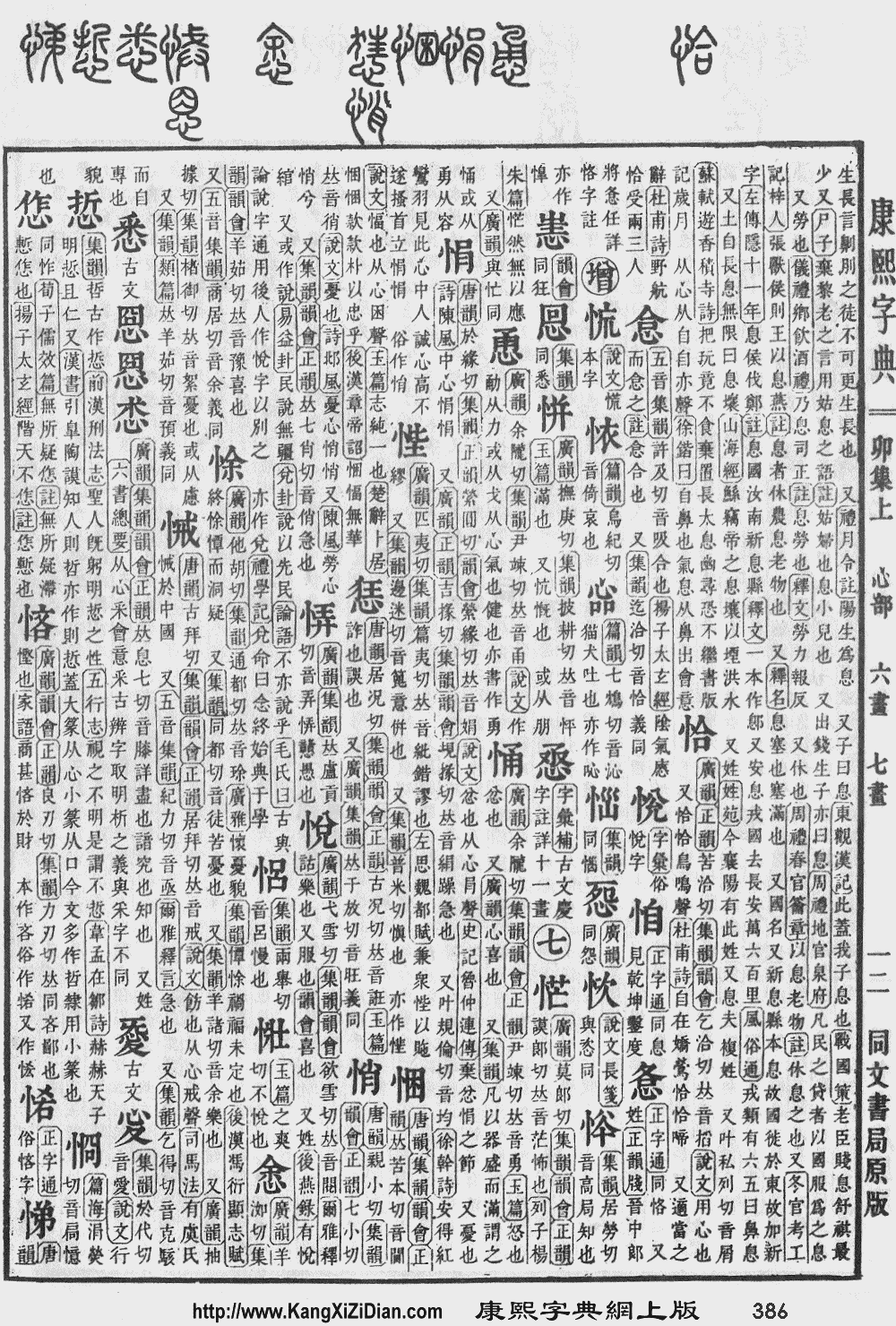
- Kangxi Dictionary: page 386, character 6
- Hanyu Da Zidian (first edition): volume 4, page 2298, character 9
- Unihan data for U+393A
- Unihan data for U+2F8A1
Chinese
| For pronunciation and definitions of 㤺 – see 慌 (“to flee; to fear; to dread; to be afraid; etc.”). (This character is a variant form of 慌). |
This article is issued from Wiktionary. The text is licensed under Creative Commons - Attribution - Sharealike. Additional terms may apply for the media files.