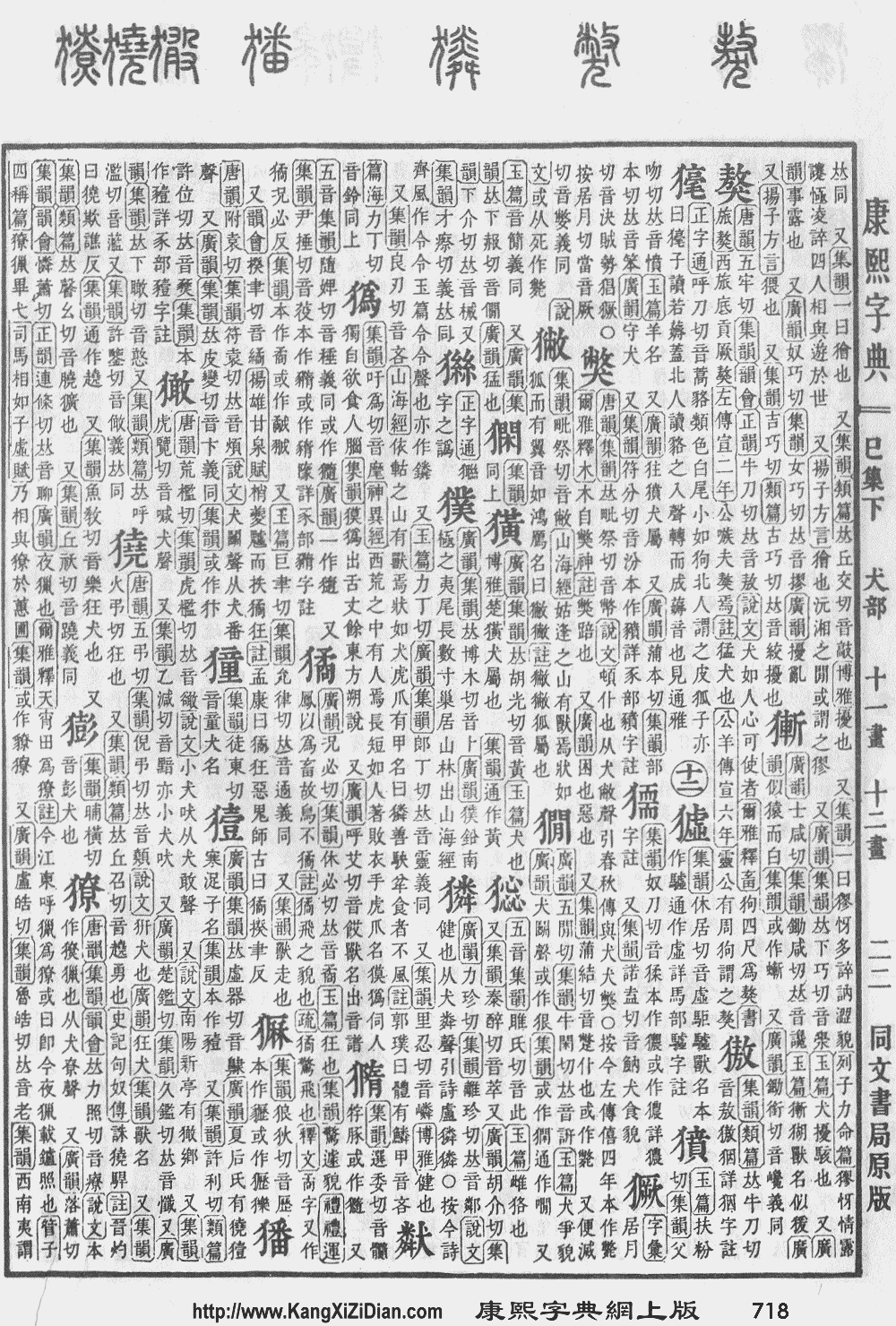
㺔

㺔 U+3E94, 㺔
CJK UNIFIED IDEOGRAPH-3E94
← 㺓
[U+3E93]
CJK Unified Ideographs Extension A 㺕 →
[U+3E95]

Translingual

Han character

㺔 (Kangxi radical 94, 犬+12, 15 strokes, cangjie input 大竹戈大火 (KHIKF), composition ⿰犭爲)

References

Chinese

simp. and trad.
㺔

Glyph origin

Phono-semantic compound (形聲/形声) : semantic 犭 + phonetic 爲 (OC *ɢʷal, *ɢʷal, *ɢʷals).

Pronunciation 1


Rime
Character 㺔
Reading # 1/1
Initial (聲) 曉 (32)
Final (韻) 泰 (25)
Tone (調) Departing (H)
Openness (開合) Open
Division (等) I
Fanqie 呼艾切
Baxter xajH
Reconstructions
Zhengzhang
Shangfang
/hɑiH/
Pan
Wuyun
/hɑiH/
Shao
Rongfen
/xɑiH/
Edwin
Pulleyblank
/hajH/
Li
Rong
/xɑiH/
Wang
Li
/xɑiH/
Bernard
Karlgren
/xɑiH/
Expected
Mandarin
Reflex
hài
Expected
Cantonese
Reflex
hoi3

Definitions

㺔

  1. name of a kind of beast

Pronunciation 2


Definitions

㺔

  1. Only used in 獏㺔.

Japanese

Kanji

㺔

(uncommon “Hyōgai” kanji)

  1. name of a kind of beast
  2. a legendary monster

Readings

  • On (unclassified): き (ki); かい (kai)

Middle Vietnamese

Alternative forms

Etymology

From Proto-Vietic *-vɔːj.

Noun

㺔 (voi)

  1. elephant

Descendants

  • Vietnamese: voi (㺔)

Vietnamese

Glyph origin

Phono-semantic compound (形聲/形声) : semantic 犭 + phonetic 爲 (vi).

Han character

㺔: Nôm readings: voi[1][2][3], vỏi[2], vây[1]

Noun

㺔 • (voi)

  1. Nôm form of voi (“elephant”).

References

  1. Nguyễn (2014).
  2. Trần (2004).
  3. Nguyễn et al. (2009).
This article is issued from Wiktionary. The text is licensed under Creative Commons - Attribution - Sharealike. Additional terms may apply for the media files.