从
| ||||||||
Translingual
| Stroke order | |||
|---|---|---|---|
 | |||
| Stroke order | |||
|---|---|---|---|
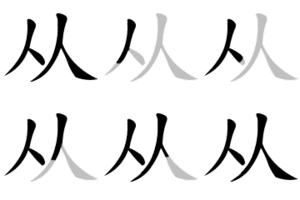 | |||
| Traditional | 從 |
|---|---|
| Shinjitai | 従 |
| Simplified | 从 |
Han character
从 (Kangxi radical 9, 人+2, 4 strokes, cangjie input 人人 (OO), four-corner 88000, composition ⿰人人)
Related characters
- 從 (Traditional form of 从)
References
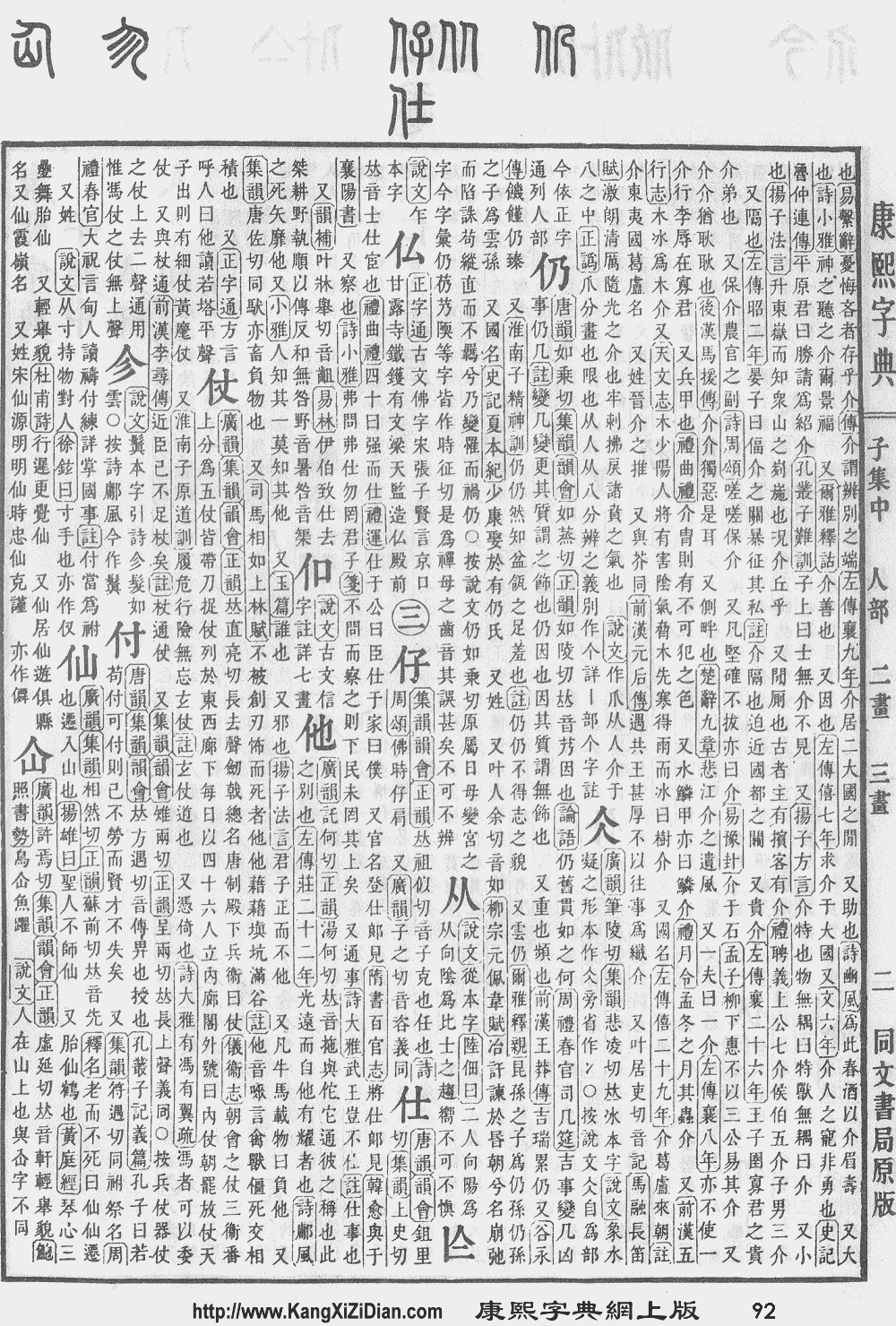
- Kangxi Dictionary: page 92, character 3
- Dai Kanwa Jiten: character 30890
- Dae Jaweon: page 195, character 1
- Hanyu Da Zidian (first edition): volume 1, page 105, character 3
- Unihan data for U+4ECE
Chinese
Glyph origin
| Historical forms of the character 从 | |||
|---|---|---|---|
| Shang | Western Zhou | Shuowen Jiezi (compiled in Han) | Liushutong (compiled in Ming) |
| Oracle bone script | Bronze inscriptions | Small seal script | Transcribed ancient scripts |
 |
 |
 |
 |
Characters in the same phonetic series (从) (Zhengzhang, 2003)
Ideogrammic compound (會意/会意) – a person (人) walking with another person in the same direction – to follow. Duplication of 人.
Etymology 1
| For pronunciation and definitions of 从 – see 從 (“to follow; to come after; to comply with; to submit to; etc.”). (This character is the simplified and variant traditional form of 從). |
Notes:
|
Etymology 2
| For pronunciation and definitions of 从 – see 叢 (“to collect; to gather; to assemble; to crowd together; bush; shrub; thicket; grove; etc.”). (This character is the draft (1955) first-round simplified and variant form of 叢). |
Notes:
|
Japanese
Vietnamese
Han character
从: Hán Nôm readings: tòng, tùng, tụng
- This term needs a translation to English. Please help out and add a translation, then remove the text
{{rfdef}}.
References
This article is issued from Wiktionary. The text is licensed under Creative Commons - Attribution - Sharealike. Additional terms may apply for the media files.