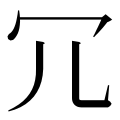
冗
See also: 宂
| ||||||||
 | ||||||||
Translingual
| Stroke order | |||
 | |||
Han character
冗 (Kangxi radical 14, 冖+2, 4 strokes, cangjie input 月竹弓 (BHN) or 難月竹弓 (XBHN) or 月竹山 (BHU), four-corner 37217, composition ⿱冖几(U+5197) or ⿱冖儿(U+2F817))
Derived characters
References
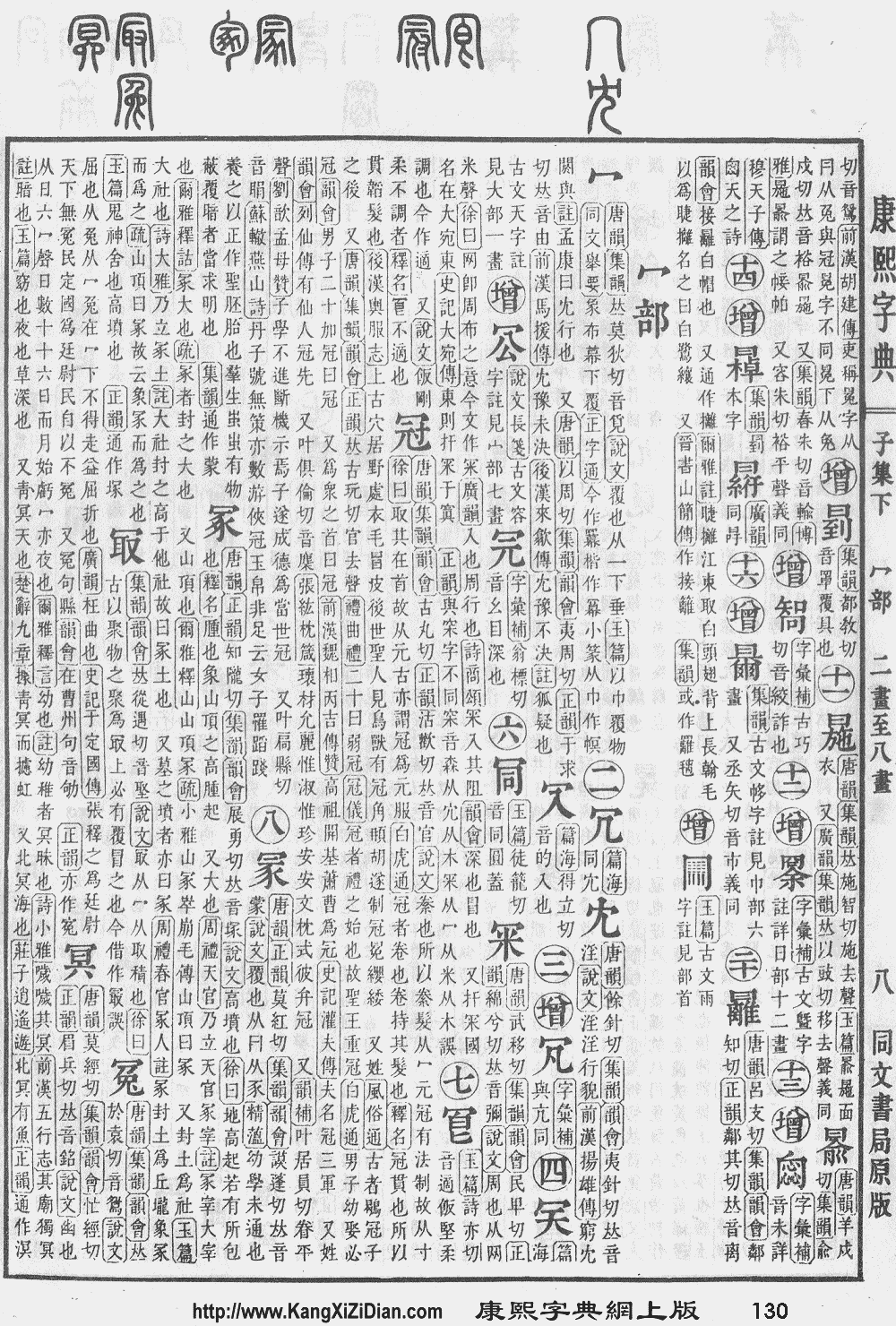
- Kangxi Dictionary: page 130, character 13
- Dai Kanwa Jiten: character 1566
- Dae Jaweon: page 292, character 13
- Hanyu Da Zidian (first edition): volume 1, page 302, character 16
- Unihan data for U+5197
- Unihan data for U+2F817
Chinese
| trad. | 冗/宂* | |
|---|---|---|
| simp. | 冗 | |
| alternative forms | 冘 | |
Glyph origin
| Historical forms of the character 冗 | |
|---|---|
| Shang | Shuowen Jiezi (compiled in Han) |
| Oracle bone script | Small seal script |
 |
 |
Ideogrammic compound (會意/会意) : 宀 (“roof”) + 儿 (“person”) — a person at home without work to do.
Pronunciation
Definitions
冗
- superfluous; unnecessary; surplus; uncalled-for; spare; excessive; redundant
- complicated and tedious; overloaded with details
- busy routine
Synonyms
- (superfluous):
- (complicated and tedious):
Japanese
Korean
Hanja
冗 (eum 용 (yong))
- This term needs a translation to English. Please help out and add a translation, then remove the text
{{rfdef}}.
Vietnamese
Han character
冗: Hán Việt readings: nhũng[1][2][3]
冗: Nôm readings: nũng[1][3], nhõng[3][4], nhũng[2], đem[2], nhùng[4]
- This term needs a translation to English. Please help out and add a translation, then remove the text
{{rfdef}}.
References
- Nguyễn (2014).
- Nguyễn et al. (2009).
- Trần (2004).
- Hồ (1976).
This article is issued from Wiktionary. The text is licensed under Creative Commons - Attribution - Sharealike. Additional terms may apply for the media files.