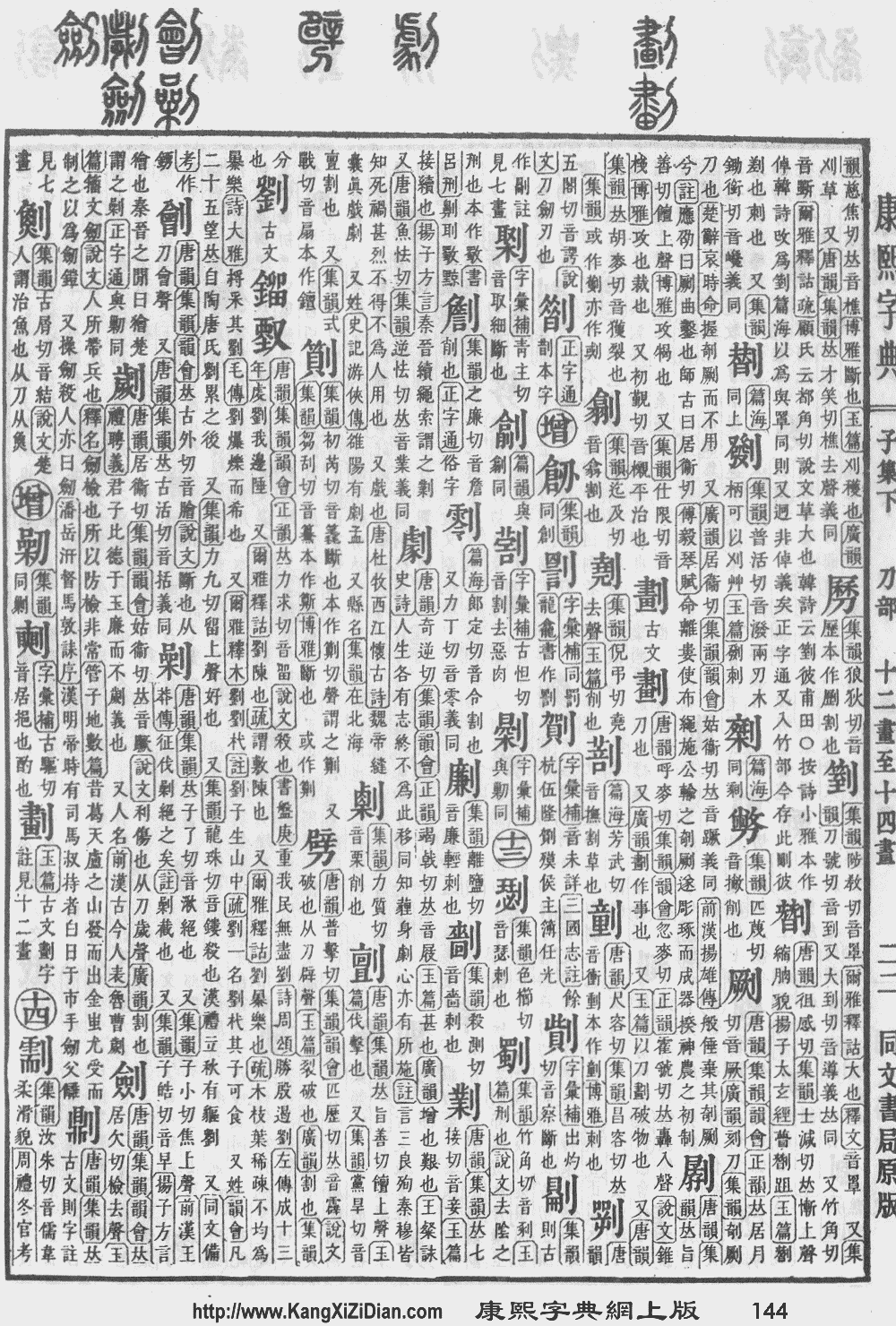
劌

See also: 刿
劌 U+528C, 劌
CJK UNIFIED IDEOGRAPH-528C
← 劋
[U+528B]
CJK Unified Ideographs 劍 →
[U+528D]

Translingual

Han character

劌 (Kangxi radical 18, 刀+13, 15 strokes, cangjie input 卜竹中弓 (YHLN), four-corner 12200, composition ⿰歲刂)

  1. to cut, injure, stab, stick on

References

  • Kangxi Dictionary: page 144, character 44
  • Dai Kanwa Jiten: character 2227
  • Dae Jaweon: page 326, character 3
  • Hanyu Da Zidian (first edition): volume 1, page 357, character 13
  • Unihan data for U+528C

Chinese

Glyph origin

Pronunciation 1

trad. 劌
simp. 刿


Note:
  • kùi/kuih - vernacular;
  • kòe - literary.

    Rime
    Character 劌
    Reading # 1/1
    Initial (聲) 見 (28)
    Final (韻) 祭 (38)
    Tone (調) Departing (H)
    Openness (開合) Closed
    Division (等) III
    Fanqie 居衛切
    Baxter kjwejH
    Reconstructions
    Zhengzhang
    Shangfang
    /kˠiuᴇiH/
    Pan
    Wuyun
    /kʷᵚieiH/
    Shao
    Rongfen
    /kiuæiH/
    Edwin
    Pulleyblank
    /kjwiajH/
    Li
    Rong
    /kjuɛiH/
    Wang
    Li
    /kĭwɛiH/
    Bernard
    Karlgren
    /ki̯wɛiH/
    Expected
    Mandarin
    Reflex
    guì
    Expected
    Cantonese
    Reflex
    gwai3
    Baxter–Sagart system 1.1 (2014)
    Character 劌
    Reading # 1/1
    Modern
    Beijing
    (Pinyin)
    guì
    Middle
    Chinese
    ‹ kjwejH ›
    Old
    Chinese
    /*[C.qʷ](r)a[t]-s/
    English to wound, damage

    Notes for Old Chinese notations in the Baxter–Sagart system:

    * Parentheses "()" indicate uncertain presence;
    * Square brackets "[]" indicate uncertain identity, e.g. *[t] as coda may in fact be *-t or *-p;
    * Angle brackets "<>" indicate infix;
    * Hyphen "-" indicates morpheme boundary;

    * Period "." indicates syllable boundary.
    Zhengzhang system (2003)
    Character 劌
    Reading # 1/1
    No. 12166
    Phonetic
    component
    歲
    Rime
    group
    祭
    Rime
    subdivision
    1
    Corresponding
    MC rime
    Old
    Chinese
    /*kʷrads/

    Definitions

    劌

    1. (literary) to stab; to cut
      1. (Hokkien) to be cut, hooked, or scratched by a sharp object (such as a nail)
        衫予釘仔劌破去。 [Hokkien, trad.]
        衫予钉仔刿破去。 [Hokkien, simp.]
        Sam hō͘ teng-á kuì phòa-khì. [Pe̍h-ōe-jī]
        The clothes are cut by an iron nail.

    Compounds

    Pronunciation 2

    trad. 劌
    simp. 刿
    alternative forms 揆 (koe̍h) Zhangzhou Hokkien
    撅 (“to rub against”) Zhangzhou Hokkien


    Definitions

    劌

    1. (Xiamen and Zhangzhou Hokkien) to rub against; to smear with (paste, etc.)
    2. (Xiamen and Zhangzhou Hokkien) Classifier for a segment or section of something that is long: piece; segment; length
    Synonyms
    • (classifier): 段 (duàn), 截 (jié)

    Pronunciation 3

    trad. 劌
    simp. 刿
    alternative forms 刮
    撅

    Definitions

    劌

    1. (Zhangzhou and Taiwanese Hokkien) to wipe with a flat or long object
    2. (Taiwanese Hokkien) to trip over a flat or long object

    References

    Japanese

    Kanji

    劌

    (uncommon “Hyōgai” kanji)

    1. This term needs a translation to English. Please help out and add a translation, then remove the text {{rfdef}}.

    Readings

    Korean

    Hanja

    劌 (eum 귀 (gwi))

    1. This term needs a translation to English. Please help out and add a translation, then remove the text {{rfdef}}.

    Vietnamese

    Han character

    劌: Hán Nôm readings: quế

    1. This term needs a translation to English. Please help out and add a translation, then remove the text {{rfdef}}.

    References

    This article is issued from Wiktionary. The text is licensed under Creative Commons - Attribution - Sharealike. Additional terms may apply for the media files.