予
| ||||||||
Translingual
| Stroke order | |||
 | |||
Han character
予 (Kangxi radical 6, 亅+3, 4 strokes, cangjie input 弓戈弓弓 (NINN), four-corner 17202, composition ⿱龴𠄐)
- Shuowen Jiezi radical №127
Derived characters
Further reading
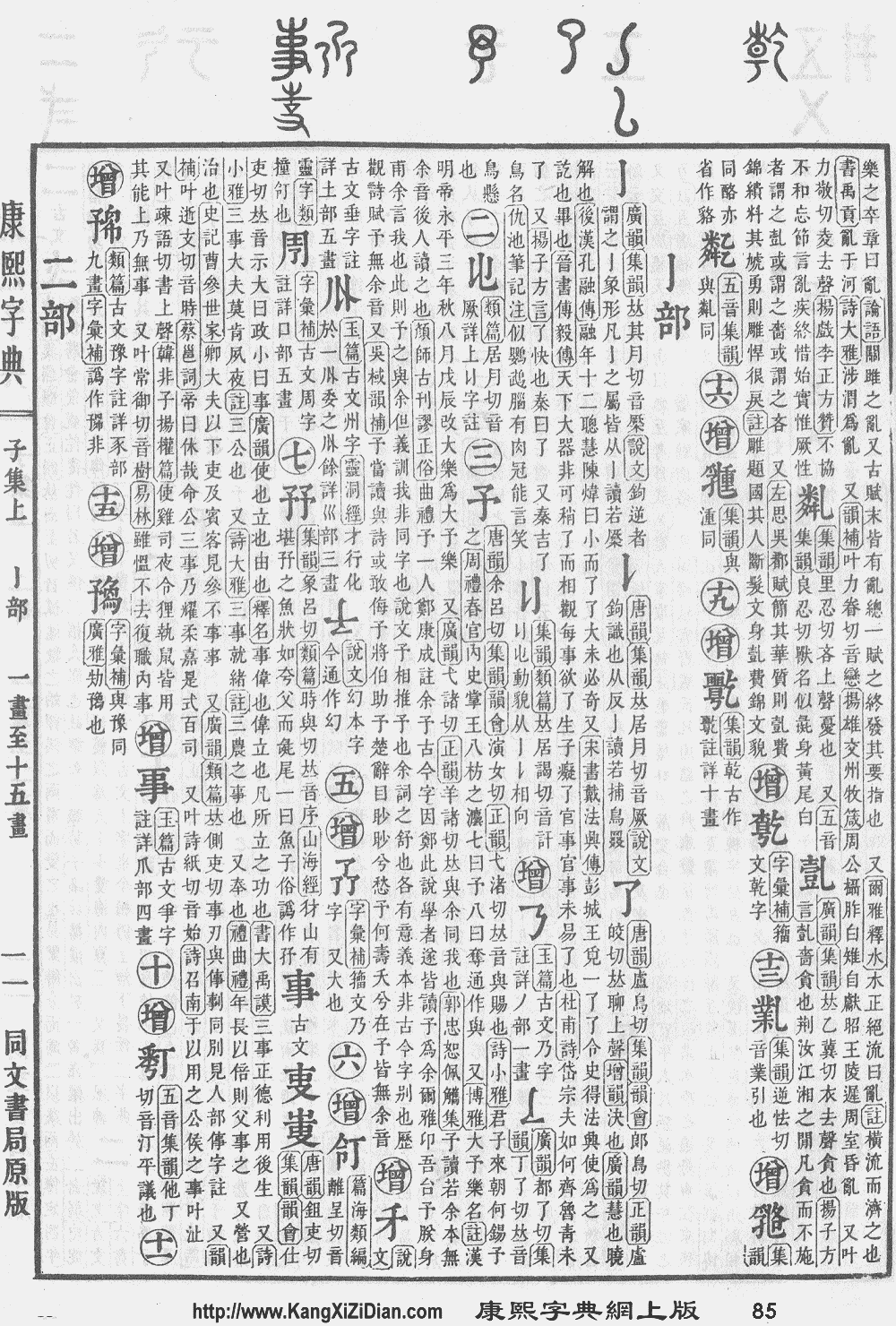
- Kangxi Dictionary: page 85, character 16
- Dai Kanwa Jiten: character 231
- Dae Jaweon: page 174, character 6
- Hanyu Da Zidian (first edition): volume 1, page 52, character 2
- Unihan data for U+4E88
Chinese
Glyph origin
| Historical forms of the character 予 | |||||||||||||||
|---|---|---|---|---|---|---|---|---|---|---|---|---|---|---|---|
| Shuowen Jiezi (compiled in Han) | |||||||||||||||
| Small seal script | |||||||||||||||
 | |||||||||||||||
|
References: Mostly from Richard Sears' Chinese Etymology site (authorisation),
|


Jiajie (假借) and Ideogram (指事) . Originally 吕 (OC *ɡ·raʔ) borrowed for sound, later 亅 was added as a distinguishing mark.
Pronunciation
Compounds
Etymology 2
| simp. and trad. |
予 | |
|---|---|---|
| alternative forms | ||
與 (OC *laʔ) is often considered to be the original character (Lin, 1998, 1999; Mei, 2007); Taiwan's Ministry of Education considers the cognate 予 (OC *laʔ) to be the original character. In either case, this would be the same word as etymology 1.
Alternatively, Zhao (1991) argues that this is a Kra-Dai substrate, suggesting a borrowing from Proto-Tai *haɰꟲ (“to give”), whence Zhuang hawj (“to give; to allow”) and Bouyei haec (“to give; to allow”). Note that the Tai word has been connected to Middle Chinese 許 (MC xjoX, “to allow”) (Manomaivibool, 1975). On the other hand, Zheng (2008) considers both the Hokkien word and the Kra-Dai word to be derived from 與.
Assuming 與 to be the etymon, there are also various theories on the development of the h- initial:
- Old Chinese /*ɡl/ → /*ɡ/ → /*ɣ/ → /h/ (Mei, 2007);
- Fricativization of the /*l/ initial in Old Chinese, possibly originating in the Chu dialect (Zheng, 2008);
- /tʰ/ (Quanzhou) → /h/ (other varieties) (Lin, 1998; Zhou, 2006; Taiwan's Ministry of Education).
Sagart (2017c) considers 與/与 to be a problematic etymon but agrees with the third theory on the development of h- above. He suggests that a possible trigger for the change from /tʰ/ to /h/ is that /tʰɔ/ is often used with 乞 /kʰit/, allowing /kʰit tʰɔ/ to be reanalysed as /kʰit hɔ/. This etymology was also independently proposed by Lien (2002).
Pronunciation
Definitions
予
- (Hokkien) to give
- (Teochew) to deliver; to give
- (Hokkien) to allow
- 予伊去! [Hokkien] ― Hō͘ i khì! [Pe̍h-ōe-jī] ― Let it go!
- (Hokkien) to cause; to make
- (Hokkien, Teochew) by (used in constructing the passive)
- 伊予人拍。 [Hokkien] ― I hō͘ lâng phah. [Pe̍h-ōe-jī] ― He was beaten up (by someone).
- (Penang Hokkien) to pay
Synonyms
| Variety | Location | Words |
|---|---|---|
| Formal (Written Standard Chinese) | 付 | |
| Mandarin | Taiwan | 付 |
| Guilin | 付 | |
| Yangzhou | 付 | |
| Malaysia | 還, 付 | |
| Singapore | 還, 付 | |
| Cantonese | Guangzhou | 畀 |
| Hong Kong | 畀 | |
| Singapore (Guangfu) | 畀 | |
| Gan | Nanchang | 付 |
| Hakka | Kuching (Hepo) | 還 |
| Eastern Min | Fuzhou | 付 |
| Southern Min | Tainan | 付 |
| Penang (Hokkien) | 予 | |
| Singapore (Hokkien) | 還 | |
| Manila (Hokkien) | 把拉, 還 obsolete | |
| Wu | Shanghai | 付 |
Derived terms
- hőng (Min Nan)
- 樹頭徛予在,毋驚樹尾做風颱/树头徛予在,毋惊树尾做风台 (chhiū-thâu khiā hō͘ chāi, m̄ kiaⁿ chhiū-bóe chò-hong-thai) (Min Nan)
Etymology 3
| simp. and trad. |
予 | |
|---|---|---|
Traditionally considered a variant of 余 (OC *la), however Shijing and Chuci rhymes suggests that the expected tone reflex was rising tone, similar to Pronunciation 1 (Mattos, 1971; Pulleyblank, 1995), which corresponds to a glottal stop coda in Old Chinese. It could thus be reanalyzed an emphatic form of the *l- series of first-person pronouns, similar to 我 (OC *ŋaːlʔ, “me, us”) compared to 吾 (OC *ŋaː, “I, we”) in the *ŋ- series.
Cognate with 余 (OC *la), 台 (OC *lɯ, “I”), 朕 (OC *l'ɯmʔ). Further etymology is obscure (Schuessler, 2007). Li F. (1976) reconstructs Old Chinese *rag, and compares it to Proto-Tai *rawᴬ (“first person plural pronoun”) > Thai เรา (rao, “we”). However, Schuessler considers this etymon belonging to 兩 (OC *raŋʔ, *raŋs, “both”).
Pronunciation
Definitions
予
- (obsolete) Alternative form of 余 (“I, me”)
- 予畏上帝,不敢不正。 [Classical Chinese, trad. and simp.]
- From: The Book of Documents, circa 4th – 3rd century BCE
- Yú wèi shàngdì, bù gǎn bù zhèng. [Pinyin]
- As I fear the Heaven, I dare not but punish him.
- 夫子矢之曰:「予所否者,天厭之!天厭之!」 [Classical Chinese, trad.]
- From: The Analects of Confucius, c. 475 – 221 BCE, translated based on James Legge's version
- Fūzǐ shǐ zhī yuē: “Yú suǒ pǐ zhě, tiān yàn zhī! Tiān yàn zhī!” [Pinyin]
- On which the Master swore, saying, "Wherein I have done improperly, may Heaven reject me! May Heaven reject me!"
夫子矢之曰:「予所否者,天厌之!天厌之!」 [Classical Chinese, simp.]
- a surname
Synonyms
Etymology 4
| For pronunciation and definitions of 予 – see 豫 (“relaxed; comfortable; at ease; etc.”). (This character is the second-round simplified and variant form of 豫). |
Notes:
|
Etymology 5
| For pronunciation and definitions of 予 – see 預 (“beforehand, in advance; to take part in; etc.”). (This character is the second-round simplified form of 預). |
Notes:
|
Further reading
- “Entry #573”, in 臺灣閩南語常用詞辭典 [Dictionary of Frequently-Used Taiwan Minnan] (overall work in Mandarin and Hokkien), Ministry of Education, R.O.C., 2023.
Japanese
| 予 | |
| 豫 |
Readings
Readings
Compounds
- 予輩 (yohai)
Etymology
| Kanji in this term |
|---|
| 予 |
| よ Grade: 3 |
| on’yomi |
| Alternative spelling |
|---|
| 余 |
From Middle Chinese 予 (MC yo).
Pronoun
予 • (yo)
- first-person personal pronoun; I, me
- 1802-1814: Tōkaidōchū Hizakurige (volume 1)
- 予此街道に毫をはせて膝栗毛の書を著す。
- I, on this highway, in a little while, "Hizakurige"'s lyrics I'll write
- 1802-1814: Tōkaidōchū Hizakurige (volume 1)
References
- “予”, in 漢字ぺディア (Kanjipedia) (in Japanese), 日本漢字能力検定協会, 2015–2024
- Matsumura, Akira, editor (2006), 大辞林 [Daijirin] (in Japanese), Third edition, Tōkyō: Sanseidō, →ISBN
- Asō, Isoji (1958) Nihon Koten Bungaku Taikei 62: Tōkaidōchū Hizakurige (in Japanese), Tōkyō: Iwanami Shoten, →ISBN
Korean
Hanja
予 (eum 여 (yeo))
- This term needs a translation to English. Please help out and add a translation, then remove the text
{{rfdef}}.
Vietnamese
Han character
- This term needs a translation to English. Please help out and add a translation, then remove the text
{{rfdef}}.