卫
| ||||||||
Translingual
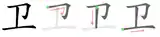
| Stroke order | |||
|---|---|---|---|
 | |||
Han character
卫 (Kangxi radical 26, 卩+1, 3 strokes, cangjie input 尸中一 (SLM), four-corner 17102, composition ⿻𠃌丄 or ⿱𰆊一)
Derived characters
- 𫁱
Related characters
- 衛 (Traditional form of 卫, preferred form in Taiwan)
- 衞 (Orthodox form in Kangxi dictionary, preferred form in Hong Kong)
- 𠀄 (Unorthodox variant of 衛 found in Zhongwen Da Cidian 《中文大辭典》)
References
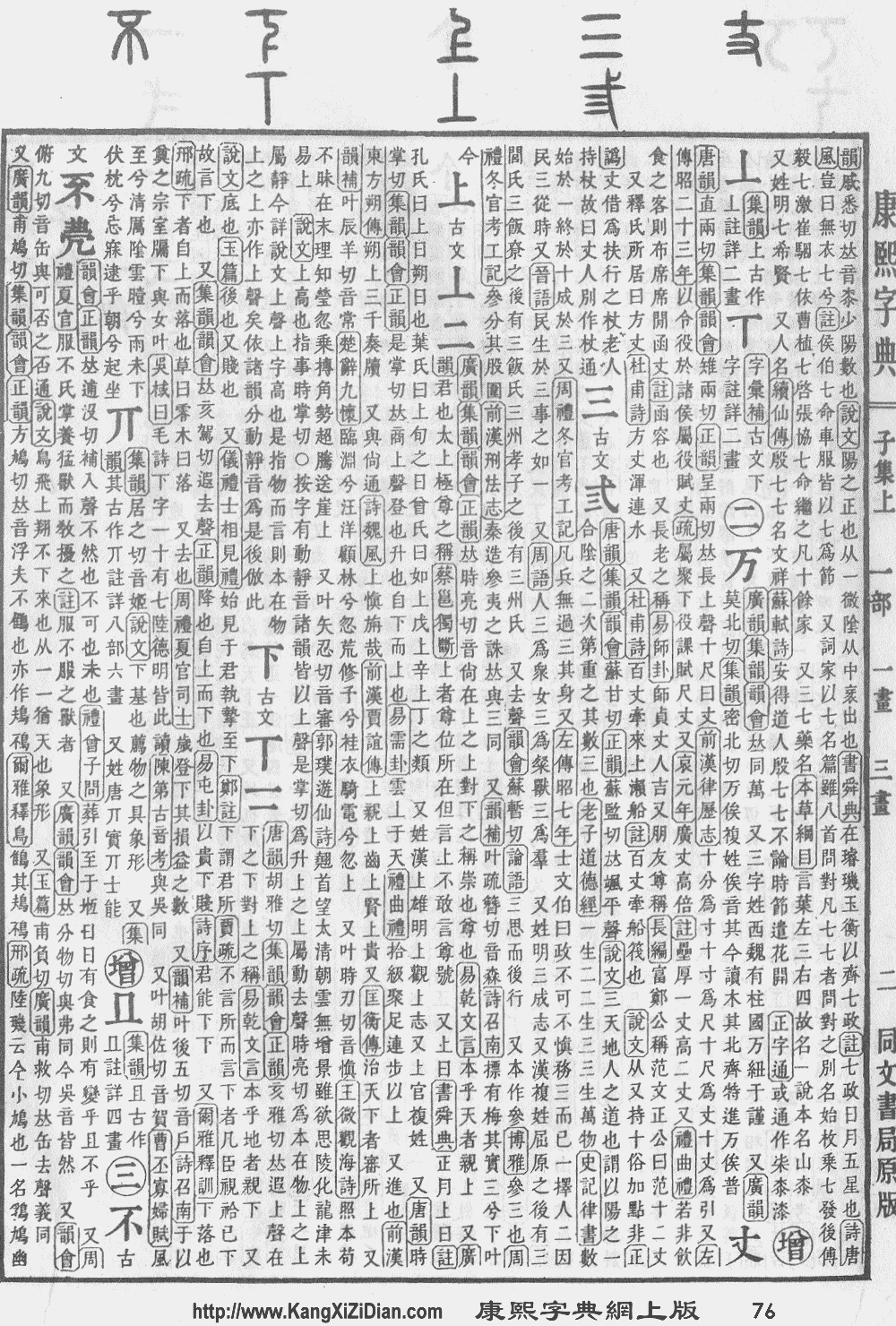
- Kangxi Dictionary: not present, would follow page 76, character 14
- Hanyu Da Zidian (first edition): volume 1, page 50, character 4
- Unihan data for U+536B
Chinese
Glyph origin
This character is not known to have existed prior to the simplification of Chinese characters by the People's Republic of China in 1956.
The simplification of 衛/卫 (wèi) to 卫 (wèi) may have been influenced by the Japanese katakana ヱ (we), compare the Japanese ryakuji ⿰彳ヱ.
In Zhongwen Da Cidian 《中文大辭典》, a dictionary based on the Japanese Dai Kan-Wa Jiten and published in Taiwan from 1962 to 1968, 𠀄 (wèi), a character which is visually similar to 卫 (wèi) (乛 on top instead of 𠃌 (gǔn)), is recorded as an unorthodox variant of 衛/卫 (wèi).
Another theory is that 卫 (wèi) is a variant of 𫝀 (wǔ), which is the top component of 韋/韦 (wéi) in the middle of 衛/卫 (wèi).[1]
Definitions
| For pronunciation and definitions of 卫 – see 衛 (“to guard; to protect; to defend; security guard; etc.”). (This character is the simplified form of 衛). |
Notes:
|