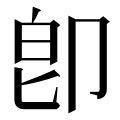
卽
See also: 即
| ||||||||
 | ||||||||
Translingual
Han character
卽 (Kangxi radical 26, 卩+7, 9 strokes, cangjie input 竹心尸中 (HPSL) or 難竹心尸中 (XHPSL), composition ⿰皀卩)
References
- Kangxi Dictionary: page 160, character 3
- Dai Kanwa Jiten: character 2872
- Hanyu Da Zidian (first edition): volume 1, page 316, character 2
- Unihan data for U+537D
- Unihan data for U+2F830

Chinese
Glyph origin
Phono-semantic compound (形聲/形声) : semantic 皀 + phonetic 卪 (OC *ʔsiːɡ).
Japanese
| 即 | |
| 卽 |
Kanji
卽
(“Jinmeiyō” kanji used for names, kyūjitai kanji, shinjitai form 即)
- This term needs a translation to English. Please help out and add a translation, then remove the text
{{rfdef}}.
Korean
Alternative forms
Etymology
From Middle Chinese 卽 (MC tsik).
| Historical Readings | ||
|---|---|---|
| Dongguk Jeongun Reading | ||
| Dongguk Jeongun, 1448 | Recorded as Middle Korean 즉〮 (Yale: cúk) in Dongguk Jeongun (東國正韻 / 동국정운), 1448. | |
| Middle Korean | ||
| Text | Eumhun | |
| Gloss (hun) | Reading | |
| Hunmong Jahoe, 1527 | 고 즉 | Recorded as Middle Korean 즉 (cuk) (Yale: cuk) in Gwangju Cheonjamun (光州千字文 / 광주천자문), 1575. |
| Gwangju Cheonjamun, 1575 | 곧 즉 | Recorded as Middle Korean 즉 (cuk) (Yale: cuk) in Sinjeung Yuhap (新增類合 / 신증유합), 1576. |
| Early Modern Korean | ||
| Text | Final (韻) | Reading |
| Samun Seonghwi, 1751 | 나아갈 즉 | Recorded as Early Modern Korean 즉 (Yale: cuk) in Juhae Cheonjamun (註解千字文 / 주해천자문), 1804. |
Pronunciation
- (SK Standard/Seoul) IPA(key): [t͡ɕɯk̚]
- Phonetic hangul: [즉]
Compounds
This article is issued from Wiktionary. The text is licensed under Creative Commons - Attribution - Sharealike. Additional terms may apply for the media files.