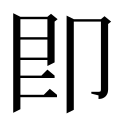
即
| ||||||||
 | ||||||||
Translingual
| Stroke order | |||
|---|---|---|---|
 | |||
Han character
即 (Kangxi radical 26, 卩+5, 7 strokes, cangjie input 日戈尸中 (AISL), four-corner 77720, composition ⿰⿲𠄌𫜹丶卩)
Derived characters
References
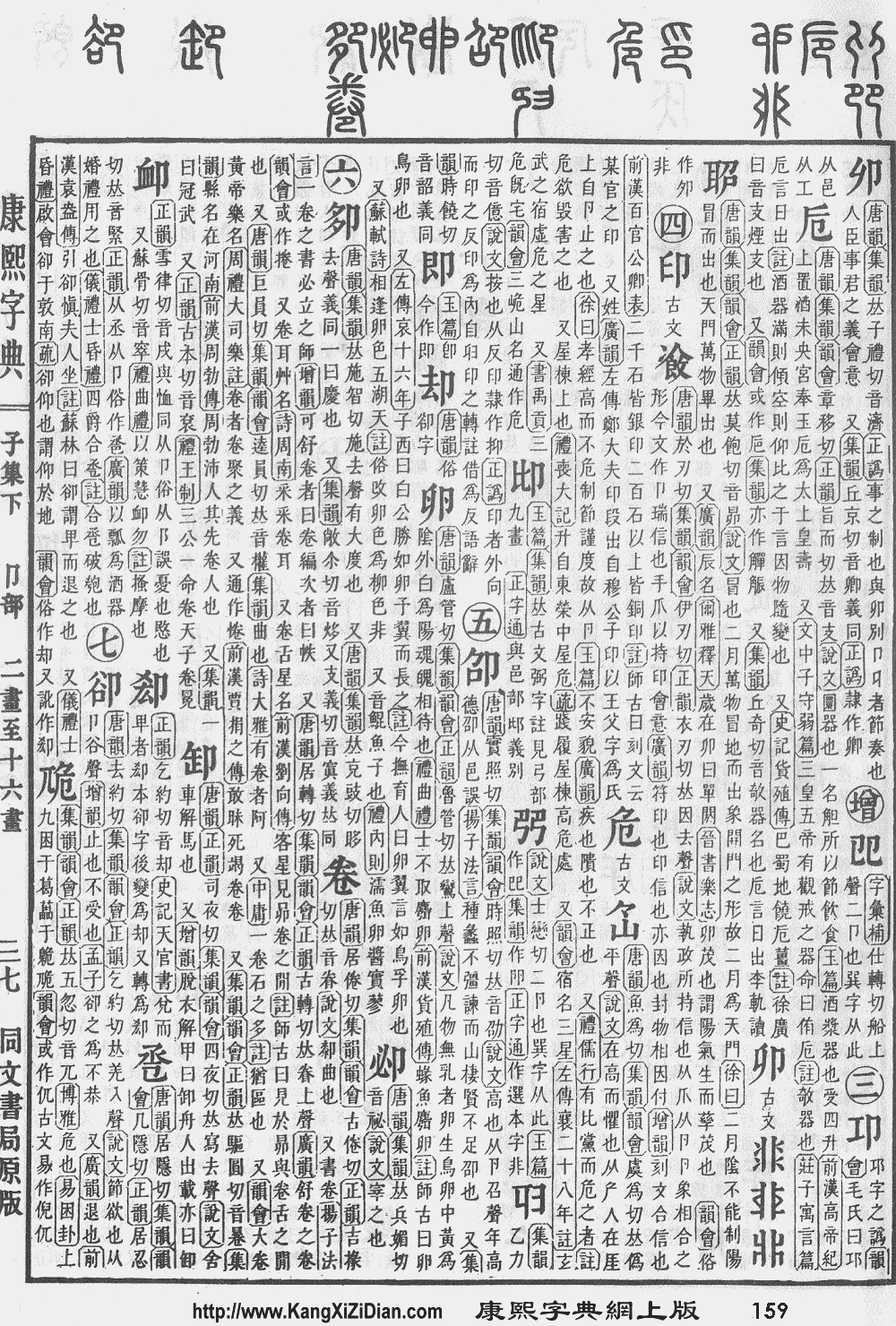
- Kangxi Dictionary: page 159, character 18
- Dai Kanwa Jiten: character 2855
- Dae Jaweon: page 364, character 7
- Hanyu Da Zidian (first edition): volume 1, page 314, character 2
- Unihan data for U+5373
- Unihan data for U+2F82F
Chinese
| simp. and trad. |
即 | |
|---|---|---|
| alternative forms | 卽 皍 | |
Glyph origin
| Historical forms of the character 即 | |||
|---|---|---|---|
| Shang | Western Zhou | Shuowen Jiezi (compiled in Han) | Liushutong (compiled in Ming) |
| Oracle bone script | Bronze inscriptions | Small seal script | Transcribed ancient scripts |
 |
 |
 |
 |
Characters in the same phonetic series (即) (Zhengzhang, 2003)
Ideogrammic compound (會意/会意) : 皀 (“ancient round-mouthed food vessel”) + 卩 (“to kneel”) – to come near to eat; to approach.
Pronunciation
Definitions
即
- (obsolete) to come near to eat
- to approach; to come near; to be near
- 虎將即禽,禽不知虎之即己也,而相鬥兩罷,而歸其死於虎。 [Classical Chinese, trad.]
- From: Zhanguo Ce, circa 5th – 3rd centuries BCE
- Hǔ jiāng jí qín, qín bùzhī hǔ zhī jí jǐ yě, ér xiàng dòu liǎng bà, ér guī qí sǐ yú hǔ. [Pinyin]
- A tiger is about to approach [two] beasts. The beasts are not aware that the tiger is approaching themselves, and instead fought among themselves such that they both became exhausted. In the end they would both die in the hands of the tiger.
虎将即禽,禽不知虎之即己也,而相斗两罢,而归其死于虎。 [Classical Chinese, simp.]
- to ascend; to go up; to assume office
- 即位 ― jíwèi ― to ascend to the throne
- prompted by the occasion
- (literary) if; assuming that
- (literary) even if; even though
- namely; that is; to be the same as; i.e.
- promptly; quickly; immediately; at once
- now; at present
- 在即 ― zàijí ― to be imminent
- a surname
- (Southern Min, determiner) this
Compounds
- 一拍即合 (yīpāijíhé)
- 一觸即潰/一触即溃 (yīchùjíkuì)
- 一觸即發/一触即发 (yīchùjífā)
- 不即
- 不即不離/不即不离 (bùjíbùlí)
- 不死即傷/不死即伤
- 事寬即圓/事宽即圆
- 俯拾即是
- 刻即
- 即且
- 即世 (jíshì)
- 即事 (jíshì)
- 即事即理
- 即事窮理/即事穷理
- 即事詩/即事诗
- 即今 (jíjīn)
- 即代
- 即令 (jílìng)
- 即位 (jíwèi)
- 即位登龍/即位登龙
- 即使 (jíshǐ)
- 即便 (jíbiàn)
- 即刑
- 即刻 (jíkè)
- 即即
- 即即世世
- 即即足足
- 即可 (jíkě)
- 即吉
- 即命
- 即夜 (jíyè)
- 即安
- 即將/即将 (jíjiāng)
- 即小見大/即小见大
- 即席 (jíxí)
- 即席演奏
- 即序
- 即心即佛
- 即心是佛
- 即忙
- 即戎
- 即或
- 即拜
- 即政
- 即敘/即叙
- 即日 (jírì)
- 即早 (jízǎo)
- 即早兒/即早儿
- 即是 (jíshì)
- 即時/即时 (jíshí)
- 即時作業/即时作业
- 即時新聞/即时新闻 (jíshí xīnwén)
- 即景
- 即景會心/即景会心
- 即景生情
- 即期匯票/即期汇票
- 即此
- 即死 (jísǐ)
- 即溜
- 即溫聽厲/即温听厉
- 即漸/即渐
- 即炤/即照
- 即物窮理/即物穷理
- 即用
- 即留
- 即目
- 即真
- 即祚
- 即禽
- 即立
- 即興/即兴 (jíxìng)
- 即興表演/即兴表演
- 即色宗
- 即色空
- 即行
- 即裡漸裡/即里渐里
- 即路
- 即身成佛
- 即速 (jísù)
- 即阼
- 即鹿無虞/即鹿无虞
- 即墨 (Jímò)
- 即墨之戰/即墨之战
- 即墨侯
- 即墨牛
- 在即 (zàijí)
- 捨近即遠/舍近即远
- 搖筆即來/摇笔即来
- 旋即 (xuánjí)
- 是即
- 是即是
- 棄同即異/弃同即异
- 然即
- 當即/当即 (dāngjí)
- 登即 (dēngjí)
- 目即
- 目即成誦/目即成诵
- 相即相入
- 相次即世
- 瞬即
- 稍縱即逝/稍纵即逝 (shāozòngjíshì)
- 空即是色 (kōng jí shì sè)
- 立即 (lìjí)
- 若即若離/若即若离 (ruòjíruòlí)
- 若離若即/若离若即
- 著即
- 賡即/赓即 (gēngjí)
- 趕即/赶即
- 足律即留
- 跟即
- 迅即 (xùnjí)
- 速即
- 遂即
- 遽即
- 還即/还即
- 除服即吉
- 隨即/随即 (suíjí)
- 隨插即用/随插即用
- 離即/离即
- 非死即傷/非死即伤 (fēisǐjíshāng)
- 麾之即去
References
- “即”, in 漢語多功能字庫 (Multi-function Chinese Character Database), 香港中文大學 (the Chinese University of Hong Kong), 2014–
Japanese
| 即 | |
| 卽 |
Readings
Compounds
Prefix
即 • (soku-)
References
- Matsumura, Akira, editor (2006), 大辞林 [Daijirin] (in Japanese), Third edition, Tōkyō: Sanseidō, →ISBN
- NHK Broadcasting Culture Research Institute, editor (1998), NHK日本語発音アクセント辞典 [NHK Japanese Pronunciation Accent Dictionary] (in Japanese), Tōkyō: NHK Publishing, →ISBN
Korean
Vietnamese
This article is issued from Wiktionary. The text is licensed under Creative Commons - Attribution - Sharealike. Additional terms may apply for the media files.