喑

喑 U+5591, 喑
CJK UNIFIED IDEOGRAPH-5591
← 喐
[U+5590]
CJK Unified Ideographs 喒 →
[U+5592]

Translingual

Han character

喑 (Kangxi radical 30, 口+9, 12 strokes, cangjie input 口卜廿日 (RYTA), four-corner 60061, composition ⿰口音)

  1. the sobbing of infants
  2. cry ceaselessly
  3. mute, dumb

Derived characters

  • 𤺵

References

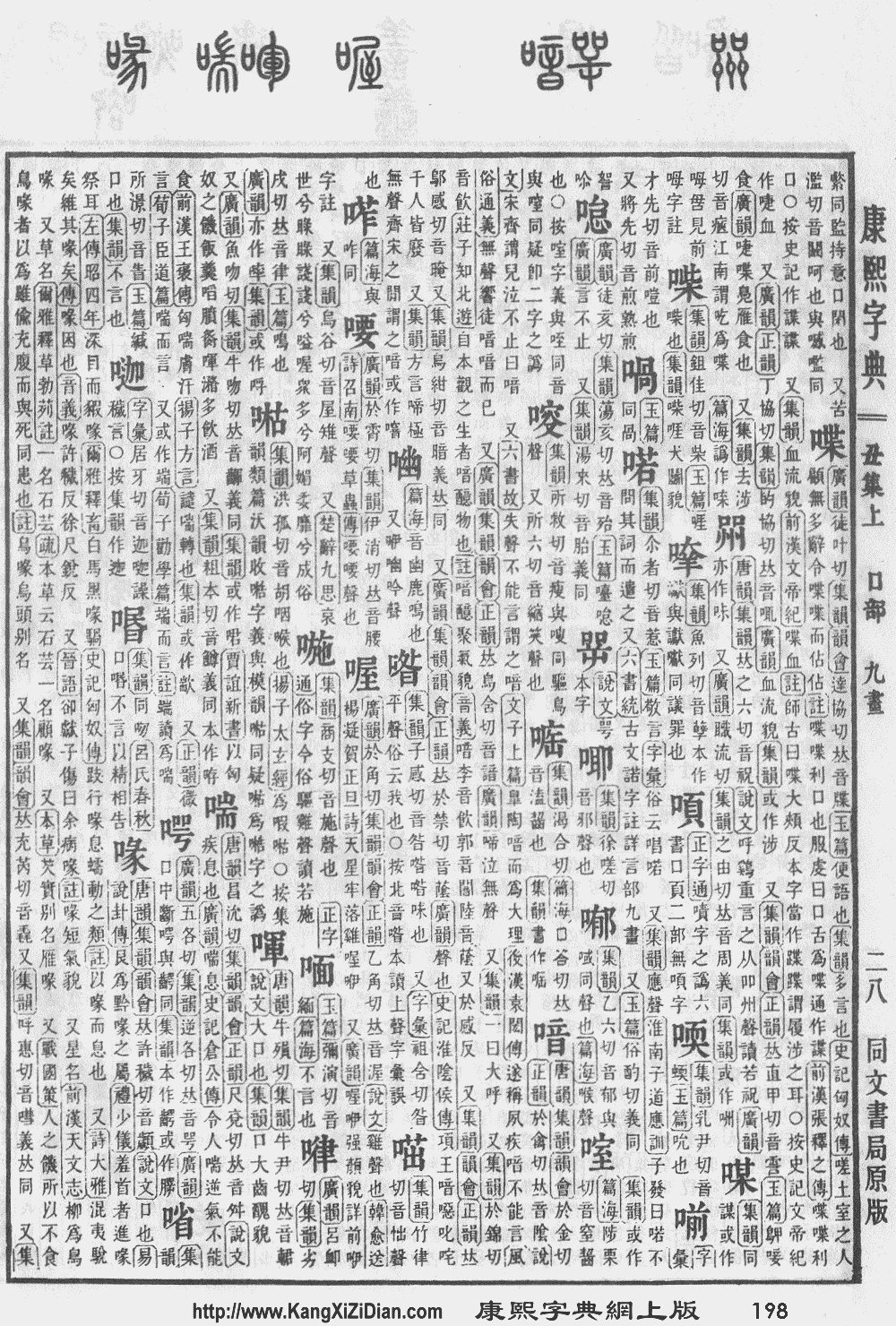
  • Kangxi Dictionary: page 198, character 18
  • Dai Kanwa Jiten: character 3934
  • Dae Jaweon: page 420, character 6
  • Hanyu Da Zidian (first edition): volume 1, page 659, character 6
  • Unihan data for U+5591

Chinese

simp. and trad.
喑
alternative forms 瘖
噾

Glyph origin

Historical forms of the character 喑
Shuowen Jiezi (compiled in Han)
Small seal script

Pronunciation


Rime
Character 喑 喑 喑
Reading # 1/3 2/3 3/3
Initial (聲) 影 (34) 影 (34) 影 (34)
Final (韻) 侵 (140) 覃 (159) 侵 (140)
Tone (調) Level (Ø) Level (Ø) Departing (H)
Openness (開合) Open Open Open
Division (等) III I III
Fanqie 於金切 烏含切 於禁切
Baxter 'im 'om 'imH
Reconstructions
Zhengzhang
Shangfang
/ʔˠiɪm/ /ʔʌm/ /ʔˠiɪmH/
Pan
Wuyun
/ʔᵚim/ /ʔəm/ /ʔᵚimH/
Shao
Rongfen
/ʔiem/ /ʔɒm/ /ʔiemH/
Edwin
Pulleyblank
/ʔjim/ /ʔəm/ /ʔjimH/
Li
Rong
/ʔjəm/ /ʔᴀm/ /ʔjəmH/
Wang
Li
/ĭĕm/ /ɒm/ /ĭĕmH/
Bernard
Karlgren
/ʔi̯əm/ /ʔăm/ /ʔi̯əmH/
Expected
Mandarin
Reflex
yīn ān yìn
Expected
Cantonese
Reflex
jam1 am1 jam3
Zhengzhang system (2003)
Character 喑 喑 喑
Reading # 1/3 2/3 3/3
No. 15209 15226 15228
Phonetic
component
音 音 音
Rime
group
侵 侵 侵
Rime
subdivision
1 1 1
Corresponding
MC rime
諳 音 蔭
Old
Chinese
/*qɯːm/ /*qrɯm/ /*qrɯms/

Definitions

喑

  1. This term needs a translation to English. Please help out and add a translation, then remove the text {{rfdef}}.

Compounds

  • 喑啞/喑哑 (yīnyǎ)
  • 喑喑
  • 喑嗚/喑呜
  • 喑嗚叱吒/喑呜叱吒
  • 喑噁/喑𫫇 (yīnwù)
  • 喑惡叱吒/喑恶叱吒
  • 打耳喑

Etymology 2

For pronunciation and definitions of 喑 – see 瘖 (“mute; dumb; speechless”).
(This character is the simplified and variant traditional form of 瘖).
Notes:

References

Japanese

Kanji

喑

(uncommon “Hyōgai” kanji)

  1. to be dumb
  2. the sobbing of infants

Readings

Korean

Hanja

喑 • (eum) (hangeul 음, revised eum, McCune–Reischauer ŭm)

  1. deaf mute
  2. cry ceaselessly

Tày

Noun

喑 (ám)

  1. Nôm form of ám (“piece; crumb”).
    拾喑𱙊鸡尊否平喑蕡大棟
    Slíp ám nựa cáy ton, bấu phính ám bon đại đống
    Ten pieces of capon doesn't equal a taro

Adjective

喑 (ím)

  1. Nôm form of ím (“full; satiated”).
    吟欢𦙦󲁵煩吟辛喑𦙶󲁴
    Gằm van săm mí phàn, gằm tăn ím gò ghẻ.
    Courtesy costs nothing.
    (literally, “Sweet words and the heart won't be bothered, stupid words and one's full to the point of slitting one's throat.”)
    𫪄喑𫪄󲁶抉飴粑𫠯𱎋
    kin ím kin lưa, khuýt khỉ bưa lồng lảng
    to eat full and overeat and throw crumbs all over the floor.
    喑咟唃𥃸
    ím pác dác tha
    to have eyes bigger than one's stomach
    (literally, “to have a full stomach but hungry eyes”)

References

  • Lục Văn Pảo, Hoàng Tuấn Nam (2003) Hoàng Triều Ân, editor, Từ điển chữ Nôm Tày [A Dictionary of (chữ) Nôm Tày]‎ (in Vietnamese), Hanoi: Nhà xuất bản Khoa học Xã hội

Vietnamese

Han character

喑: Hán Nôm readings: ầm

  1. This term needs a translation to English. Please help out and add a translation, then remove the text {{rfdef}}.

Zhuang

Adjective

喑

  1. Sawndip form of imq (“full; satiated”)

Verb

喑

  1. Sawndip form of imq (“to be full; to be satiated”)
This article is issued from Wiktionary. The text is licensed under Creative Commons - Attribution - Sharealike. Additional terms may apply for the media files.