侵
| ||||||||
Translingual
Han character
侵 (Kangxi radical 9, 人+7, 9 strokes, cangjie input 人尸一水 (OSME), four-corner 27247, composition ⿰亻𠬶)
References
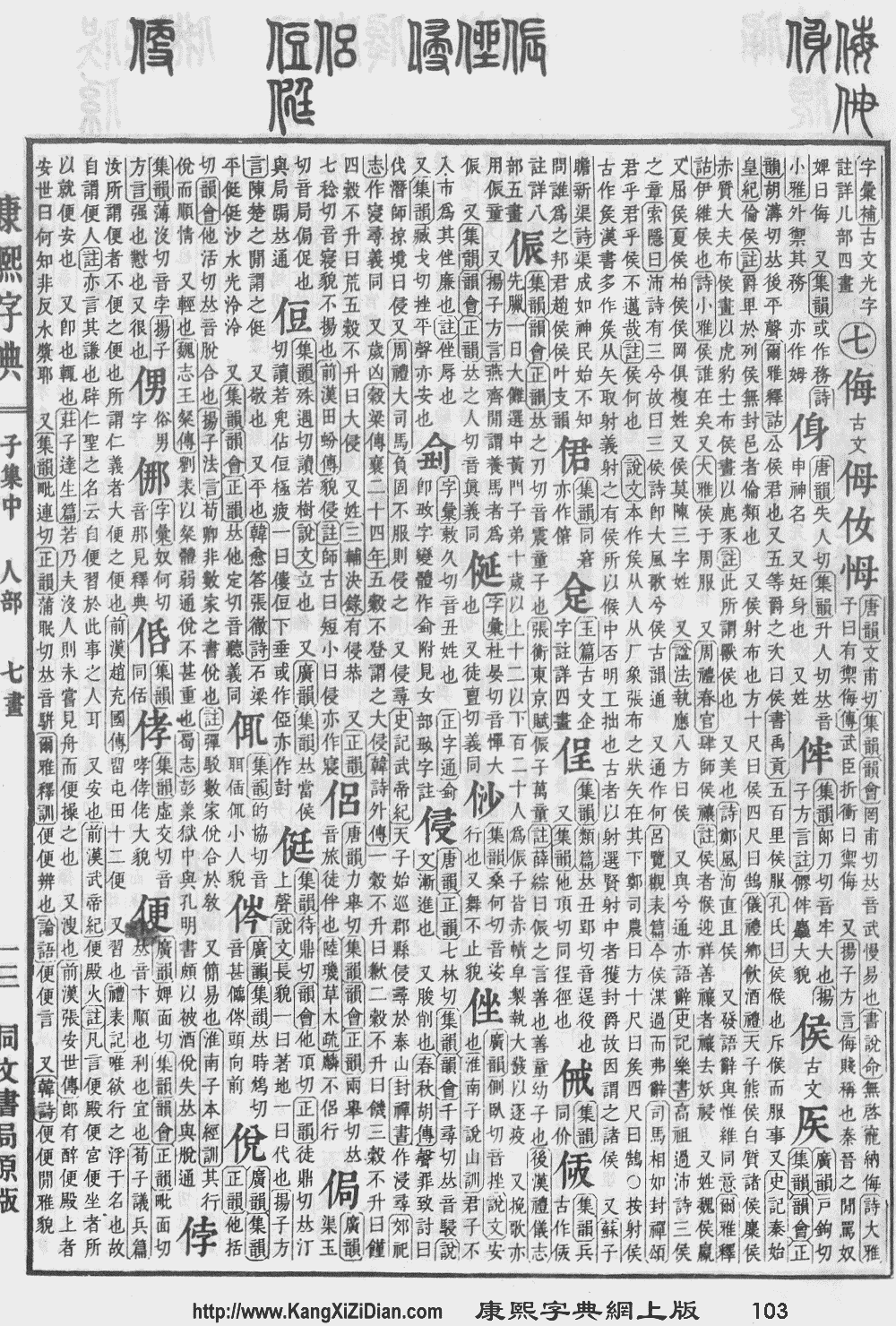
- Kangxi Dictionary: page 103, character 19
- Dai Kanwa Jiten: character 646
- Dae Jaweon: page 218, character 30
- Hanyu Da Zidian (first edition): volume 1, page 166, character 12
- Unihan data for U+4FB5
Chinese
Glyph origin
| Historical forms of the character 侵 | |||||||||||||||||||||||||||||||
|---|---|---|---|---|---|---|---|---|---|---|---|---|---|---|---|---|---|---|---|---|---|---|---|---|---|---|---|---|---|---|---|
| Shang | Western Zhou | Shuowen Jiezi (compiled in Han) | Liushutong (compiled in Ming) | ||||||||||||||||||||||||||||
| Oracle bone script | Bronze inscriptions | Small seal script | Transcribed ancient scripts | ||||||||||||||||||||||||||||
 |
 |
 |
 | ||||||||||||||||||||||||||||
|||
|
References: Mostly from Richard Sears' Chinese Etymology site (authorisation),
| |||||||||||||||||||||||||||||||


Characters in the same phonetic series (侵) (Zhengzhang, 2003)
According to Shuowen, an ideogrammic compound (會意/会意) : 人 (“person”) + 帚 (“broom”) + 又 (“hand”) – a person with a broom in hand.
Etymology 1
| trad. | 侵 | |
|---|---|---|
| simp. # | 侵 | |
| 2nd round simp. | ⿰亻彐 | |
| alternative forms | 㑴 𢔀 | |
Two Sino-Tibetan etymologies are possible:
- Cognate with Tibetan སྟིམ་པ (stim pa, “to enter; to penetrate”), Tibetan ཐིམ་པ (thim pa, “to dissolve; to disappear; absorbed”), though the two terms agree just as well with 浸 (OC *ʔsims, *sʰim) (Schuessler, 2007), or
- From Proto-Sino-Tibetan *syim (“sweep”) (STEDT); cognate with Anong śim (“to sweep”), Lhao Vo śam (“to sweep”), Burmese သိမ်း (sim:, “to gather in; to take possession of”). Note the graph 侵 shows a broom (帚) which may carry a semantic function (Schuessler, 2007).
Pronunciation
Definitions
侵
- (literary) to gradually go in
- to invade; to encroach
- 侵略 ― qīnlüè ― to invade
- 四年春,齊侯以諸侯之師侵蔡。 [Classical Chinese, trad.]
- From: Commentary of Zuo, c. 4th century BCE, translated based on James Legge's version
- Sì nián chūn, Qí hóu yǐ zhūhóu zhī shī qīn Cài. [Pinyin]
- In this year, in spring, the marquis of Qi, with the forces of many of the princes, made an incursion into Cai.
四年春,齐侯以诸侯之师侵蔡。 [Classical Chinese, simp.]
- approaching
- 侵晨 ― qīnchén ― the approach of daybreak
- a surname
Compounds
- 互不侵犯
- 侵事
- 侵佔/侵占 (qīnzhàn)
- 侵侮
- 侵傍
- 侵入 (qīnrù)
- 侵凌 (qīnlíng)
- 侵削
- 侵剝百端/侵剥百端
- 侵占 (qīnzhàn)
- 侵占罪
- 侵吞 (qīntūn)
- 侵哄
- 侵噬
- 侵奪/侵夺
- 侵官
- 侵害 (qīnhài)
- 侵尋/侵寻 (qīnxún)
- 侵徹力/侵彻力
- 侵掠 (qīnlüè)
- 侵擾/侵扰 (qīnrǎo)
- 侵早
- 侵星
- 侵晨 (qīnchén)
- 侵暴
- 侵曉/侵晓 (qīnxiǎo)
- 侵權行為/侵权行为 (qīnquán xíngwéi)
- 侵淫
- 侵漁/侵渔
- 侵瀆/侵渎
- 侵牟
- 侵犯 (qīnfàn)
- 侵用
- 侵略 (qīnlüè)
- 侵略主義/侵略主义 (qīnlüè zhǔyì)
- 侵略者 (qīnlüèzhě)
- 侵肌透骨
- 侵蝕/侵蚀 (qīnshí)
- 侵蝕作用/侵蚀作用
- 侵蝕基準/侵蚀基准
- 侵蝕平原/侵蚀平原
- 侵蝕循環/侵蚀循环
- 侵襲/侵袭 (qīnxí)
- 侵越 (qīnyuè)
- 侵陵 (qīnlíng)
- 入侵 (rùqīn)
- 冷語侵人/冷语侵人
- 匈奴入侵
- 大侵
- 大舉入侵/大举入侵
- 幕侵天
- 廝侵/厮侵
- 性侵犯 (xìngqīnfàn)
- 死臨侵/死临侵
- 略地侵城
- 百毒不侵 (bǎidúbùqīn)
Pronunciation
Japanese
| Shinjitai | 侵 | |
| Kyūjitai [1] |
侵󠄁 侵+ 󠄁?(Adobe-Japan1) |
 |
| 侵󠄃 侵+ 󠄃?(Hanyo-Denshi) (Moji_Joho) | ||
| The displayed kanji may be different from the image due to your environment. See here for details. | ||
Readings
References
- “侵”, in 漢字ぺディア (Kanjipedia) (in Japanese), 日本漢字能力検定協会, 2015–2024
Korean
Hanja
侵 (eum 침 (chim))
- This term needs a translation to English. Please help out and add a translation, then remove the text
{{rfdef}}.
Vietnamese
Han character
侵: Hán Nôm readings: xâm, xăm, xơm
- This term needs a translation to English. Please help out and add a translation, then remove the text
{{rfdef}}.
References
This article is issued from Wiktionary. The text is licensed under Creative Commons - Attribution - Sharealike. Additional terms may apply for the media files.