囍
See also: 𡅕 and 🉤
| ||||||||
Translingual
Han character
囍 (Kangxi radical 30, 口+21, 24 strokes, cangjie input 土口土口口 (GRGRR), four-corner 44661, composition ⿰喜喜 (GHTJ) or ⿰𠶮𠶮 (K))
References
- Kangxi Dictionary: not present, would follow page 216, character 5
- Dae Jaweon: page 438, character 24
- Hanyu Da Zidian (first edition): not present, would follow volume 1, page 707, character 6
- Unihan data for U+56CD
Chinese
| simp. and trad. |
囍 | |
|---|---|---|
| alternative forms | 𡅕 𡄝 | |

Glyph origin
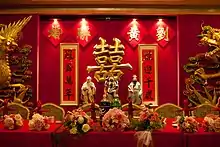
Ideogrammic compound (會意/会意) : 喜 + 喜 (“happiness”). Duplication of 喜, the two characters representing the bride and groom.
Pronunciation
References
- "Polysyllabic characters revisited", Victor Mair, Language Log
Japanese
Related terms
- 双喜紋 (sōkimon)
Korean
Hanja
囍 • (hui) (hangeul 희, revised hui, McCune–Reischauer hŭi)
- Symbol of marriage between a man and a woman; double happiness
Vietnamese
Han character
囍: Hán Nôm readings: hỉ, song hỉ
- This term needs a translation to English. Please help out and add a translation, then remove the text
{{rfdef}}.
References
This article is issued from Wiktionary. The text is licensed under Creative Commons - Attribution - Sharealike. Additional terms may apply for the media files.