喜
| ||||||||
Translingual
| Stroke order | |||
|---|---|---|---|
 | |||
Han character
喜 (Kangxi radical 30, 口+9, 12 strokes, cangjie input 土口廿口 (GRTR), four-corner 40601, composition ⿱壴口)
References
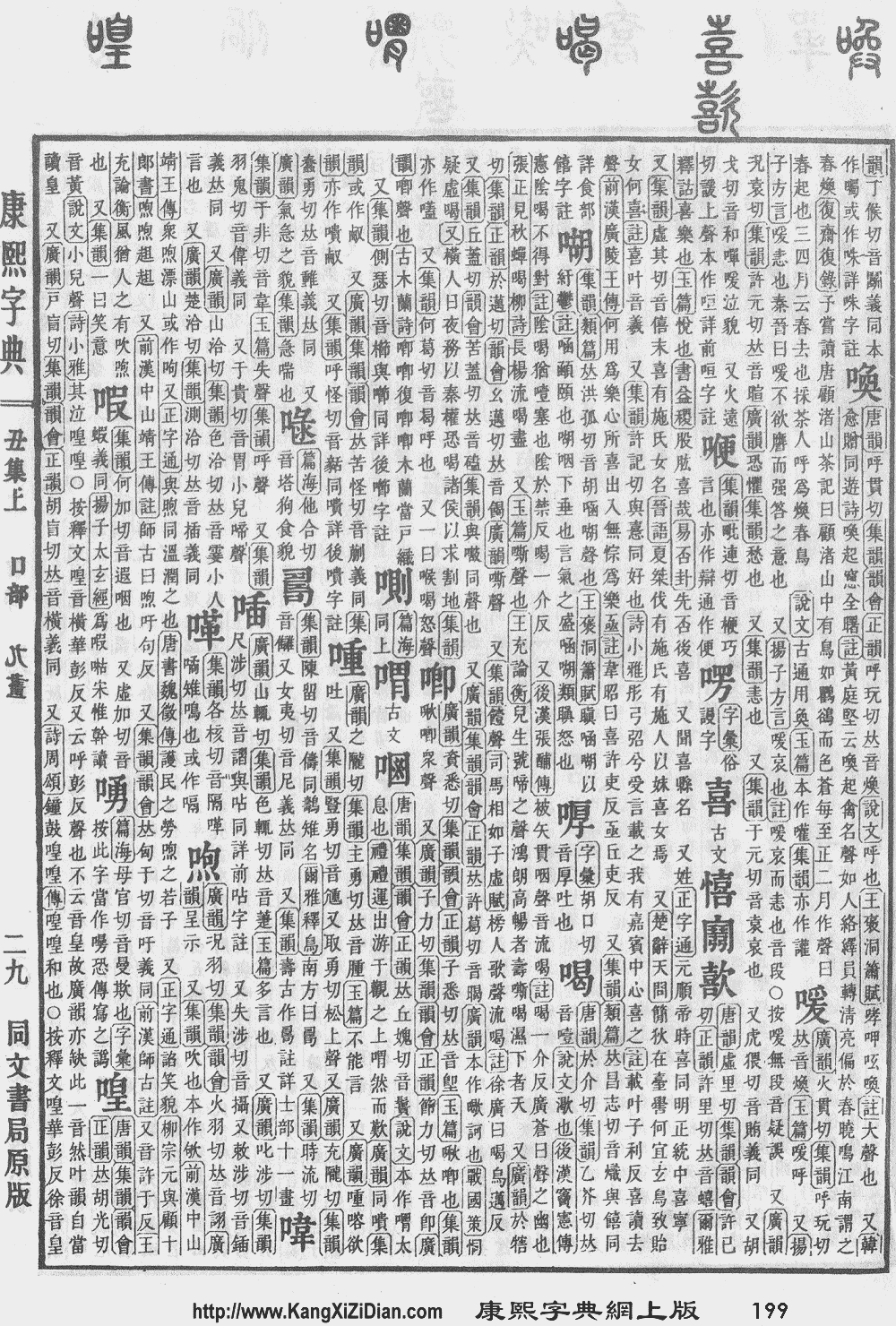
- Kangxi Dictionary: page 199, character 5
- Dai Kanwa Jiten: character 3957
- Dae Jaweon: page 420, character 29
- Hanyu Da Zidian (first edition): volume 1, page 649, character 2
- Unihan data for U+559C
Chinese
| simp. and trad. |
喜 | |
|---|---|---|
| 2nd round simp. | ⿳士䒑口 | |
| alternative forms | 憙 to enjoy | |
Glyph origin
| Historical forms of the character 喜 | |||
|---|---|---|---|
| Shang | Western Zhou | Shuowen Jiezi (compiled in Han) | Liushutong (compiled in Ming) |
| Oracle bone script | Bronze inscriptions | Small seal script | Transcribed ancient scripts |
 |
 |
 |
 |
Characters in the same phonetic series (喜) (Zhengzhang, 2003)
Ideogrammic compound (會意/会意) : 壴 (“drum”) + 口 (“mouth”).
Duplicated character: 囍.
Pronunciation 1
Definitions
喜
- happy; pleased; joyful
- joyful; worth celebrating
- joyful thing; happy event
- pregnancy
- (dated, euphemistic) variola; smallpox
- to be fond of; to like; to love; to enjoy
- (of an organism) to need; to require
- 仙人掌喜充足陽光,耐旱不耐寒,喜排水良好的砂質壤土。 [MSC, trad.]
- From: 彭光途, 陆家怡, 梅慧敏 (1987) 花卉栽培技术, Beijing: 中国林业出版社, →ISBN, page 177
- Xiānrénzhǎng xǐ chōngzú yángguāng, nàihàn bù nàihán, xǐ páishuǐ liánghǎo de shā zhì rǎngtǔ. [Pinyin]
- (please add an English translation of this usage example)
仙人掌喜充足阳光,耐旱不耐寒,喜排水良好的砂质壤土。 [MSC, simp.]
- (literary) to be prone to
- a surname
Pronunciation 2
Pronunciation 3
| For pronunciation and definitions of 喜 – see 饎 (“food; to cook”). (This character is a variant form of 饎). |
Compounds
- 不喜
- 乖覺可喜/乖觉可喜 (guāijuékěxǐ)
- 人間喜劇/人间喜剧
- 兜喜神方
- 出閣之喜/出阁之喜
- 勿藥有喜/勿药有喜
- 千歡萬喜/千欢万喜
- 厭舊喜新/厌旧喜新
- 又驚又喜/又惊又喜 (yòujīngyòuxǐ)
- 取喜
- 可喜 (kěxǐ)
- 可喜可賀/可喜可贺 (kěxǐkěhè)
- 可喜娘
- 吃喜
- 同喜
- 吃喜酒
- 吵喜
- 喜上眉梢 (xǐshàngméishāo)
- 喜不自勝/喜不自胜
- 喜不自禁
- 喜事 (xǐshì)
- 喜信 (xǐxìn)
- 喜兆
- 喜出望外 (xǐchūwàngwài)
- 喜劇/喜剧 (xǐjù)
- 喜劇人物/喜剧人物
- 喜劇形象/喜剧形象
- 喜劇片/喜剧片
- 喜劇電影/喜剧电影
- 喜功
- 喝喜酒
- 喜地歡天/喜地欢天
- 喜堂
- 喜報/喜报 (xǐbào)
- 喜好 (xǐhào)
- 喜娘 (xǐniáng)
- 喜孜孜 (xǐzīzī)
- 喜客
- 喜宴 (xǐyàn)
- 喜容
- 喜峰口
- 喜帖 (xǐtiě)
- 喜幛
- 喜形於色/喜形于色
- 喜得 (xǐdé)
- 喜從天降/喜从天降
- 喜怒哀樂/喜怒哀乐 (xǐnù'āilè)
- 喜怒無常/喜怒无常 (xǐnùwúcháng)
- 喜悅/喜悦 (xǐyuè)
- 喜愛/喜爱 (xǐ'ài)
- 喜感 (xǐgǎn)
- 喜慶/喜庆 (xǐqìng)
- 喜房
- 喜新厭故/喜新厌故
- 喜新厭舊/喜新厌旧 (xǐxīnyànjiù)
- 喜服
- 喜果 (xǐguǒ)
- 喜極而泣/喜极而泣 (xǐjí'érqì)
- 喜樂/喜乐 (xǐlè)
- 喜歌劇/喜歌剧 (xǐgējù)
- 喜歡/喜欢
- 喜氣/喜气 (xǐqì)
- 喜氣旺色/喜气旺色
- 喜氣洋洋/喜气洋洋 (xǐqìyángyáng)
- 喜洽
- 喜洋洋 (xǐyángyáng)
- 喜當爹/喜当爹 (xǐdāngdiē)
- 喜病
- 喜眉笑眼
- 喜神
- 喜笑
- 喜笑顏開/喜笑颜开 (xǐxiàoyánkāi)
- 喜筵 (xǐyán)
- 喜糖 (xǐtáng)
- 喜聞樂見/喜闻乐见 (xǐwénlèjiàn)
- 喜聯/喜联
- 喜脈/喜脉 (xǐmài)
- 喜色 (xǐsè)
- 喜花
- 喜蟲兒/喜虫儿
- 喜訊/喜讯 (xǐxùn)
- 喜躍/喜跃 (xǐyuè)
- 喜躍抃舞/喜跃抃舞
- 喜逐顏開/喜逐颜开
- 喬遷之喜/乔迁之喜 (qiáoqiānzhīxǐ)
- 喜酒 (xǐjiǔ)
- 喜錢/喜钱 (xǐqián)
- 喜雨 (xǐyǔ)
- 喜雪 (xǐxuě)
- 喜餅/喜饼
- 喜鵲/喜鹊 (xǐquè)
- 喜鵲叫吉/喜鹊叫吉
- 四喜
- 四喜袋
- 回嗔作喜 (huíchēn zuòxǐ)
- 報喜/报喜 (bàoxǐ)
- 報喜人/报喜人
- 夢熊之喜/梦熊之喜
- 大喜 (dàxǐ)
- 大喜事
- 大喜若狂
- 大喜過望/大喜过望 (dàxǐguòwàng)
- 大四喜 (dàsìxǐ)
- 天喜
- 好大喜功 (hàodàxǐgōng)
- 婚喪喜慶/婚丧喜庆 (hūnsāngxǐqìng)
- 宜喜宜嗔
- 宜嗔宜喜
- 害喜 (hàixǐ)
- 小喜
- 幸喜 (xìngxǐ)
- 弄璋之喜 (nòngzhāngzhīxǐ)
- 弄瓦之喜 (nòngwǎzhīxǐ)
- 忻喜 (xīnxǐ)
- 忽喜忽憂/忽喜忽忧
- 恭喜 (gōngxǐ)
- 恭喜發財/恭喜发财 (gōngxǐ fācái)
- 悲喜 (bēixǐ)
- 悲喜交切
- 悲喜交加
- 悲喜交并
- 悲喜交至
- 悲喜交集 (bēixǐ-jiāojí)
- 悲喜兼集
- 悲喜劇/悲喜剧 (bēixǐjù)
- 意念喜劇/意念喜剧
- 慶喜/庆喜
- 憂喜交集/忧喜交集 (yōuxǐ jiāojí)
- 憂喜參半/忧喜参半
- 懽喜/欢喜
- 新喜
- 新喜劇/新喜剧
- 暗喜 (ànxǐ)
- 暗自竊喜/暗自窃喜
- 有喜 (yǒuxǐ)
- 欣喜 (xīnxǐ)
- 欣喜若狂 (xīnxǐruòkuáng)
- 欣喜雀躍/欣喜雀跃 (xīnxǐ quèyuè)
- 欣然自喜
- 歡喜/欢喜 (huānxǐ)
- 歡喜佛/欢喜佛 (huānxǐfó)
- 歡喜冤家/欢喜冤家
- 歡喜若狂/欢喜若狂 (huānxǐruòkuáng)
- 歡喜錢兒/欢喜钱儿
- 歡天喜地/欢天喜地 (huāntiānxǐdì)
- 歡歡喜喜/欢欢喜喜
- 沖喜/冲喜 (chōngxǐ)
- 法喜
- 沾沾自喜 (zhānzhānzìxǐ)
- 洋洋喜氣/洋洋喜气
- 滂喜篇
- 滿心歡喜/满心欢喜
- 燕喜
- 狂喜 (kuángxǐ)
- 白喜草
- 白四喜兒/白四喜儿
- 皆大歡喜/皆大欢喜 (jiēdàhuānxǐ)
- 空歡喜/空欢喜 (kōng huānxǐ)
- 竊喜/窃喜 (qièxǐ)
- 聞喜宴/闻喜宴
- 聞過則喜/闻过则喜
- 聞過色喜/闻过色喜
- 見喜/见喜
- 見獵心喜/见猎心喜 (jiànlièxīnxǐ)
- 見而色喜/见而色喜
- 討喜/讨喜 (tǎoxǐ)
- 誌喜/志喜
- 賀喜/贺喜 (hèxǐ)
- 賀喜撮空/贺喜撮空
- 轉悲為喜/转悲为喜
- 轉愁為喜/转愁为喜
- 轉憂成喜/转忧成喜
- 轉憂為喜/转忧为喜
- 道喜 (dàoxǐ)
- 隨喜/随喜 (suíxǐ)
- 雙喜/双喜 (shuāngxǐ)
- 雙喜臨門/双喜临门 (shuāngxǐlínmén)
- 驕矜自喜/骄矜自喜
- 驚喜/惊喜 (jīngxǐ)
- 驚喜交加/惊喜交加
- 黑色喜劇/黑色喜剧
Japanese
See also
- 㐂 (non-standard variant for this character)
Etymology 2
| Kanji in this term |
|---|
| 喜 |
| き Grade: 5 |
| on’yomi |
Pronunciation
- IPA(key): [kʲi]
Korean
Vietnamese
Han character
喜: Hán Nôm readings: hỉ, hỷ, hẻ, hởi
- This term needs a translation to English. Please help out and add a translation, then remove the text
{{rfdef}}.
References
- Nom Foundation
- Thiều Chửu : Hán Việt Tự Điển Hà Nội 1942
- Trần Văn Chánh: Từ Điển Hán Việt NXB Trẻ, Ho Chi Minh Ville, 1999
- Vũ Văn Kính: Đại Tự Điển Chữ Nôm, NXB Văn Nghệ, Ho Chi Minh Ville, 1999
This article is issued from Wiktionary. The text is licensed under Creative Commons - Attribution - Sharealike. Additional terms may apply for the media files.