垣

垣 U+57A3, 垣
CJK UNIFIED IDEOGRAPH-57A3
← 垢
[U+57A2]
CJK Unified Ideographs 垤 →
[U+57A4]

Translingual

Han character

Stroke order
9 strokes

垣 (Kangxi radical 32, 土+6, 9 strokes, cangjie input 土一日一 (GMAM), four-corner 41116, composition ⿰土亘)

  1. low wall

Derived characters

  • 𭈲, 𭝧

References

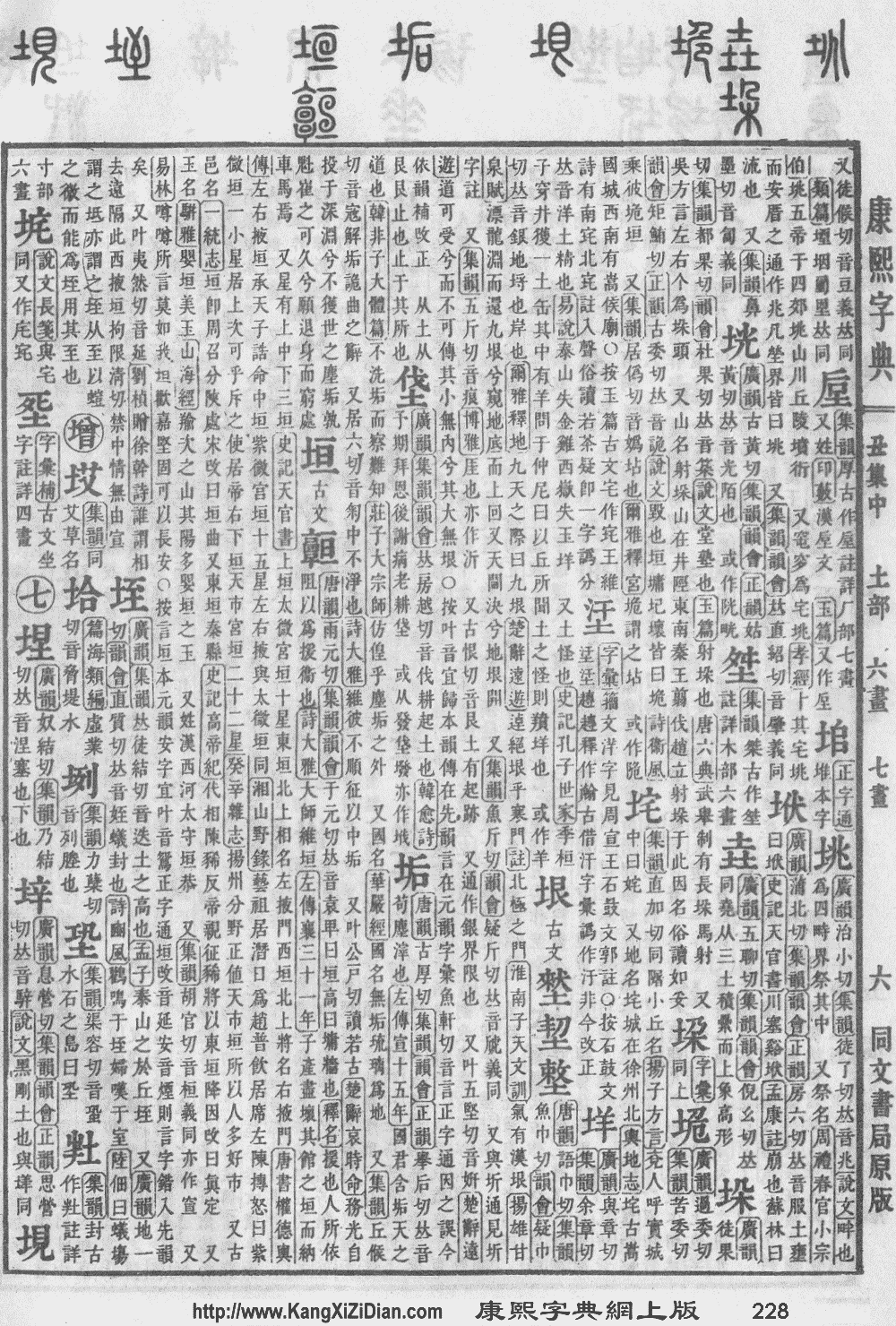
  • Kangxi Dictionary: page 228, character 20
  • Dai Kanwa Jiten: character 5060
  • Dae Jaweon: page 464, character 17
  • Hanyu Da Zidian (first edition): volume 1, page 437, character 11
  • Unihan data for U+57A3

Chinese

simp. and trad.
垣

Glyph origin

Historical forms of the character 垣
Warring States Shuowen Jiezi (compiled in Han) Liushutong (compiled in Ming)
Bronze inscriptions Small seal script Transcribed ancient scripts

Phono-semantic compound (形聲/形声, OC *ɢʷan) : semantic 土 (“earth”) + phonetic 亘 ().

Pronunciation


Rime
Character 垣
Reading # 1/1
Initial (聲) 云 (35)
Final (韻) 元 (66)
Tone (調) Level (Ø)
Openness (開合) Closed
Division (等) III
Fanqie 雨元切
Baxter hjwon
Reconstructions
Zhengzhang
Shangfang
/ɦʉɐn/
Pan
Wuyun
/ɦʷiɐn/
Shao
Rongfen
/ɣiuɐn/
Edwin
Pulleyblank
/ɦuan/
Li
Rong
/ɣiuɐn/
Wang
Li
/ɣĭwɐn/
Bernard
Karlgren
/i̯wɐn/
Expected
Mandarin
Reflex
yuán
Expected
Cantonese
Reflex
jyun4
Baxter–Sagart system 1.1 (2014)
Character 垣
Reading # 1/1
Modern
Beijing
(Pinyin)
yuán
Middle
Chinese
‹ hjwon ›
Old
Chinese
/*[ɢ]ʷar/
English wall

Notes for Old Chinese notations in the Baxter–Sagart system:

* Parentheses "()" indicate uncertain presence;
* Square brackets "[]" indicate uncertain identity, e.g. *[t] as coda may in fact be *-t or *-p;
* Angle brackets "<>" indicate infix;
* Hyphen "-" indicates morpheme boundary;

* Period "." indicates syllable boundary.
Zhengzhang system (2003)
Character 垣
Reading # 1/1
No. 14017
Phonetic
component
亘
Rime
group
元
Rime
subdivision
1
Corresponding
MC rime
袁
Old
Chinese
/*ɢʷan/

Definitions

垣

  1. wall
  2. city
  3. (astronomy) enclosure

Compounds

  • 三垣
  • 垝垣
  • 城垣 (chéngyuán)
  • 垣墉 (yuányōng)
  • 垣牆/垣墙
  • 垣衣
  • 堧垣
  • 女垣
  • 宸垣
  • 寒垣
  • 屬垣/属垣
  • 屬垣有耳/属垣有耳
  • 張垣/张垣 (Zhāngyuán)
  • 掖垣
  • 敗宇頹垣/败宇颓垣
  • 新垣 (xīnyuán)
  • 斷井頹垣/断井颓垣
  • 斷垣殘壁/断垣残壁 (duànyuáncánbì)
  • 斷壁殘垣/断壁残垣 (duànbìcányuán)
  • 斷壁頹垣/断壁颓垣
  • 殘垣敗壁/残垣败壁
  • 泥垣宮/泥垣宫
  • 牆垣/墙垣 (qiángyuán)
  • 省垣
  • 短垣自逾
  • 破屋壞垣/破屋坏垣
  • 破瓦頹垣/破瓦颓垣
  • 籬垣/篱垣
  • 粉垣
  • 補垣塞穴/补垣塞穴
  • 襄垣縣/襄垣县
  • 西垣
  • 踰垣/逾垣
  • 鑽穴踰垣/钻穴逾垣
  • 陳垣/陈垣

Japanese

Alternative forms

Kanji

垣

(common “Jōyō” kanji)

Readings

Etymology

Kanji in this term
垣
かき
Grade: S
kun’yomi

(This etymology is missing or incomplete. Please add to it, or discuss it at the Etymology scriptorium.)

Pronunciation

  • (Tokyo) かき​ [kàkíꜜ] (Odaka – [2])[1]
  • IPA(key): [ka̠kʲi]

Noun

垣(かき) • (kaki) 

  1. fence

See also

References

  1. Matsumura, Akira, editor (2006), 大辞林 [Daijirin] (in Japanese), Third edition, Tōkyō: Sanseidō, →ISBN

Vietnamese

Han character

垣: Hán Nôm readings: viên

  1. This term needs a translation to English. Please help out and add a translation, then remove the text {{rfdef}}.
This article is issued from Wiktionary. The text is licensed under Creative Commons - Attribution - Sharealike. Additional terms may apply for the media files.