复
| ||||||||
Translingual
| Stroke order | |||
|---|---|---|---|
 | |||
Han character
复 (Kangxi radical 35, 夊+6, 9 strokes, cangjie input 人日竹水 (OAHE), four-corner 80407, composition ⿱𭥍夂(GHJV) or ⿱𭥍夊(T))
References
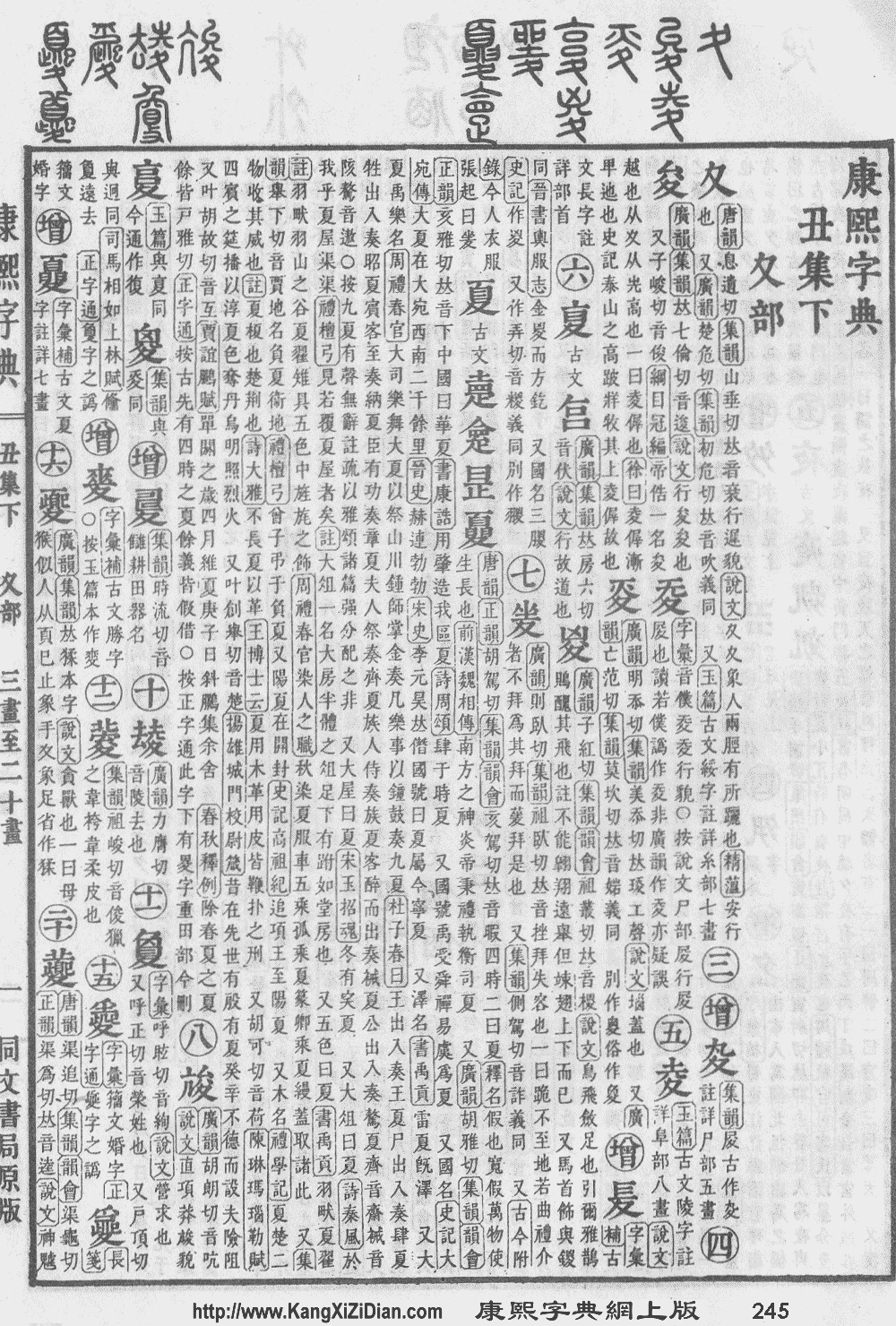
- Kangxi Dictionary: not present, would follow page 245, character 10
- Hanyu Da Zidian (first edition): volume 2, page 869, character 6
- Unihan data for U+590D
Chinese
Glyph origin
| Historical forms of the character 复 | ||||
|---|---|---|---|---|
| Shang | Western Zhou | Warring States | Shuowen Jiezi (compiled in Han) | Liushutong (compiled in Ming) |
| Oracle bone script | Bronze inscriptions | Chu slip and silk script | Small seal script | Transcribed ancient scripts |
 |
 |
 |
 |
 |
Pronunciation
Etymology 2
| For pronunciation and definitions of 复 – see 復 (“to return; to recover; to resume; etc.”). (This character is the simplified form of 復). |
Notes:
|
Etymology 3
| For pronunciation and definitions of 复 – see 複 (“lined garment; to repeat; to double; to overlap; etc.”). (This character is the simplified form of 複). |
Notes:
|
Definitions
| For pronunciation and definitions of 复 – see 覆 (“to cover; to tip over; to overturn; to flip over; etc.”). (This character is the former (1964–1986) first-round simplified form of 覆). |
Notes:
|
Usage notes
覆 was officially simplified to 复 in 1964–1986, but now it only simplifies to 复 in the meaning of "to return; to reply", e.g. 答覆/答复 (dáfù), 反覆/反复 (fǎnfù), and 回覆/回复 (huífù). In other meanings, 覆 no longer simplifies to 复, e.g. 翻覆 (fānfù), 覆蓋/覆盖 (fùgài), 顛覆/颠覆 (diānfù), 傾覆/倾覆 (qīngfù), and 覆轍/覆辙 (fùzhé).
Korean
Vietnamese
This article is issued from Wiktionary. The text is licensed under Creative Commons - Attribution - Sharealike. Additional terms may apply for the media files.