伏
| ||||||||
Translingual
| Stroke order | |||
|---|---|---|---|
 | |||
Han character
伏 (Kangxi radical 9, 人+4, 6 strokes, cangjie input 人戈大 (OIK), four-corner 23234, composition ⿰亻犬)
References
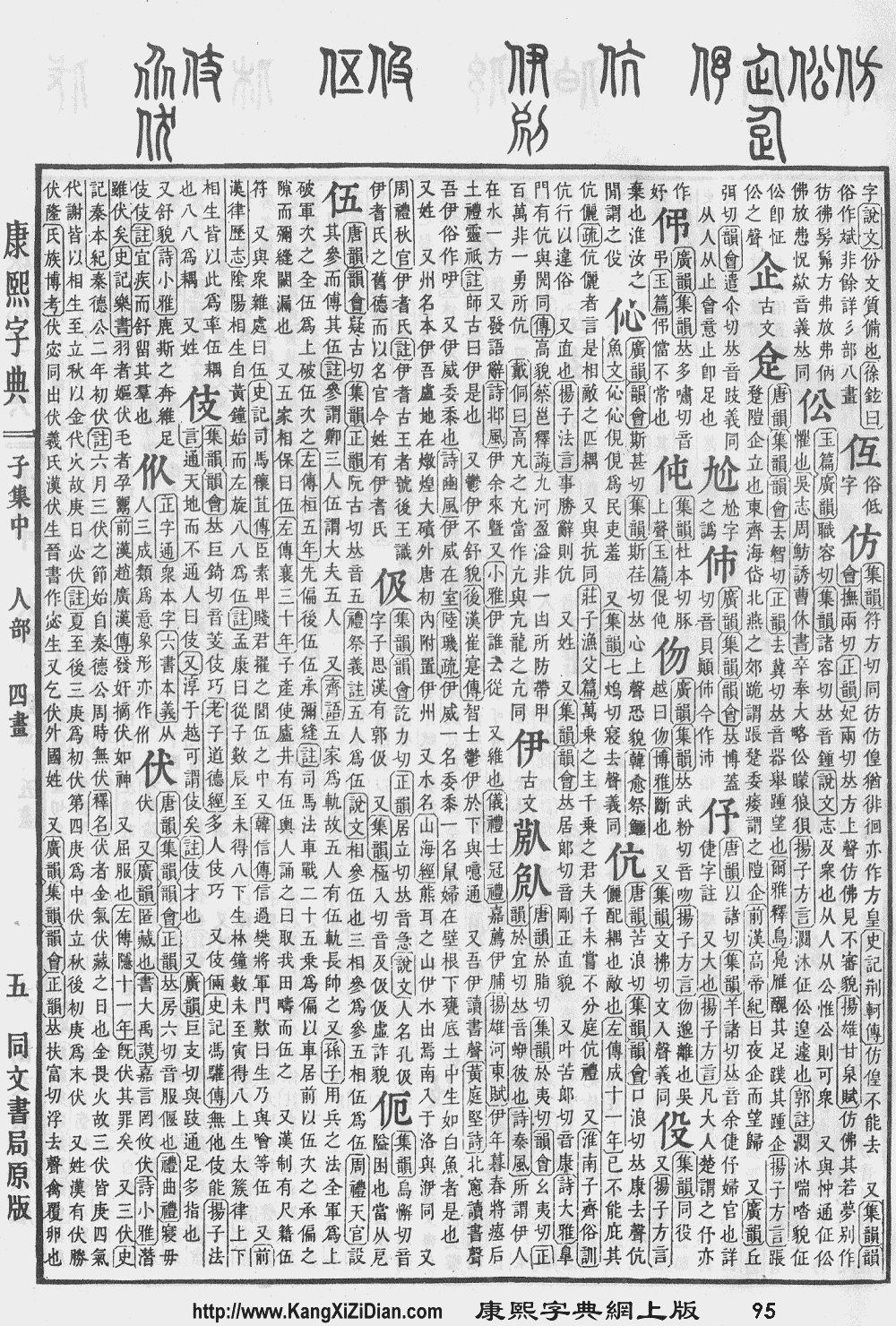
- Kangxi Dictionary: page 95, character 23
- Dai Kanwa Jiten: character 438
- Dae Jaweon: page 202, character 7
- Hanyu Da Zidian (first edition): volume 1, page 119, character 4
- Unihan data for U+4F0F
Chinese
| simp. and trad. |
伏 | |
|---|---|---|
Glyph origin
| Historical forms of the character 伏 | |||||||||||||||||||||
|---|---|---|---|---|---|---|---|---|---|---|---|---|---|---|---|---|---|---|---|---|---|
| Western Zhou | Warring States | Shuowen Jiezi (compiled in Han) | Liushutong (compiled in Ming) | ||||||||||||||||||
| Bronze inscriptions | Chu slip and silk script | Qin slip script | Small seal script | Transcribed ancient scripts | |||||||||||||||||
 |
 |
 |
 |
 | |||||||||||||||||
||||
|
References: Mostly from Richard Sears' Chinese Etymology site (authorisation),
| |||||||||||||||||||||


Characters in the same phonetic series (伏) (Zhengzhang, 2003)
Ideogrammic compound (會意/会意) : 人 (“person”) + 犬 (“dog”) – meaning “prostrate”.
- A dog at the side of a person.
- A person adopting the position of a dog.
Pronunciation 1
Definitions
伏
- to lie prostrate
- to crouch; to crawl
- to ambush; to lie hidden
- to hide; to conceal
- to surrender; to yield
- to accept; to submit; to bear; to endure
- to subdue
- to go down; to fall down
- to remain; to wait for
- to remove
- 屠羊說曰:「大王失國,非臣之罪,故不敢伏其誅;大王反國,非臣之功,故不敢當其賞。」 [Classical Chinese, trad.]
- From: Zhuangzi, circa 3rd – 2nd centuries BCE
- Tú yáng Yuè yuē: “Dàiwang shī guó, fēi chén zhī zuì, gù bùgǎn fú qí zhū; dàiwang fǎn guó, fēi chén zhī gōng, gù bùgǎn dāng qí shǎng.” [Pinyin]
- (please add an English translation of this usage example)
屠羊说曰:「大王失国,非臣之罪,故不敢伏其诛;大王反国,非臣之功,故不敢当其赏。」 [Classical Chinese, simp.]
- residence
- hottest days of summer
- (Hong Kong Cantonese) below expectation; worse than anticipated; trappy
- Synonym: 雷 (léi) (Mandarin)
- (obsolete) horizontal wooden bar in front of a carriage chair
- Short for 伏特 (fútè, “volt”).
- Alternative form of 服
- a surname: Fu
Synonyms
- (to hide):
- 匿藏 (nìcáng)
- 埋
- 埋藏 (máicáng) (figuratively)
- 暗囥 (Hokkien, Teochew)
- 暗藏 (àncáng)
- 潛藏/潜藏 (qiáncáng)
- 竄/窜 (cuàn) (literary, or in compounds)
- 竄匿/窜匿 (cuànnì)
- 藏蹤/藏踪 (cángzōng)
- 藏身 (cángshēn)
- 藏躲 (cángduǒ)
- 覕囥/𰴕囥 (Hokkien)
- 走覕/走𰴕 (Xiamen Hokkien, Zhangzhou Hokkien, Taiwanese Hokkien)
- 走閃/走闪 (Min Nan)
- 躲藏 (duǒcáng)
- 躲避 (duǒbì)
- 逃 (táo)
- 逃匿 (táonì)
- 迴避/回避 (huíbì)
- 逃避 (táobì)
- 避諱/避讳 (bìhuì) (colloquial)
- 閃覕/闪𰴕 (Min Nan)
- 隱秘/隐秘 (yǐnmì)
- 隱蔽/隐蔽 (yǐnbì)
- 隱藏/隐藏 (yǐncáng)
- 隱覕/隐𰴕 (ín-bih, ún-bih) (Min Nan)
- 隱避/隐避 (yǐnbì)
- (hottest days of summer): 伏天 (fútiān)
Compounds
- 下伏
- 三伏 (sānfú)
- 三伏天 (sānfútiān)
- 三伏潭 (Sānfútán)
- 不伏
- 不伏手
- 不伏水土
- 不伏燒埋/不伏烧埋
- 不伏老
- 不甘雌伏
- 中伏 (zhōngfú)
- 乞伏
- 二伏
- 伏下 (fúxià)
- 伏不是
- 伏乞
- 伏事 (fúshì)
- 伏伺
- 伏低
- 伏位
- 伏低做小
- 伏侍
- 伏兵 (fúbīng)
- 伏几
- 伏劍/伏剑
- 伏匿
- 伏善
- 伏地 (fúdì)
- 伏地扣子
- 伏地挺身 (fúdì tǐngshēn)
- 伏地聖人/伏地圣人
- 伏天 (fútiān)
- 伏尸
- 伏尸流血
- 伏屍/伏尸
- 伏席
- 伏惟 (fúwéi)
- 伏想
- 伏手
- 伏打電池/伏打电池
- 伏擊/伏击 (fújī)
- 伏日
- 伏旱
- 伏暑
- 伏望
- 伏枕
- 伏案 (fú'àn)
- 伏櫪/伏枥
- 伏櫪守株/伏枥守株
- 伏櫪老驥/伏枥老骥
- 伏死
- 伏氣/伏气
- 伏水
- 伏汛
- 伏法 (fúfǎ)
- 伏波
- 伏流 (fúliú)
- 伏特 (fútè)
- 伏特加 (fútèjiā)
- 伏特計/伏特计 (fútèjì)
- 伏犧/伏牺 (Fúxī)
- 伏犧氏/伏牺氏
- 伏狀/伏状
- 伏獵/伏猎
- 伏甲 (fújiǎ)
- 伏眾/伏众
- 伏礁
- 伏祈
- 伏禮/伏礼
- 伏竄/伏窜
- 伏筆/伏笔 (fúbǐ)
- 伏維尚饗/伏维尚飨
- 伏罪 (fúzuì)
- 伏羲 (Fúxī)
- 伏羲氏
- 伏翼
- 伏聞/伏闻
- 伏肉
- 伏臘/伏腊
- 伏莽
- 伏落
- 伏藏
- 伏虎擒龍/伏虎擒龙
- 伏虎降龍/伏虎降龙
- 伏行
- 伏見/伏见 (Fújiàn)
- 伏誅/伏诛 (fúzhū)
- 伏謁/伏谒
- 伏讀/伏读
- 伏貼/伏贴
- 伏路 (fúlù)
- 伏身
- 伏軍/伏军 (fújūn)
- 伏軾/伏轼
- 伏輸/伏输 (fúshū)
- 伏辯/伏辩
- 伏願/伏愿
- 伏首貼耳/伏首贴耳
- 伏魔大帝
- 伏龍鳳雛/伏龙凤雏
- 倒伏
- 俯伏 (fǔfú)
- 倚伏
- 倒心伏計/倒心伏计
- 做小伏低
- 入伏 (rùfú)
- 准伏
- 初伏
- 制伏 (zhìfú)
- 加伏特
- 匍伏 (púfú)
- 匿伏 (nìfú)
- 十面埋伏 (shímiànmáifú)
- 危機四伏/危机四伏 (wēijīsìfú)
- 四伏 (sìfú)
- 埋伏 (máifú)
- 報伏/报伏
- 塌伏
- 夜行晝伏/夜行昼伏
- 姦伏/奸伏
- 嫗伏/妪伏
- 安伏
- 帖伏
- 干伏
- 平伏
- 廋伏
- 待伏
- 心伏口伏
- 愆伏
- 慴伏/慑伏
- 所伏
- 扶伏 (púfú)
- 扶伏 (púfú)
- 招伏
- 拱伏
- 按家伏業/按家伏业
- 搭伏
- 搭伏定
- 摘伏發隱/摘伏发隐
- 摘奸發伏
- 擒伏
- 擒奸摘伏
- 擒姦擿伏/擒奸擿伏
- 擿伏
- 擿奸發伏
- 攝伏/摄伏
- 收伏 (shōufú)
- 數伏/数伏 (shǔfú)
- 敵後伏擊/敌后伏击
- 於伏/于伏
- 晝伏/昼伏
- 晝伏夜出/昼伏夜出 (zhòufúyèchū)
- 晝伏夜游/昼伏夜游
- 暑伏
- 曉伏夜行/晓伏夜行
- 末伏
- 此起彼伏 (cǐqǐbǐfú)
- 歲時伏臘/岁时伏腊
- 水土不伏
- 沉伏
- 滯伏/滞伏
- 潛伏/潜伏 (qiánfú)
- 潛伏分子/潜伏分子
- 潛伏感染/潜伏感染
- 潛伏期/潜伏期 (qiánfúqī)
- 潛龍伏虎/潜龙伏虎
- 煦伏
- 狐憑鼠伏/狐凭鼠伏
- 狐潛鼠伏/狐潜鼠伏
- 獸伏/兽伏
- 甘伏
- 畫伏狀/画伏状
- 發奸擿伏
- 發姦擿伏/发奸擿伏
- 發擿姦伏/发擿奸伏
- 發隱擿伏/发隐擿伏
- 神欽鬼伏/神钦鬼伏
- 禍福倚伏/祸福倚伏
- 竄伏/窜伏
- 終伏/终伏
- 綿延起伏/绵延起伏
- 老驥伏櫪/老骥伏枥 (lǎojìfúlì)
- 蒲伏 (púfú)
- 蜷伏
- 蟄伏/蛰伏 (zhéfú)
- 觳觫伏罪
- 設伏/设伏
- 誘伏/诱伏
- 請伏/请伏
- 赤伏符
- 起伏 (qǐfú)
- 起伏不平
- 跧伏
- 跪伏 (guìfú)
- 踡伏
- 連綿起伏/连绵起伏
- 降伏 (xiángfú)
- 降龍伏虎/降龙伏虎
- 陰伏/阴伏
- 隱伏/隐伏
- 雌伏
- 頭伏/头伏
- 馴伏/驯伏
- 高低起伏
- 龍虎並伏/龙虎并伏
Pronunciation 2
Definitions
伏
- (archaic or dialectal) to hatch
- 伏小雞/伏小鸡 [Shanghainese] ― 6bu 5shiau-ci [Wugniu] ― to hatch chicks
Compounds
- 伏卵
- 伏抱
- 伏雌
- 伏雞/伏鸡
Etymology 2
| For pronunciation and definitions of 伏 – see 復 (“to return; to recover; to resume; etc.”). (This character is a variant form of 復). |
Etymology 3
| For pronunciation and definitions of 伏 – see 負 (“to carry; to bear; to rely on; to load; to burden; etc.”). (This character is a variant form of 負). |
Etymology 4
| For pronunciation and definitions of 伏 – see 袱. (This character is the second-round simplified form of 袱). |
Notes:
|
Etymology 5
| For pronunciation and definitions of 伏 – see 匐. (This character is the second-round simplified form of 匐). |
Notes:
|
Japanese
Korean
Vietnamese
This article is issued from Wiktionary. The text is licensed under Creative Commons - Attribution - Sharealike. Additional terms may apply for the media files.