尙
See also: 尚
| ||||||||
Translingual
| Traditional | 尚 |
|---|---|
| Simplified | 尚 |
| Japanese | 尚 |
| Korean | 尙 |
Alternative forms
Han character
尙 (Kangxi radical 42, 小+5, 8 strokes, cangjie input 火月口 (FBR) or 難難火月口 (XXFBR), composition ⿱小冋)
Derived characters
- 𭯝 𮞢 𭉢
References
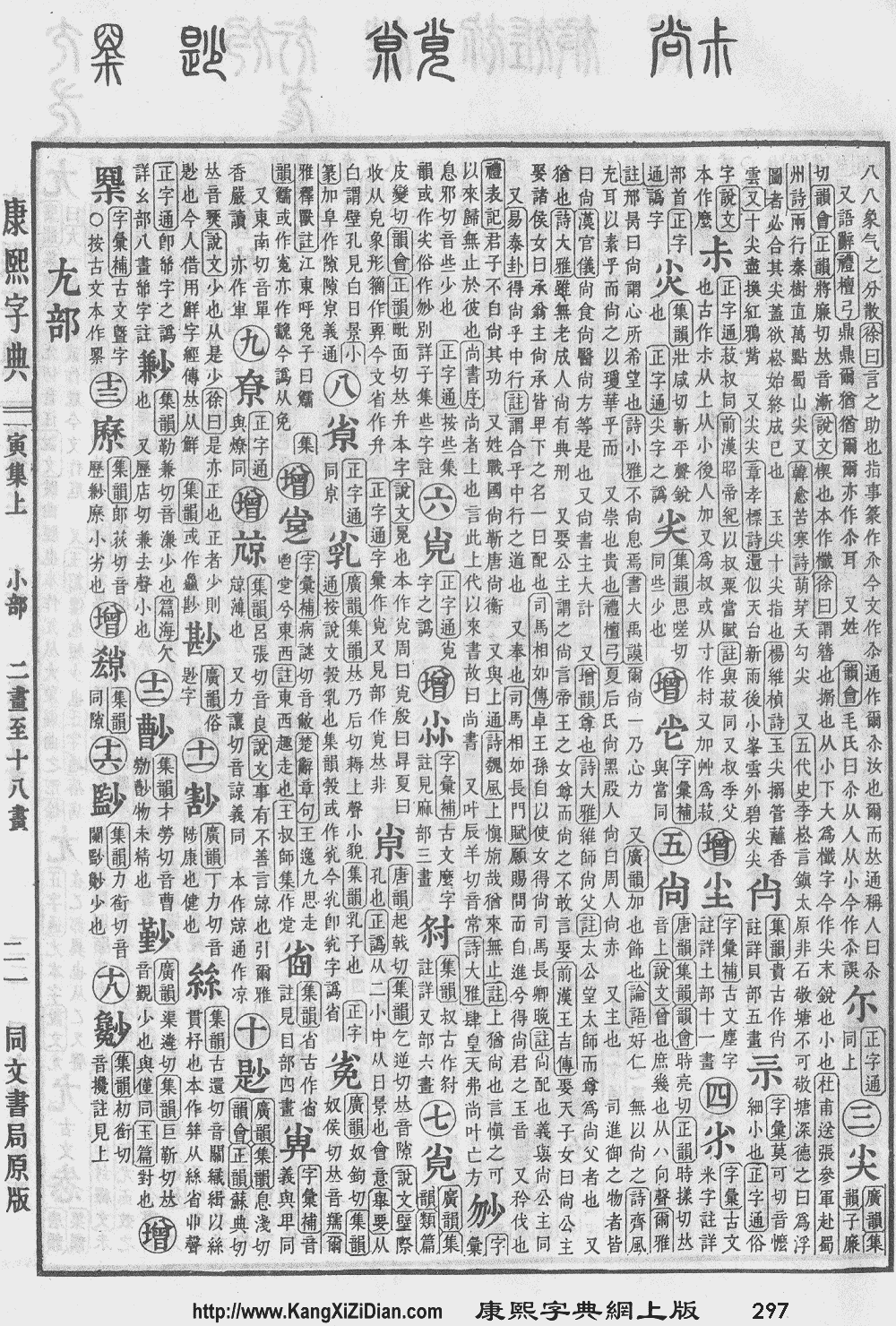
- Kangxi Dictionary: page 297, character 11
- Dai Kanwa Jiten: character 7493
- Hanyu Da Zidian (first edition): volume 1, page 563, character 5
- Unihan data for U+5C19
Chinese
Japanese
| 尚 | |
| 尙 |
Kanji
尙
Readings
- Go-on: じょう (jō)←じやう (zyau, historical)
- Kan-on: しょう (shō)←しやう (syau, historical)
- Kun: たっとぶ (tattobu, 尙ぶ); とうとぶ (tōtobu, 尙ぶ)←たふとぶ (tafutobu, 尙ぶ, historical); なお (nao, 尙)←なほ (nafo, 尙, historical)
Korean
Hanja
尙 • (sang) (hangeul 상, revised sang, McCune–Reischauer sang)
- This term needs a translation to English. Please help out and add a translation, then remove the text
{{rfdef}}.
Vietnamese
Han character
尙: Hán Nôm readings: thượng, chuộng, sượng, thằng
- This term needs a translation to English. Please help out and add a translation, then remove the text
{{rfdef}}.
References
This article is issued from Wiktionary. The text is licensed under Creative Commons - Attribution - Sharealike. Additional terms may apply for the media files.