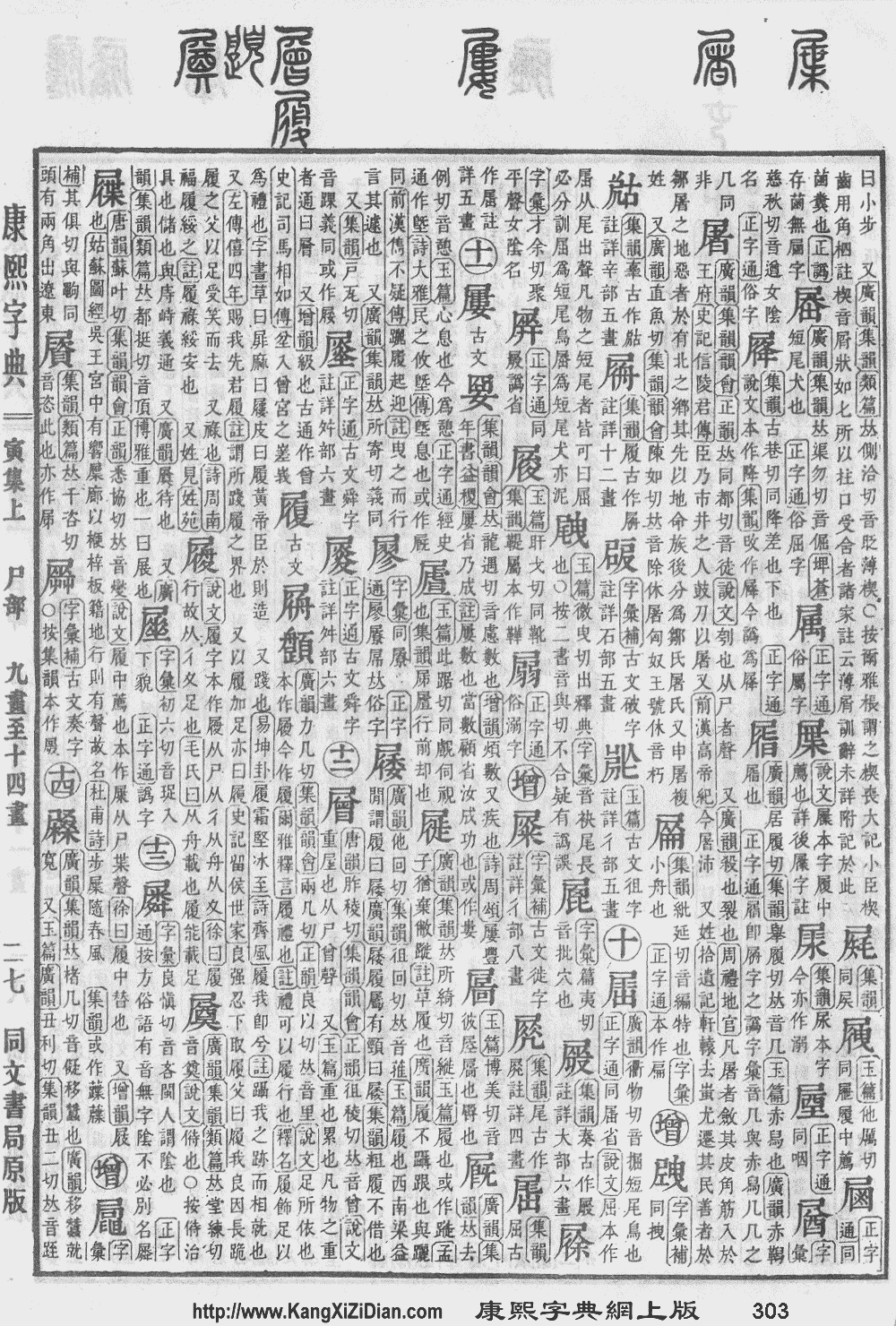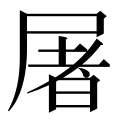
屠

屠 U+5C60, 屠
CJK UNIFIED IDEOGRAPH-5C60
← 屟
[U+5C5F]
CJK Unified Ideographs 屡 →
[U+5C61]

屠 U+2F877, 屠
CJK COMPATIBILITY IDEOGRAPH-2F877
← 㞁
[U+2F876]
CJK Compatibility Ideographs Supplement 屮 →
[U+2F878]

Translingual

Han character

屠 (Kangxi radical 44, 尸+9, 12 strokes, cangjie input 尸十大日 (SJKA), four-corner 77264, composition ⿸尸者)

  1. butcher, slaughter, massacre
  2. slaughterer
  3. slaughterhouse
  4. a surname

Derived characters

References

Chinese

simp. and trad.
屠

Glyph origin

Phono-semantic compound (形聲/形声, OC *daː, *da) : semantic 尸 (“body”) + phonetic 者 (OC *tjaːʔ).

Pronunciation


Note:
  • tô͘ - literary;
  • tó͘ - vernacular variant, more common in Quanzhou.

Rime
Character 屠
Reading # 2/2
Initial (聲) 定 (7)
Final (韻) 模 (23)
Tone (調) Level (Ø)
Openness (開合) Open
Division (等) I
Fanqie 同都切
Baxter du
Reconstructions
Zhengzhang
Shangfang
/duo/
Pan
Wuyun
/duo/
Shao
Rongfen
/do/
Edwin
Pulleyblank
/dɔ/
Li
Rong
/do/
Wang
Li
/du/
Bernard
Karlgren
/dʱuo/
Expected
Mandarin
Reflex
tú
Expected
Cantonese
Reflex
tou4
Baxter–Sagart system 1.1 (2014)
Character 屠
Reading # 1/1
Modern
Beijing
(Pinyin)
tú
Middle
Chinese
‹ du ›
Old
Chinese
/*[d]ˁa/
English butcher (v.)

Notes for Old Chinese notations in the Baxter–Sagart system:

* Parentheses "()" indicate uncertain presence;
* Square brackets "[]" indicate uncertain identity, e.g. *[t] as coda may in fact be *-t or *-p;
* Angle brackets "<>" indicate infix;
* Hyphen "-" indicates morpheme boundary;

* Period "." indicates syllable boundary.
Zhengzhang system (2003)
Character 屠
Reading # 1/2
No. 16978
Phonetic
component
者
Rime
group
魚
Rime
subdivision
0
Corresponding
MC rime
徒
Old
Chinese
/*daː/

Definitions

屠

  1. to slaughter livestock; to butcher livestock
  2. to massacre; to slaughter
  3. butcher
  4. a surname
    屠呦呦  ―  Tú Yōuyōu  ―  Tu Youyou

Compounds

  • 大屠殺/大屠杀 (dàtúshā)
  • 屠伯
  • 屠刀 (túdāo)
  • 屠城 (túchéng)
  • 屠場/屠场
  • 屠夫 (túfū)
  • 屠宰 (túzǎi)
  • 屠家 (tújiā)
  • 屠宰場/屠宰场 (túzǎichǎng)
  • 屠宰稅/屠宰税
  • 屠戮 (túlù)
  • 屠戶/屠户 (túhù)
  • 屠殺/屠杀 (túshā)
  • 屠毒筆墨/屠毒笔墨
  • 屠沽 (túgū)
  • 屠沽兒/屠沽儿
  • 屠沽子
  • 屠滅/屠灭
  • 屠燒/屠烧
  • 屠牛朝歌
  • 屠狗
  • 屠狗之輩/屠狗之辈
  • 屠蘇/屠苏
  • 屠蘇酒/屠苏酒
  • 屠販/屠贩
  • 屠門大嚼/屠门大嚼
  • 屠龍/屠龙
  • 屠龍之技/屠龙之技
  • 山林屠販/山林屠贩
  • 放下屠刀 (fàngxiàtúdāo)
  • 斷屠/断屠
  • 浮屠 (Fútú)
  • 狗屠
  • 狗屠角牴/狗屠角抵
  • 申屠 (Shēntú)
  • 禁屠
  • 非熊賣屠/非熊卖屠

Pronunciation


Rime
Character 屠
Reading # 1/2
Initial (聲) 澄 (11)
Final (韻) 魚 (22)
Tone (調) Level (Ø)
Openness (開合) Open
Division (等) III
Fanqie 直魚切
Baxter drjo
Reconstructions
Zhengzhang
Shangfang
/ɖɨʌ/
Pan
Wuyun
/ɖiɔ/
Shao
Rongfen
/ȡiɔ/
Edwin
Pulleyblank
/ɖɨə̆/
Li
Rong
/ȡiɔ/
Wang
Li
/ȡĭo/
Bernard
Karlgren
/ȡʱi̯wo/
Expected
Mandarin
Reflex
chú
Expected
Cantonese
Reflex
cyu4
Zhengzhang system (2003)
Character 屠
Reading # 2/2
No. 16995
Phonetic
component
者
Rime
group
魚
Rime
subdivision
0
Corresponding
MC rime
除
Old
Chinese
/*da/

Definitions

屠

  1. Only used in 休屠.

References

Japanese

Kanji

屠

(uncommon “Hyōgai” kanji)

  1. slaughter
  2. massacre

Readings

  • Go-on: ど (do); ず (zu)
  • Kan-on: と (to)
  • On: ちょ (cho)
  • Kun: ほふる (hofuru, 屠る)

Compounds

Korean

Hanja

屠 • (do, jeo) (hangeul 도, 저, revised do, jeo, McCune–Reischauer to, chŏ)

  1. This term needs a translation to English. Please help out and add a translation, then remove the text {{rfdef}}.

Vietnamese

Han character

屠: Hán Nôm readings: đồ

  1. This term needs a translation to English. Please help out and add a translation, then remove the text {{rfdef}}.
This article is issued from Wiktionary. The text is licensed under Creative Commons - Attribution - Sharealike. Additional terms may apply for the media files.