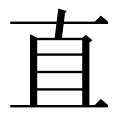
直
| ||||||||
 | ||||||||
| ||||||||
Translingual
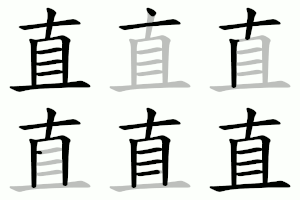
| Stroke order (Chinese) | |||
|---|---|---|---|
 | |||
| Stroke order (Japan) | |||
|---|---|---|---|
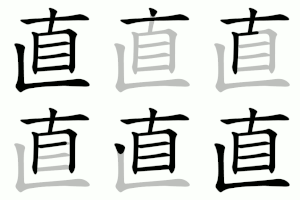 | |||
| Stroke order (Japan) | |||
|---|---|---|---|
 | |||
Alternative forms
Note the different forms, which differ in two respects: both Simplified and Traditional do not have a left vertical stroke, while the orthodox form has a left vertical stroke; and in simplified form, the top component is connected with the bottom, while in the orthodox they are separated – this last difference is shared with unrelated characters 真 and 具. The older form and stroke order are officially used in Japan and South Korea but an alternative writing in other countries.
Han character
| Traditional | 直 |
|---|---|
| Simplified | 直 |
| Japanese | 直 |
| Korean | 直 |
直 (Kangxi radical 109, 目+3, 8 strokes, cangjie input 十月一一 (JBMM), four-corner 40716, composition ⿱十⿴𠀃三(GH) or ⿱𠂇⿴𠀃三(TV) or ⿱𠂇⿺𠃊目(JK))
Derived characters
See also
References
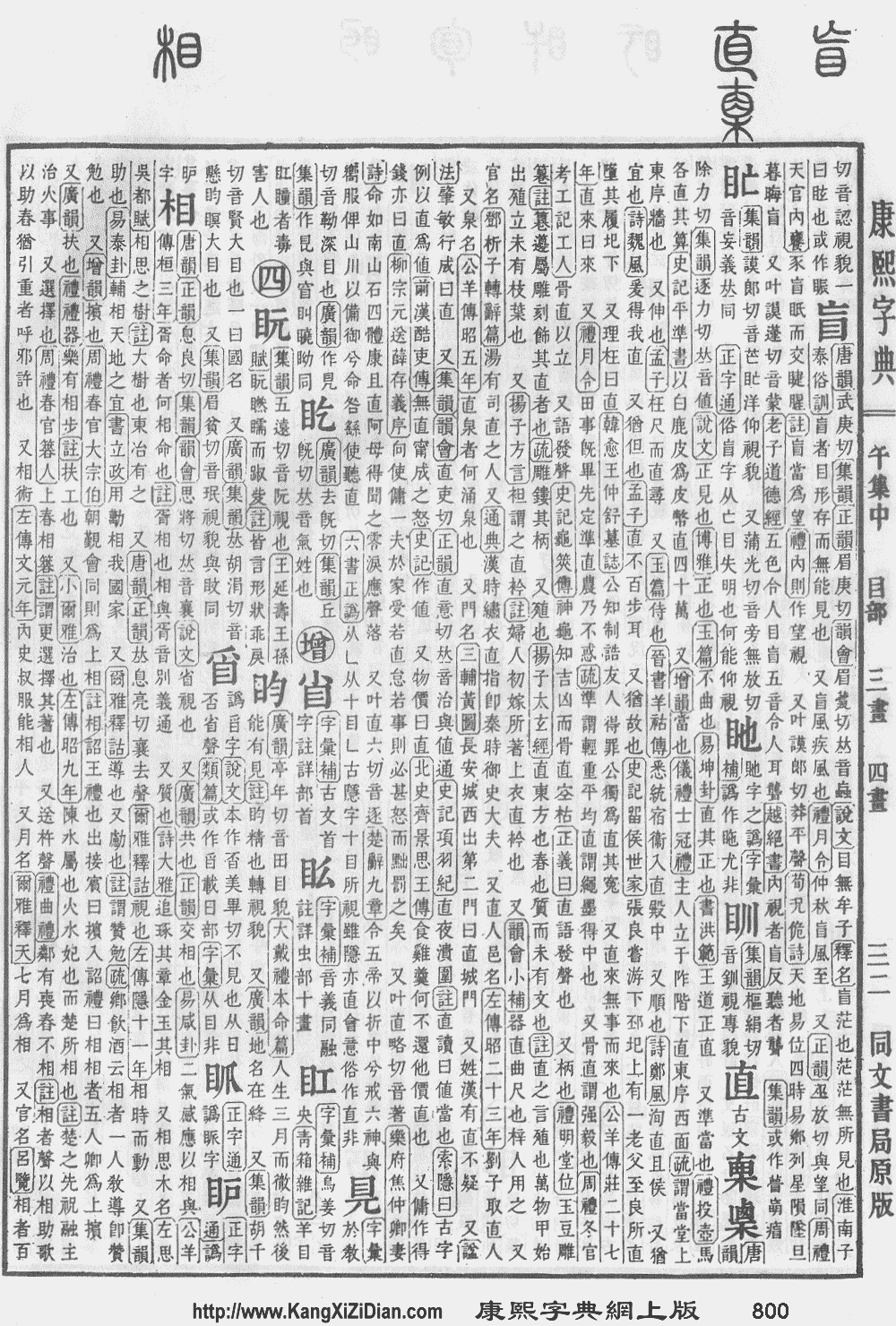
- Kangxi Dictionary: page 800, character 5
- Dai Kanwa Jiten: character 23136
- Dae Jaweon: page 1215, character 1
- Hanyu Da Zidian (first edition): volume 1, page 61, character 7
- Unihan data for U+76F4
- Unihan data for U+FAA8
- Unihan data for U+2F940
Chinese
| simp. and trad. |
直 | |
|---|---|---|
| 2nd round simp. | 𰅰 | |
| alternative forms | 直 old ⿱十且 1981 | |
Glyph origin
| Historical forms of the character 直 | |||
|---|---|---|---|
| Shang | Western Zhou | Shuowen Jiezi (compiled in Han) | Liushutong (compiled in Ming) |
| Oracle bone script | Bronze inscriptions | Small seal script | Transcribed ancient scripts |
 |
 |
 |
 |
Oracle bone script: Ideogrammic compound (會意/会意) : 目 (“eye”) + 丨 (“vertical stroke”) – vertical stroke above the eye; looking straight ahead.
The line on the side appears in bronze script and subsequently stretched under the 目 shape, while the traditional form appears in seal script.
Etymology
- "simply; only"
- According to Schuessler (2007), cognate with 特 (OC *dɯːɡ, “single”). Also compare Darmiya taku (“one”).
- "straight; right"
- According to STEDT, from Proto-Sino-Tibetan *m-tjak/ŋ ~ tik/ŋ (“good; very; real; straight”), which also includes 正 (OC *tjeŋ, “first (lunar month)”), 正 (OC *tjeŋs, “straight; correct”), 政 (OC *tjeŋs, “government; rule”) and 實 (OC *ɦliɡ, “solid; true”). Cognates include Tibetan ཏིག་ཏིག (tig tig, “certainly”), Mizo dik (“correct”), Proto-Lolo-Burmese *N-d(y)ak (“truly; very; intensitive”). An allofam is probably 德 (OC *tɯːɡ, “virtue”) (Schuessler, 2007).
- “heterosexual”
- Semantic loan from English straight.
Pronunciation
Definitions
直
- straight; linear; undeviating
- to straighten
- vertical; upright; erect
- honest; fair
- straightforward; forthright; frank
- directly; straight
- 直去 ― zhíqù ― to go directly to
- intentionally; deliberately
- † only; just
- Synonym: 只
- (Chinese calligraphy) vertical stroke in Chinese characters
- † Alternative form of 值 (“to be worth”)
- constantly
- (slang) straight; heterosexual
- (historical) Short for 直隸/直隶 (Zhílì, “Zhili”).
- 直系軍閥/直系军阀 ― Zhí xì jūnfá ― the Zhili faction (of the Beiyang warlords)
- 直皖戰爭/直皖战争 ― Zhí Wǎn zhànzhēng ― Zhili–Anhui War)
- a surname
Synonyms
| Variety | Location | Words |
|---|---|---|
| Formal (Written Standard Chinese) | 豎 | |
| Mandarin | Beijing | 豎 |
| Jinan | 豎 | |
| Xi'an | 豎, 順, 立 | |
| Wuhan | 豎, 直 | |
| Chengdu | 豎, 立 | |
| Guiyang | 豎, 直 | |
| Yangzhou | 豎 | |
| Hefei | 豎 | |
| Cantonese | Guangzhou | 掂, 戙 |
| Hong Kong | 直, 掂, 戙 | |
| Yangjiang | 掂, 直 | |
| Gan | Nanchang | 敦, 直 |
| Hakka | Meixian | 直 |
| Jin | Taiyuan | 豎 |
| Northern Min | Jian'ou | 直 |
| Eastern Min | Fuzhou | 直, 徛 |
| Southern Min | Xiamen | 徛 |
| Chaozhou | 徛, 直 | |
| Wu | Suzhou | 直, 豎 |
| Wenzhou | 豎 | |
| Xiang | Changsha | 敦, 直 |
| Shuangfeng | 敦, 直 | |
Compounds
- 一往直前 (yīwǎngzhíqián)
- 一直 (yīzhí)
- 不直 (bùzhí)
- 不顧曲直/不顾曲直
- 亢直 (kàngzhí)
- 亮直
- 以直報怨/以直报怨 (yǐzhíbàoyuàn)
- 仗義直言/仗义直言
- 伸直 (shēnzhí)
- 侃直
- 倒橫直豎/倒横直竖
- 僵直
- 儤直
- 兩眼發直/两眼发直
- 兩腳直跳/两脚直跳
- 剛直/刚直 (gāngzhí)
- 剪直
- 勇往直前 (yǒngwǎngzhíqián)
- 勇猛直前
- 北直隸/北直隶
- 口快心直 (kǒukuàixīnzhí)
- 司直
- 唾沫直嚥/唾沫直咽
- 單刀直入/单刀直入 (dāndāozhírù)
- 嘴直
- 垂直 (chuízhí)
- 坦直
- 垂直線/垂直线
- 垂直起飛/垂直起飞
- 垂直距離/垂直距离
- 垂直面
- 境外直航
- 夜直
- 大直若屈
- 奮起直追/奋起直追
- 女直 (Nǚzhí)
- 好諛惡直/好谀恶直
- 委任直選/委任直选
- 婞直 (xìngzhí)
- 寒毛直豎/寒毛直竖
- 小枉大直
- 峭直
- 峻直
- 師直為壯/师直为壮
- 平直 (píngzhí)
- 平直康莊/平直康庄
- 平鋪直序/平铺直序
- 平鋪直敘/平铺直叙 (píngpūzhíxù)
- 廉直
- 徑直/径直 (jìngzhí)
- 心直
- 心直口快 (xīnzhíkǒukuài)
- 心直嘴快 (xīnzhízuǐkuài)
- 忠直 (zhōngzhí)
- 急起直追 (jíqǐzhízhuī)
- 急轉直下/急转直下 (jízhuǎnzhíxià)
- 惡直醜正/恶直丑正
- 愚直 (yúzhí)
- 憨直 (hānzhí)
- 懞直/蒙直
- 戇直/戆直 (zhuàngzhí)
- 截彎取直/截弯取直
- 打得逼直
- 扶搖直上/扶摇直上 (fúyáozhíshàng)
- 扭曲作直
- 抗直
- 扶直 (fúzhí)
- 扯直
- 承直
- 拗曲作直
- 挺直 (tǐngzhí)
- 振筆直書/振笔直书
- 撓直為曲/挠直为曲
- 是非曲直 (shìfēiqūzhí)
- 曲直 (qūzhí)
- 曲直分明
- 朴直 (pǔzhí)
- 枉尺直尋/枉尺直寻
- 梗直 (gěngzhí)
- 橫直/横直 (héngzhí)
- 樸直/朴直 (pǔzhí)
- 橫行直撞/横行直撞 (héngxíngzhízhuàng)
- 橫衝直撞/横冲直撞 (héngchōngzhízhuàng)
- 正法直度
- 正直 (zhèngzhí)
- 正直清廉
- 正直無私/正直无私
- 正直無邪/正直无邪
- 正色直言
- 正言直諫/正言直谏
- 氣壯理直/气壮理直
- 汲直
- 沽直
- 爽直 (shuǎngzhí)
- 率直 (shuàizhí)
- 理直 (lǐzhí)
- 理直氣壯/理直气壮 (lǐzhíqìzhuàng)
- 當直/当直 (dāngzhí)
- 當直的/当直的
- 當直巡邏/当直巡逻
- 白直
- 直下
- 直上
- 直上直下
- 直上青雲/直上青云
- 直來直往/直来直往
- 直偷硬取
- 直入 (zhírù)
- 直入公堂
- 直內方外/直内方外
- 直到 (zhídào)
- 直升 (zhíshēng)
- 直升機 (zhíshēngjī)
- 直去直來/直去直来
- 直呼其名
- 直喻
- 直奉戰爭/直奉战争
- 直子
- 直宿
- 直射
- 直尺 (zhíchǐ)
- 直屬/直属 (zhíshǔ)
- 直己 (zhíjǐ)
- 直布羅陀/直布罗陀 (Zhíbùluótuó)
- 直待 (zhídài)
- 直徑/直径 (zhíjìng)
- 直得
- 直心眼兒/直心眼儿
- 直性子 (zhíxìngzi)
- 直恁
- 直情徑行/直情径行
- 直截 (zhíjié)
- 直截了當/直截了当 (zhíjiéliǎodàng)
- 直承
- 直抒己見/直抒己见
- 直拳
- 直指
- 直挺挺
- 直捷 (zhíjié)
- 直接 (zhíjiē)
- 直接了當/直接了当 (zhíjiēliǎodàng)
- 直捷了當/直捷了当 (zhíjiéliǎodàng)
- 直接保護/直接保护
- 直接廣播/直接广播
- 直接徵稅/直接征税
- 直接推理
- 直接接觸/直接接触
- 直接政治
- 直接民權/直接民权
- 直接灸
- 直接稅/直接税
- 直接立法
- 直接肥料 (zhíjiē féiliào)
- 直接證據/直接证据
- 直接貿易/直接贸易 (zhíjiē màoyì)
- 直接選舉/直接选举 (zhíjiē xuǎnjǔ)
- 直搗/直捣 (zhídǎo)
- 直搗黃龍/直捣黄龙 (zhídǎohuánglóng)
- 直撥/直拨 (zhíbō)
- 直播 (zhíbō)
- 直播衛星/直播卫星
- 直播電視/直播电视
- 直效行銷/直效行销
- 直教
- 直斥 (zhíchì)
- 直是
- 直書/直书 (zhíshū)
- 直木必伐
- 直木賞/直木赏
- 直根 (zhígēn)
- 直桶桶
- 直棋
- 直棍兒/直棍儿
- 直沽
- 直流電/直流电 (zhíliúdiàn)
- 直流馬達/直流马达
- 直溜 (zhíliu)
- 直瀉而下/直泻而下
- 直營/直营
- 直爽 (zhíshuǎng)
- 直率 (zhíshuài)
- 直皖戰爭/直皖战争
- 直直 (zhízhí)
- 直眉瞪眼
- 直瞪瞪
- 直視/直视 (zhíshì)
- 直立 (zhílì)
- 直立人 (zhílìrén)
- 直立莖/直立茎
- 直笛 (zhídí)
- 直筆/直笔 (zhíbǐ)
- 直筒子
- 直節/直节
- 直節勁氣/直节劲气
- 直系 (zhíxì)
- 直系親屬/直系亲属 (zhíxì qīnshǔ)
- 直紋/直纹
- 直線/直线 (zhíxiàn)
- 直繫/直系
- 直而不挺
- 直聲/直声
- 直肚直腸/直肚直肠
- 直脈/直脉
- 直腸/直肠 (zhícháng)
- 直腸子/直肠子 (zhíchángzi)
- 直腸癌/直肠癌 (zhícháng'ái)
- 直腸直肚/直肠直肚 (zhíchángzhídù)
- 直臣 (zhíchén)
- 直自
- 直致
- 直著身子
- 直落
- 直落三
- 直行 (zhíxíng)
- 直裰
- 直襬/直摆 (zhíbǎi)
- 直覺/直觉 (zhíjué)
- 直觀/直观 (zhíguān)
- 直角 (zhíjiǎo)
- 直角坐標/直角坐标
- 直角規/直角规
- 直言 (zhíyán)
- 直言不諱/直言不讳 (zhíyánbùhuì)
- 直言勿諱/直言勿讳
- 直言危行
- 直言取禍/直言取祸
- 直言極諫/直言极谏
- 直言正色
- 直言正論/直言正论
- 直言正諫/直言正谏
- 直言無忌/直言无忌
- 直言無諱/直言无讳
- 直言無隱/直言无隐
- 直言盡意/直言尽意
- 直言讜議/直言谠议
- 直言賈禍/直言贾祸
- 直言骨鯁/直言骨鲠
- 直話/直话
- 直話直說/直话直说
- 直語補證/直语补证
- 直諒/直谅
- 直諒多聞/直谅多闻
- 直諫/直谏 (zhíjiàn)
- 直講/直讲
- 直譯/直译 (zhíyì)
- 直譯詞/直译词
- 直豁
- 直豎/直竖
- 直賣店/直卖店
- 直跳
- 直蹶蹶
- 直身 (zhíshēn)
- 直躬
- 直躬之信
- 直轄/直辖 (zhíxiá)
- 直轄市/直辖市 (zhíxiáshì)
- 直通 (zhítōng)
- 直進直出/直进直出
- 直道 (zhídào)
- 直達/直达 (zhídá)
- 直道不容
- 直道事人
- 直道而行
- 直達車/直达车 (zhídáchē)
- 直銷/直销 (zhíxiāo)
- 直閣/直阁
- 直闖/直闯
- 直陳/直陈
- 直隸/直隶 (zhílì)
- 直音 (zhíyīn)
- 直須/直须 (zhíxū)
- 直頭布袋/直头布袋
- 直餾/直馏
- 直鼻權腮/直鼻权腮
- 矯枉過直/矫枉过直
- 砥平繩直/砥平绳直
- 秉筆直書/秉笔直书 (bǐngbǐzhíshū)
- 立直
- 筆直/笔直 (bǐzhí)
- 簡直/简直 (jiǎnzhí)
- 綢直/绸直
- 縱曲枉直/纵曲枉直
- 總統直選/总统直选
- 老直
- 耿直 (gěngzhí)
- 聳直/耸直
- 脡直
- 舉直措枉/举直措枉
- 訐直/讦直
- 讜言直聲/谠言直声
- 豈直/岂直
- 豹立直
- 質直/质直
- 質直渾厚/质直浑厚
- 迂直
- 迂直之計/迂直之计
- 逼直
- 遺直/遗直
- 酬直
- 鈞容直/钧容直
- 鉛直/铅直 (qiānzhí)
- 鐵口直斷/铁口直断
- 鐵嘴直斷/铁嘴直断
- 鐵筆直書/铁笔直书
- 長驅直入/长驱直入 (chángqūzhírù)
- 陡直 (dǒuzhí)
- 隨直/随直
- 雙眉直豎/双眉直竖
- 青雲直上/青云直上 (qīngyúnzhíshàng)
- 頭直上/头直上
- 骨直
- 魯直/鲁直
- 鯁直/鲠直 (gěngzhí)
- 鼓勇直行
Descendants
References
- Dictionary of Chinese Character Variants (教育部異體字字典), A02759
- “Entry #4389”, in 臺灣閩南語常用詞辭典 [Dictionary of Frequently-Used Taiwan Minnan] (overall work in Mandarin and Hokkien), Ministry of Education, R.O.C., 2023.
Japanese
Readings
- Go-on: じき (jiki, Jōyō)←ぢき/ちき (diki/tiki, historical); じか (jika)←ぢか (dika, historical)
- Kan-on: ちょく (choku, Jōyō)
- Kun: ただちに (tadachini, 直ちに, Jōyō); なおす (naosu, 直す, Jōyō)←なほす (nafosu, 直す, historical); なおる (naoru, 直る, Jōyō)←なほる (naforu, 直る, historical); あたい (atai, 直)←あたひ (atafi, 直, historical); すぐ (sugu, 直ぐ); すぐ (sugu, 直); なおき (naoki, 直き)←なほき (nafoki, 直き, historical); じか (jika, 直); ひた (hita, 直)
- Nanori: すぐ (sugu); なおい (naoi); のう (nō); のお (nō)
Compounds
Etymology 1
| Kanji in this term |
|---|
| 直 |
| じき Grade: 2 |
| on’yomi |
Inflection
| Stem forms | |||
|---|---|---|---|
| Imperfective (未然形) | 直だろ | じきだろ | jiki daro |
| Continuative (連用形) | 直で | じきで | jiki de |
| Terminal (終止形) | 直だ | じきだ | jiki da |
| Attributive (連体形) | 直な | じきな | jiki na |
| Hypothetical (仮定形) | 直なら | じきなら | jiki nara |
| Imperative (命令形) | 直であれ | じきであれ | jiki de are |
| Key constructions | |||
| Informal negative | 直ではない 直じゃない |
じきではない じきじゃない |
jiki de wa nai jiki ja nai |
| Informal past | 直だった | じきだった | jiki datta |
| Informal negative past | 直ではなかった 直じゃなかった |
じきではなかった じきじゃなかった |
jiki de wa nakatta jiki ja nakatta |
| Formal | 直です | じきです | jiki desu |
| Formal negative | 直ではありません 直じゃありません |
じきではありません じきじゃありません |
jiki de wa arimasen jiki ja arimasen |
| Formal past | 直でした | じきでした | jiki deshita |
| Formal negative past | 直ではありませんでした 直じゃありませんでした |
じきではありませんでした じきじゃありませんでした |
jiki de wa arimasen deshita jiki ja arimasen deshita |
| Conjunctive | 直で | じきで | jiki de |
| Conditional | 直なら(ば) | じきなら(ば) | jiki nara (ba) |
| Provisional | 直だったら | じきだったら | jiki dattara |
| Volitional | 直だろう | じきだろう | jiki darō |
| Adverbial | 直に | じきに | jiki ni |
| Degree | 直さ | じきさ | jikisa |
Derived terms
- 直に (jiki ni)
Etymology 2
| Kanji in this term |
|---|
| 直 |
| じか Grade: 2 |
| kun’yomi |
Sound change from jiki.[1]
This etymology is incomplete. You can help Wiktionary by elaborating on the origins of this term.
Related terms
- 直に (jika ni)
Etymology 2
| For pronunciation and definitions of 直 – see the following entry. | ||
| ||
| (This term, 直, is an alternative spelling of the above term.) |
Etymology 3
| Kanji in this term |
|---|
| 直 |
| ちょく Grade: 2 |
| kan’on |
Adjective
直 • (choku) †-tari (adnominal 直とした (choku to shita) or 直たる (choku taru), adverbial 直と (choku to) or 直として (choku to shite))
Verb
直する • (choku suru) suru (stem 直し (choku shi), past 直した (choku shita))
- to do one's duty, be on duty
Conjugation
| Katsuyōkei ("stem forms") | ||||
|---|---|---|---|---|
| Mizenkei ("imperfective") | 直し | ちょくし | choku shi | |
| Ren’yōkei ("continuative") | 直し | ちょくし | choku shi | |
| Shūshikei ("terminal") | 直する | ちょくする | choku suru | |
| Rentaikei ("attributive") | 直する | ちょくする | choku suru | |
| Kateikei ("hypothetical") | 直すれ | ちょくすれ | choku sure | |
| Meireikei ("imperative") | 直せよ¹ 直しろ² |
ちょくせよ¹ ちょくしろ² |
choku seyo¹ choku shiro² | |
| Key constructions | ||||
| Passive | 直される | ちょくされる | choku sareru | |
| Causative | 直させる 直さす |
ちょくさせる ちょくさす |
choku saseru choku sasu | |
| Potential | 直できる | ちょくできる | choku dekiru | |
| Volitional | 直しよう | ちょくしよう | choku shiyō | |
| Negative | 直しない | ちょくしない | choku shinai | |
| Negative continuative | 直せず | ちょくせず | choku sezu | |
| Formal | 直します | ちょくします | choku shimasu | |
| Perfective | 直した | ちょくした | choku shita | |
| Conjunctive | 直して | ちょくして | choku shite | |
| Hypothetical conditional | 直すれば | ちょくすれば | choku sureba | |
| ¹ Written imperative ² Spoken imperative | ||||
References
- Matsumura, Akira (1995) 大辞泉 [Daijisen] (in Japanese), First edition, Tōkyō: Shogakukan, →ISBN