ず
See also: す
 | ||||||||||
Japanese
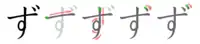
| Stroke order | |||
|---|---|---|---|
 | |||
Pronunciation
- IPA(key): [d͡zɨᵝ], [zɨᵝ]
See also
Etymology 2
From Old Japanese. Generally considered to be a combination of negation suffix ぬ (nu) in its 連用形 (ren'yōkei, “continuative or stem form”) of に (ni) + honorific suffix す (su).[1][2][3]
/nisu/ → */nzu/ → /zu/
Appears both as zu and as the older nisu form in the Man'yōshū poetry anthology.
Usage notes
Much as the older negation suffix ぬ (nu) and the modern negation suffix ない (nai), ず (zu) must come after the 未然形 (mizenkei, “irrealis or incomplete form”) of a verb.
The suffix ず (zu) is more formal than the everyday negation suffix ない (nai).
Conjugation
Classical conjugation of "ず" (irregular)
| Stem forms | ||||
|---|---|---|---|---|
| Irrealis (未然形) | ず ざら な[1] | zu zara na | ||
| Continuative (連用形) | ず[2] ざり[3] に[1] | zu zari ni | ||
| Terminal (終止形) | ず ざり | zu zari | ||
| Attributive (連体形) | ぬ ざる | nu zaru | ||
| Realis (已然形) | ね ざれ | ne zare | ||
| Imperative (命令形) | ざれ | zare | ||
| Key constructions | ||||
| Negative | - | |||
| Contrasting conjunction | ねど ざれど | nedo zaredo | ||
| Causal conjunction | ねば ざれば | neba zareba | ||
| Conditional conjunction | ずは ずば ざらば | zufa zuba zaraba | ||
| Past tense (firsthand knowledge) | ざりき | zariki | ||
| Past tense (secondhand knowledge) | ざりけり | zarikeri | ||
| Perfect tense (conscious action) | ざりつ | zaritu | ||
| Perfect tense (natural event) | ざりぬ[4] | zarinu | ||
| Perfect-continuative tense | ざりたり | zaritari | ||
| Adverbial | ず | zu | ||
| [1]Nara period form. [2]Without auxiliary verbs. [3]With auxiliary verbs. [4]Unattested. | ||||
Etymology 3
| For pronunciation and definitions of ず – see the following entries. | ||
| ||
| ||
| ||
| ||
| (This term, ず, is the hiragana spelling of the above terms.) For a list of all kanji read as ず, see Category:Japanese kanji read as ず.) |
References
- Shōgaku Tosho (1988) 国語大辞典(新装版) [Unabridged Dictionary of Japanese (Revised Edition)] (in Japanese), Tōkyō: Shogakukan, →ISBN
- Matsumura, Akira, editor (2006), 大辞林 [Daijirin] (in Japanese), Third edition, Tōkyō: Sanseidō, →ISBN
- Matsumura, Akira (1995) 大辞泉 [Daijisen] (in Japanese), First edition, Tōkyō: Shogakukan, →ISBN
This article is issued from Wiktionary. The text is licensed under Creative Commons - Attribution - Sharealike. Additional terms may apply for the media files.