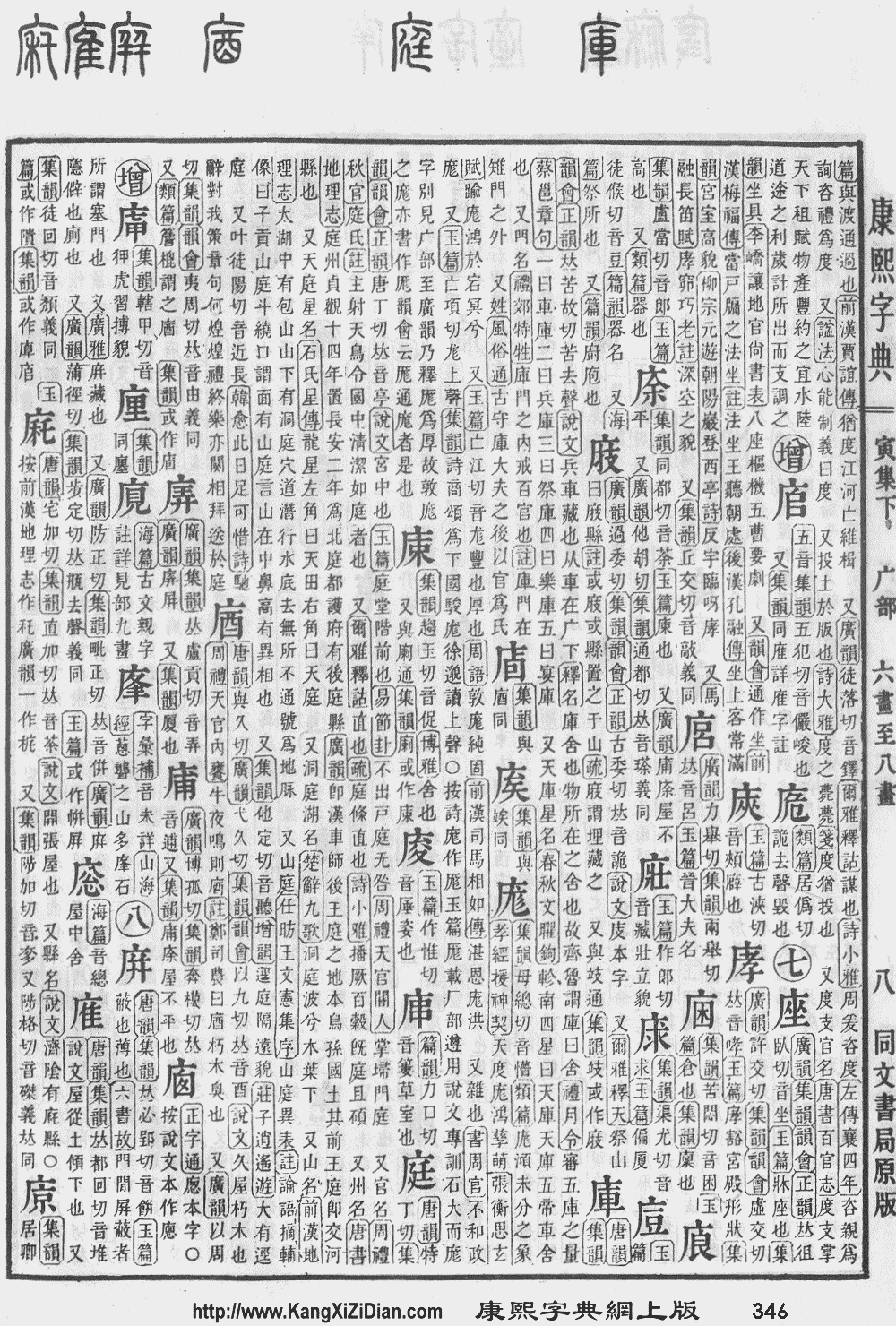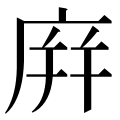
庰

庰 U+5EB0, 庰
CJK UNIFIED IDEOGRAPH-5EB0
← 庯
[U+5EAF]
CJK Unified Ideographs 庱 →
[U+5EB1]

庰 U+2F88B, 庰
CJK COMPATIBILITY IDEOGRAPH-2F88B
← 㡼
[U+2F88A]
CJK Compatibility Ideographs Supplement 庳 →
[U+2F88C]

Translingual

Han character

庰 (Kangxi radical 53, 广+8, 11 strokes, cangjie input 戈廿廿 (ITT), four-corner 00244, composition ⿸广并)

References

Chinese

simp. and trad.
庰

Pronunciation


Rime
Character 庰
Reading # 1/1
Initial (聲) 並 (3)
Final (韻) 清 (121)
Tone (調) Departing (H)
Openness (開合) Open
Division (等) III
Fanqie 防正切
Baxter bjiengH
Reconstructions
Zhengzhang
Shangfang
/biᴇŋH/
Pan
Wuyun
/biɛŋH/
Shao
Rongfen
/biæŋH/
Edwin
Pulleyblank
/biajŋH/
Li
Rong
/biɛŋH/
Wang
Li
/bĭɛŋH/
Bernard
Karlgren
/bʱi̯ɛŋH/
Expected
Mandarin
Reflex
bìng
Expected
Cantonese
Reflex
bing6
Zhengzhang system (2003)
Character 庰
Reading # 1/1
No. 941
Phonetic
component
并
Rime
group
耕
Rime
subdivision
0
Corresponding
MC rime
偋
Old
Chinese
/*beŋs/

Definitions

庰

  1. hidden place
  2. toilet; bathroom; lavatory; WC

Etymology 2

For pronunciation and definitions of 庰 – see 屏 (“a screen wall across the gate of a house for privacy; wall; etc.”).
(This character is an ancient form of 屏).

Japanese

Kanji

庰

(uncommon “Hyōgai” kanji)

  1. This term needs a translation to English. Please help out and add a translation, then remove the text {{rfdef}}.

Readings

This article is issued from Wiktionary. The text is licensed under Creative Commons - Attribution - Sharealike. Additional terms may apply for the media files.