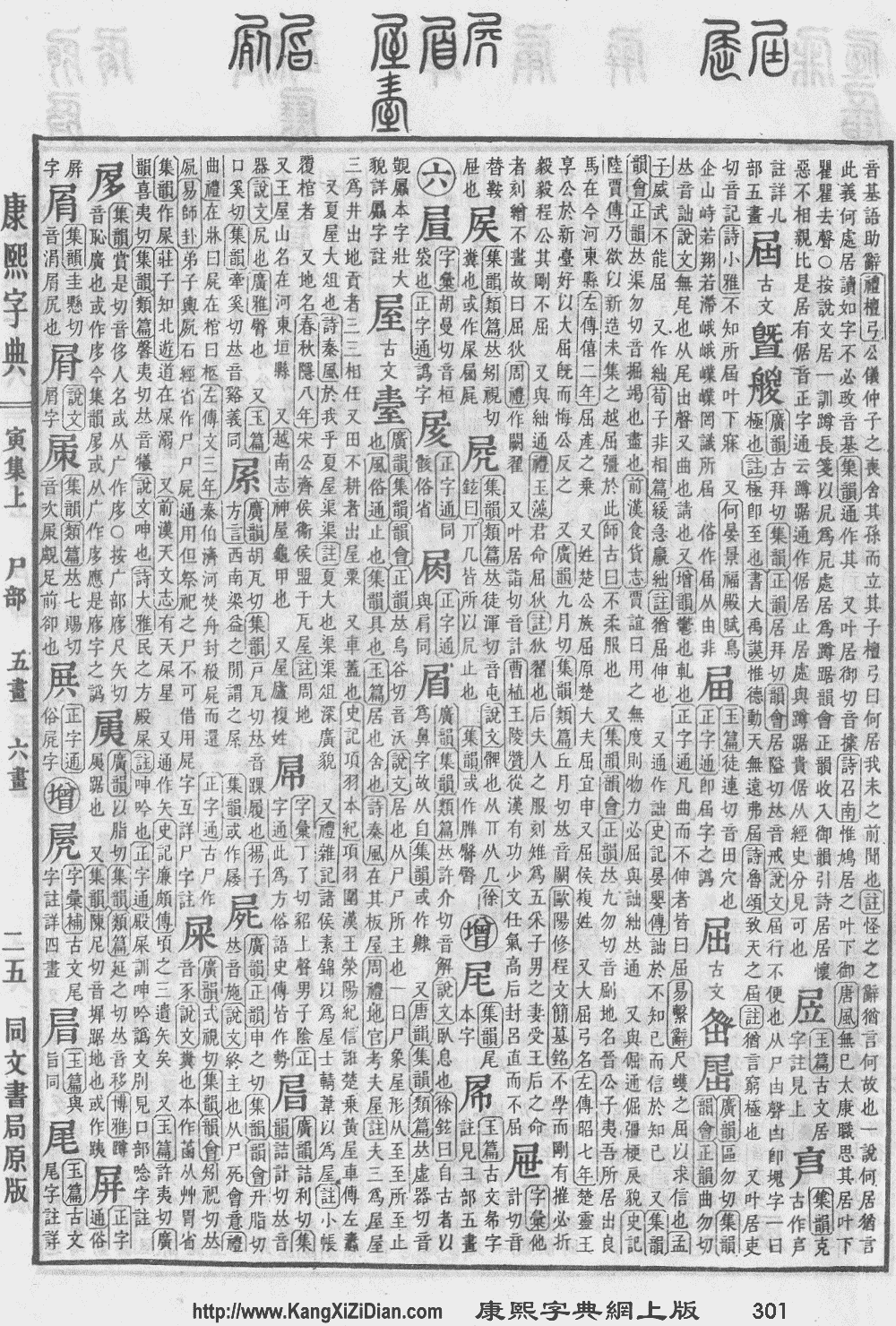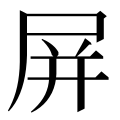
屏

See also: 摒 and 屛

屏 U+5C4F, 屏
CJK UNIFIED IDEOGRAPH-5C4F
← 屎
[U+5C4E]
CJK Unified Ideographs 屐 →
[U+5C50]

Translingual

Han character

屏 (Kangxi radical 44, 尸+6, 9 strokes, cangjie input 尸廿廿 (STT), four-corner 77241, composition ⿸尸并)

References

  • Kangxi Dictionary: page 301, character 28
  • Dai Kanwa Jiten: character 7692
  • Dae Jaweon: page 599, character 4
  • Hanyu Da Zidian (first edition): volume 2, page 973, character 4
  • Unihan data for U+5C4F

Chinese

simp. and trad.
屏
alternative forms 屛

Glyph origin

Phono-semantic compound (形聲/形声, OC *peŋ, *peŋʔ, *beːŋ) : semantic 尸 + phonetic 并 (OC *peŋ, *peŋs)

Pronunciation 1


Note:
  • pêng - literary;
  • pîn - vernacular;
  • péng/pēng - literary;
  • pín/pīn - vernacular.

    Rime
    Character 屏
    Reading # 2/3
    Initial (聲) 並 (3)
    Final (韻) 青 (125)
    Tone (調) Level (Ø)
    Openness (開合) Open
    Division (等) IV
    Fanqie 薄經切
    Baxter beng
    Reconstructions
    Zhengzhang
    Shangfang
    /beŋ/
    Pan
    Wuyun
    /beŋ/
    Shao
    Rongfen
    /bɛŋ/
    Edwin
    Pulleyblank
    /bɛjŋ/
    Li
    Rong
    /beŋ/
    Wang
    Li
    /bieŋ/
    Bernard
    Karlgren
    /bʱieŋ/
    Expected
    Mandarin
    Reflex
    píng
    Expected
    Cantonese
    Reflex
    ping4
    Baxter–Sagart system 1.1 (2014)
    Character 屏
    Reading # 1/1
    Modern
    Beijing
    (Pinyin)
    píng
    Middle
    Chinese
    ‹ beng ›
    Old
    Chinese
    /*[b]ˁeŋ/
    English screen; to protect

    Notes for Old Chinese notations in the Baxter–Sagart system:

    * Parentheses "()" indicate uncertain presence;
    * Square brackets "[]" indicate uncertain identity, e.g. *[t] as coda may in fact be *-t or *-p;
    * Angle brackets "<>" indicate infix;
    * Hyphen "-" indicates morpheme boundary;

    * Period "." indicates syllable boundary.
    Zhengzhang system (2003)
    Character 屏
    Reading # 3/3
    No. 951
    Phonetic
    component
    并
    Rime
    group
    耕
    Rime
    subdivision
    0
    Corresponding
    MC rime
    瓶
    Old
    Chinese
    /*beːŋ/
    Definitions

    屏

    1. a screen wall across the gate of a house for privacy
    2. wall
    3. folding screen, shield
    4. wall scroll
    5. to protect
    6. to shelter
    7. (computing) screen
      黑屏  ―  hēipíng  ―  black screen
    See also
    Compounds
    • 做屏風/做屏风
    • 半屏山 (Bànpíngshān)
    • 圍屏/围屏
    • 孔雀開屏/孔雀开屏
    • 屏山 (Píngshān)
    • 屏幃/屏帏
    • 屏幕 (píngmù)
    • 屏東/屏东 (Píngdōng)
    • 屏條/屏条
    • 屏翰
    • 屏翳
    • 屏蓬
    • 屏蔽 (píngbì)
    • 屏藩 (píngfān)
    • 屏襄門/屏襄门 (Píngxiāngmén)
    • 屏門/屏门
    • 屏障 (píngzhàng)
    • 屏風/屏风 (píngfēng)
    • 屏風九疊/屏风九叠
    • 屏鵝公路/屏鹅公路
    • 幃屏/帏屏
    • 截屏 (jiépíng)
    • 掛屏/挂屏
    • 插屏 (chāpíng)
    • 條屏/条屏
    • 熒光屏/荧光屏 (yíngguāngpíng)
    • 熒屏/荧屏
    • 熱屏/热屏
    • 畫屏/画屏
    • 發光屏/发光屏
    • 網屏/网屏
    • 翠屏山
    • 耳屏
    • 藩屏
    • 錦屏/锦屏
    • 雀屏
    • 雀屏中目
    • 雀屏中選/雀屏中选
    • 雲屏/云屏

    Pronunciation 2


    Rime
    Character 屏
    Reading # 3/3
    Initial (聲) 幫 (1)
    Final (韻) 清 (121)
    Tone (調) Rising (X)
    Openness (開合) Open
    Division (等) III
    Fanqie 必郢切
    Baxter pjiengX
    Reconstructions
    Zhengzhang
    Shangfang
    /piᴇŋX/
    Pan
    Wuyun
    /piɛŋX/
    Shao
    Rongfen
    /piæŋX/
    Edwin
    Pulleyblank
    /piajŋX/
    Li
    Rong
    /piɛŋX/
    Wang
    Li
    /pĭɛŋX/
    Bernard
    Karlgren
    /pi̯ɛŋX/
    Expected
    Mandarin
    Reflex
    bǐng
    Expected
    Cantonese
    Reflex
    bing2
    Zhengzhang system (2003)
    Character 屏
    Reading # 2/3
    No. 935
    Phonetic
    component
    并
    Rime
    group
    耕
    Rime
    subdivision
    0
    Corresponding
    MC rime
    餅
    Old
    Chinese
    /*peŋʔ/
    Definitions

    屏

    1. to remove
    2. to dismiss
    3. to hide
    4. to suppress
    5. to banish
    Compounds
    • 吞聲屏氣/吞声屏气
    • 屏居 (bǐngjū)
    • 屏息 (bǐngxī)
    • 屏息凝氣/屏息凝气
    • 屏息凝視/屏息凝视
    • 屏斥
    • 屏棄/屏弃 (bǐngqì)
    • 屏氣/屏气 (bǐngqì)
    • 屏氣凝神/屏气凝神
    • 屏氣攝息/屏气摄息
    • 屏氣斂息/屏气敛息
    • 屏當/屏当
    • 屏絕/屏绝 (bǐngjué)
    • 屏聲息氣/屏声息气
    • 屏語/屏语
    • 屏跡/屏迹 (bǐngjì)
    • 屏退 (bǐngtuì)
    • 屏除 (bǐngchú)
    • 屏隱/屏隐
    • 屏黜
    • 放屏
    • 斂聲屏氣/敛声屏气
    • 杜門屏跡/杜门屏迹

    Pronunciation 3


    Zhengzhang system (2003)
    Character 屏
    Reading # 1/3
    No. 932
    Phonetic
    component
    并
    Rime
    group
    耕
    Rime
    subdivision
    0
    Corresponding
    MC rime
    并
    Old
    Chinese
    /*peŋ/
    Definitions

    屏

    1. toilet

    Pronunciation 4


    Rime
    Character 屏
    Reading # 1/3
    Initial (聲) 幫 (1)
    Final (韻) 清 (121)
    Tone (調) Level (Ø)
    Openness (開合) Open
    Division (等) III
    Fanqie 府盈切
    Baxter pjieng
    Reconstructions
    Zhengzhang
    Shangfang
    /piᴇŋ/
    Pan
    Wuyun
    /piɛŋ/
    Shao
    Rongfen
    /piæŋ/
    Edwin
    Pulleyblank
    /piajŋ/
    Li
    Rong
    /piɛŋ/
    Wang
    Li
    /pĭɛŋ/
    Bernard
    Karlgren
    /pi̯ɛŋ/
    Expected
    Mandarin
    Reflex
    bīng
    Expected
    Cantonese
    Reflex
    bing1
    Definitions

    屏

    1. Only used in 屏營/屏营 (bīngyíng).

    Etymology 2

    For pronunciation and definitions of 屏 – see 摒 (“to expel; to cast off; to clean up; to tidy up; etc.”).
    (This character is the second-round simplified form of 摒).
    Notes:

    Japanese

    Kanji

    屏

    (uncommon “Hyōgai” kanji, shinjitai kanji, kyūjitai form 屛)

    1. This term needs a translation to English. Please help out and add a translation, then remove the text {{rfdef}}.

    Readings

    Korean

    Hanja

    屏 (eumhun 병풍 병 (byeongpung byeong))

    1. This term needs a translation to English. Please help out and add a translation, then remove the text {{rfdef}}.

    Vietnamese

    Han character

    屏: Hán Nôm readings: bình

    1. This term needs a translation to English. Please help out and add a translation, then remove the text {{rfdef}}.
    This article is issued from Wiktionary. The text is licensed under Creative Commons - Attribution - Sharealike. Additional terms may apply for the media files.