弍
See also: 二
| ||||||||
Translingual
Han character
弍 (Kangxi radical 56, 弋+2, 5 strokes, cangjie input 戈心一一 (IPMM), four-corner 43100, composition ⿹弋二)
References
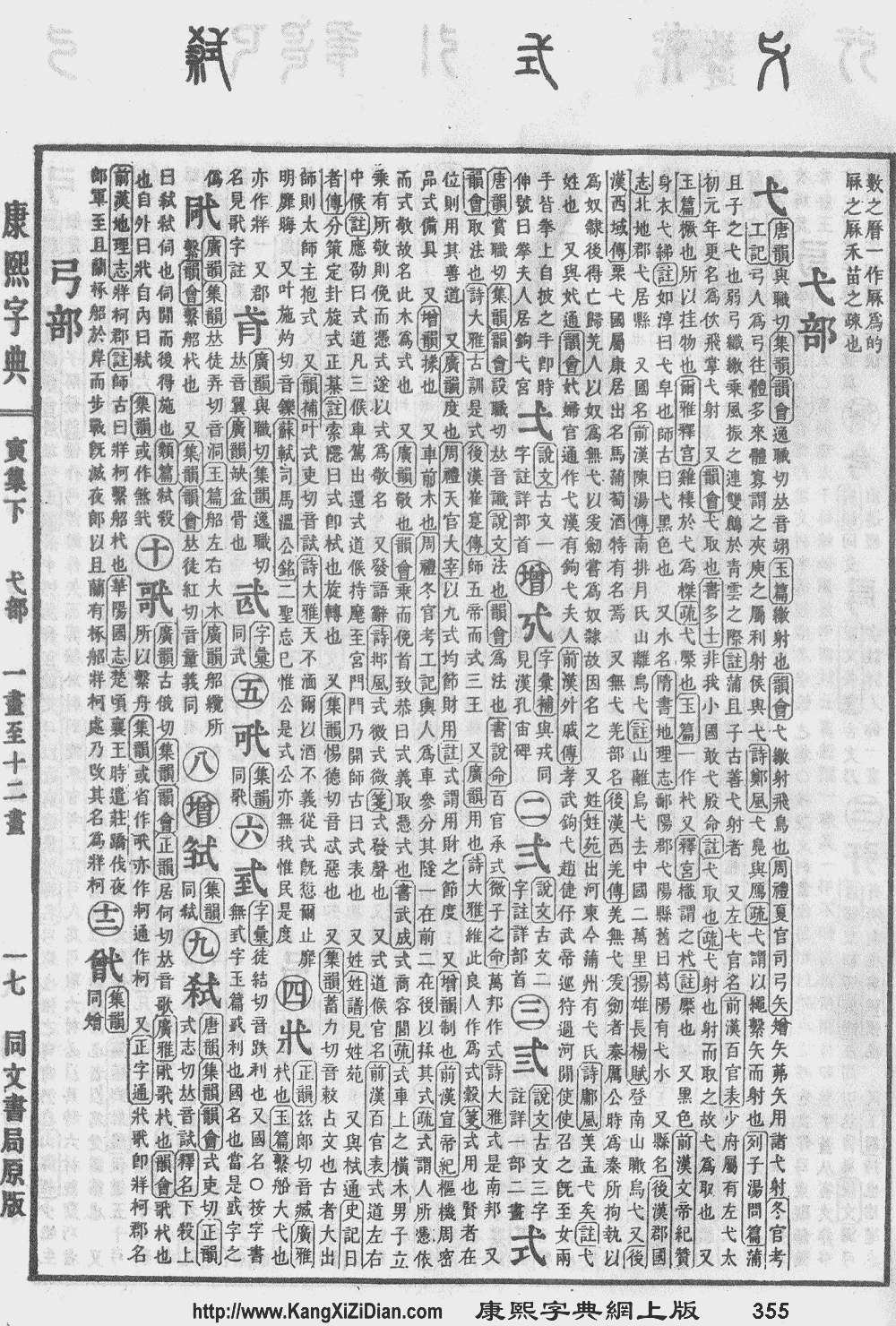
- Kangxi Dictionary: page 355, character 4
- Dai Kanwa Jiten: character 9661
- Dae Jaweon: page 670, character 21
- Hanyu Da Zidian (first edition): volume 1, page 558, character 5
- Unihan data for U+5F0D
Chinese
Glyph origin
| Historical forms of the character 弍 | |||
|---|---|---|---|
| Warring States | Shuowen Jiezi (compiled in Han) | Liushutong (compiled in Ming) | |
| Bronze inscriptions | Chu slip and silk script | Ancient script | Transcribed ancient scripts |
 |
 |
 |
 |
Etymology 1
| For pronunciation and definitions of 弍 – see 二 (“two; second; etc.”). (This character is recorded in one or more historical dictionaries as an ancient form of 二). |
Etymology 2
| For pronunciation and definitions of 弍 – see 貳 (“secondary; assistant; to be unfaithful; to be disloyal; etc.”). (This character is the second-round simplified form of 貳). |
Notes:
|
Japanese
Korean
Hanja
弍 • (i) (hangeul 이, revised i, McCune–Reischauer i, Yale i)
- This term needs a translation to English. Please help out and add a translation, then remove the text
{{rfdef}}.
Vietnamese
This article is issued from Wiktionary. The text is licensed under Creative Commons - Attribution - Sharealike. Additional terms may apply for the media files.