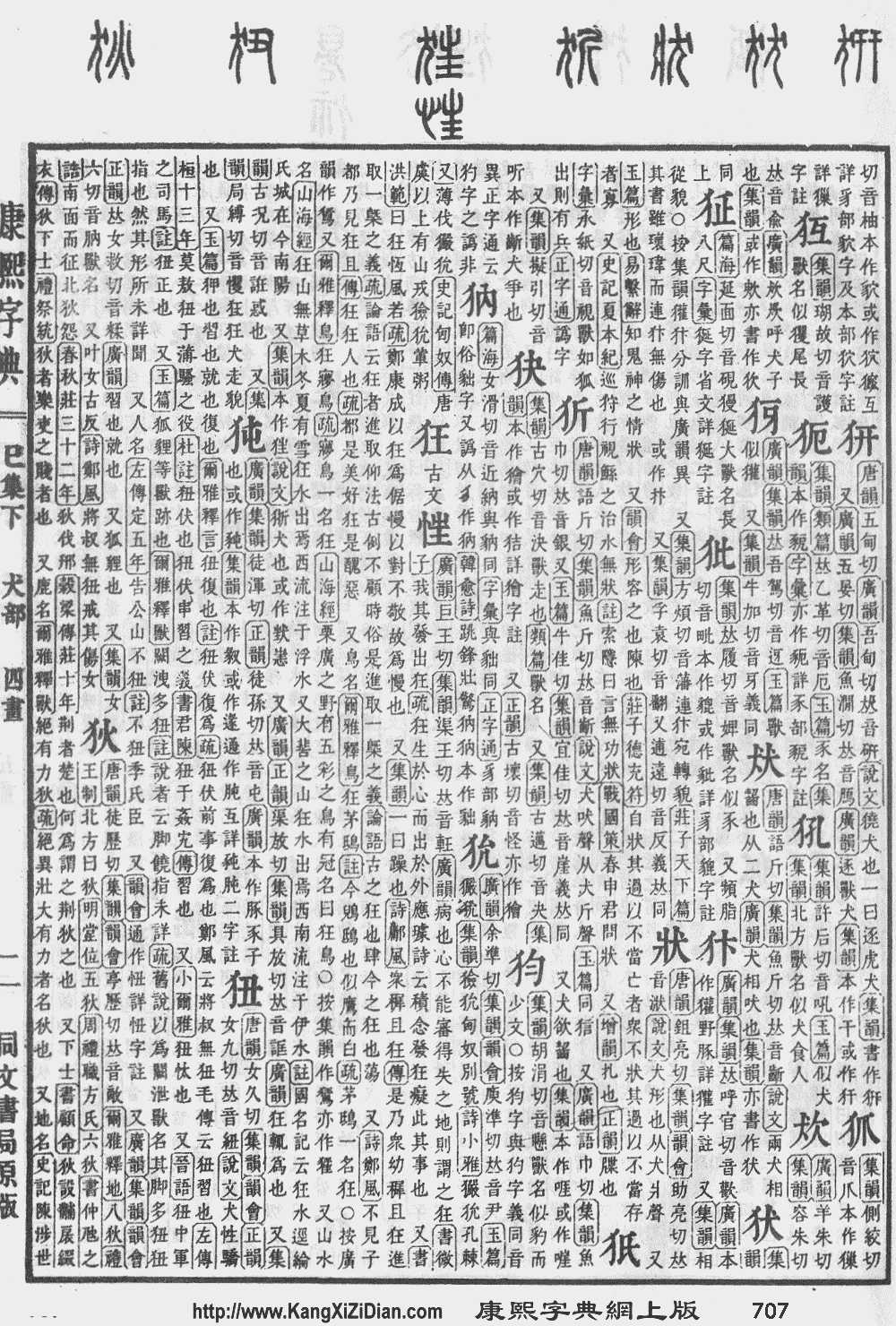
狄

狄 U+72C4, 狄
CJK UNIFIED IDEOGRAPH-72C4
← 狃
[U+72C3]
CJK Unified Ideographs 狅 →
[U+72C5]

Translingual

Han character

狄 (Kangxi radical 94, 犬+4, 7 strokes, cangjie input 大竹火 (KHF), four-corner 49280, composition ⿰犭火)

References

  • Kangxi Dictionary: page 707, character 24
  • Dai Kanwa Jiten: character 20290
  • Dae Jaweon: page 1120, character 6
  • Hanyu Da Zidian (first edition): volume 2, page 1337, character 1
  • Unihan data for U+72C4

Chinese

trad. 狄
simp. # 狄
alternative forms 翟

Glyph origin

Historical forms of the character 狄
Western Zhou
Bronze inscriptions

Etymology

"northern foreigners"
Unknown. Goldin (2011) proposes that 狄 (dí)/翟 (dí) was a "pseudo-ethnonym" and meant "feathered"; Liji mentioned that the Dí's clothings were made of birds' feathers and mammals' hairs. If so, see 翟 (dí) for more etymology.
"low servant"
Either based on the northern foreigners' endo-ethnonym, or more likely Austroasiatic (Schuessler, 2007). Compare Proto-Monic *ɗiik, Proto-Bahnaric *ɗɨc, as well as Proto-Mon-Khmer **ɗiək ~ ɗiik ~ *ɗik (“slave”).

Pronunciation


Rime
Character 狄
Reading # 1/1
Initial (聲) 定 (7)
Final (韻) 錫 (127)
Tone (調) Checked (Ø)
Openness (開合) Open
Division (等) IV
Fanqie 徒歷切
Baxter dek
Reconstructions
Zhengzhang
Shangfang
/dek̚/
Pan
Wuyun
/dek̚/
Shao
Rongfen
/dɛk̚/
Edwin
Pulleyblank
/dɛjk̚/
Li
Rong
/dek̚/
Wang
Li
/diek̚/
Bernard
Karlgren
/dʱiek̚/
Expected
Mandarin
Reflex
dí
Expected
Cantonese
Reflex
dik6
Baxter–Sagart system 1.1 (2014)
Character 狄
Reading # 1/1
Modern
Beijing
(Pinyin)
dí
Middle
Chinese
‹ dek ›
Old
Chinese
/*lˁek/
English (name of a northern tribe)

Notes for Old Chinese notations in the Baxter–Sagart system:

* Parentheses "()" indicate uncertain presence;
* Square brackets "[]" indicate uncertain identity, e.g. *[t] as coda may in fact be *-t or *-p;
* Angle brackets "<>" indicate infix;
* Hyphen "-" indicates morpheme boundary;

* Period "." indicates syllable boundary.
Zhengzhang system (2003)
Character 狄
Reading # 1/1
No. 2206
Phonetic
component
狄
Rime
group
錫
Rime
subdivision
0
Corresponding
MC rime
荻
Old
Chinese
/*deːɡ/

Definitions

狄

  1. the Di people; Zhou dynasty era term for tribes from northern China
  2. † low servant
  3. † Alternative form of 翟
  4. a surname
    狄仁傑/狄仁杰  ―  Dí Rénjié  ―  Di Renjie (Tang dynasty chancellor)

Compounds

  • 亞加狄亞/亚加狄亚
  • 儀狄/仪狄
  • 北狄 (Běidí)
  • 夷狄 (yídí)
  • 庫狄/库狄
  • 戎狄 (róngdí)
  • 揄狄
  • 狄宮/狄宫
  • 狄牙
  • 狄良突盧/狄良突卢
  • 白狄
  • 簡狄/简狄
  • 蠻夷戎狄/蛮夷戎狄 (mányí róngdí)

Japanese

Kanji

狄

(uncommon “Hyōgai” kanji)

  1. barbarian

Readings

  • On (unclassified): てき (teki)
  • Kun: えびす (ebisu)

Compounds

Korean

Etymology

From Middle Chinese 狄 (MC dek). Recorded as Middle Korean 뎍〮 (tyék) (Yale: tyek) in Hunmong Jahoe (訓蒙字會 / 훈몽자회), 1527.

Hanja

Wikisource 狄 (eumhun 오랑캐 적 (orangkae jeok))

  1. Hanja form? of 적 (“tribe from northern China”).

Compounds

References

  • 국제퇴계학회 대구경북지부 (國際退溪學會 大邱慶北支部) (2007). Digital Hanja Dictionary, 전자사전/電子字典.

Vietnamese

Han character

狄: Hán Nôm readings: địch, đệt

  1. This term needs a translation to English. Please help out and add a translation, then remove the text {{rfdef}}.
This article is issued from Wiktionary. The text is licensed under Creative Commons - Attribution - Sharealike. Additional terms may apply for the media files.