仁
| ||||||||
Translingual
| Stroke order | |||
|---|---|---|---|
 | |||
Han character
仁 (Kangxi radical 9, 人+2, 4 strokes, cangjie input 人一一 (OMM), four-corner 21210, composition ⿰亻二)
Descendants
- に (Hiragana character derived from Man'yōgana)
- ニ (Katakana character derived from Man'yōgana)
References
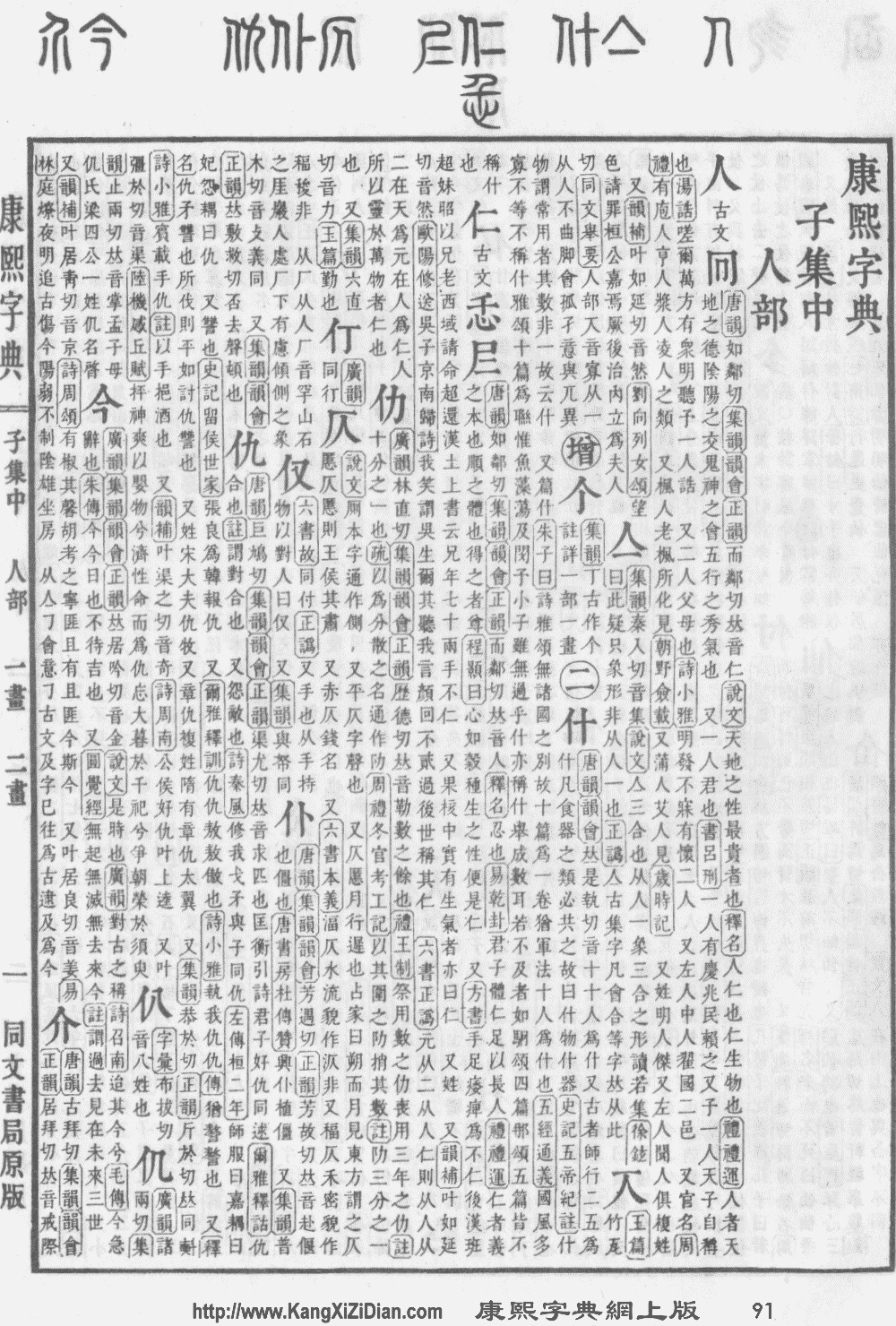
- Kangxi Dictionary: page 91, character 7
- Dai Kanwa Jiten: character 349
- Dae Jaweon: page 193, character 1
- Hanyu Da Zidian (first edition): volume 1, page 107, character 1
- Unihan data for U+4EC1
Chinese
| simp. and trad. |
仁 | |
|---|---|---|
| alternative forms | 𡰥 忎 忈 | |
Glyph origin
| Historical forms of the character 仁 | ||||||||||||||||||||
|---|---|---|---|---|---|---|---|---|---|---|---|---|---|---|---|---|---|---|---|---|
| Warring States | Shuowen Jiezi (compiled in Han) | Liushutong (compiled in Ming) | ||||||||||||||||||
| Bronze inscriptions | Chu slip and silk script | Qin slip script | Ancient script | Small seal script | Transcribed ancient scripts | |||||||||||||||
 |
 |
 |
 |
 |
 | |||||||||||||||
|||||
|
References: Mostly from Richard Sears' Chinese Etymology site (authorisation),
| ||||||||||||||||||||


Phono-semantic compound (形聲/形声, OC *njin) : phonetic 人 (OC *njin) + semantic 二.
Etymology
From Proto-Sino-Tibetan *s/k-niŋ (“heart; brain; mind”) (Schuessler, 2007; STEDT). Cognate with Tangkhul Naga ning (“mind”), Manipuri ꯄꯨꯛꯅꯤꯡ (pookneeng, “heart; mind”), Kinnauri [script needed] (stiŋ, “heart”), Garo taning (“brain”), Ngochang Achang nhaiqlom (“heart”), Bisu นืงบา (nɨŋba, “heart”). Possibly related to Tibetan ཉིང (nying, “pith, essence”) (Schuessler, 2007).
For a parallel semantic development, compare Tibetan སྙིང་རྗེ (snying rje, “compassion; kindness; mercy”), from Tibetan སྙིང (snying, “heart; mind”).
Pronunciation
Definitions
仁
- compassionate; humane
- 仁慈 ― réncí ― benevolent
- 子曰:「唯仁者能好人,能惡人。」 [Classical Chinese, trad.]
- From: The Analects of Confucius, c. 475 – 221 BCE, translated based on James Legge's version
- Zǐyuē: “Wéi rénzhě néng hào rén, néng wù rén.” [Pinyin]
- The Master said, "It is only the (truly) virtuous man, who can love, or who can hate, others."
子曰:「唯仁者能好人,能恶人。」 [Classical Chinese, simp.]- 無傷也,是乃仁術也,見牛未見羊也。 [Classical Chinese, trad.]
- From: Mencius, c. 4th century BCE
- Wúshāng yě, shì nǎi rénshù yě, jiàn niú wèi jiàn yáng yě. [Pinyin]
- 'There is no harm in their saying so,' said Mencius. 'Your conduct was an artifice of benevolence. You saw the ox, and had not seen the sheep.
无伤也,是乃仁术也,见牛未见羊也。 [Classical Chinese, simp.]
- humaneness; benevolence; kindness
- (literary) person of virtue
- 弟子入則孝,出則弟,謹而信,汎愛眾,而親仁。 [Classical Chinese, trad.]
- From: The Analects of Confucius, c. 475 – 221 BCE, translated based on James Legge's version
- Dìzǐ rù zé xiào, chū zé tì, jǐn ér xìn, fàn ài zhòng, ér qīn rén. [Pinyin]
- A youth, when at home, should be filial, and, abroad, respectful to his elders. He should be earnest and truthful. He should overflow in love to all, and cultivate the friendship of the good.
弟子入则孝,出则弟,谨而信,泛爱众,而亲仁。 [Classical Chinese, simp.]
- kernel
Compounds
- 一視同仁/一视同仁 (yīshìtóngrén)
- 不仁 (bùrén)
- 不仁不義/不仁不义
- 亞麻仁油/亚麻仁油
- 仁丹 (réndān)
- 仁人 (rénrén)
- 仁人君子 (rénrénjūnzǐ)
- 仁人志士 (rénrénzhìshì)
- 仁兄 (rénxiōng)
- 仁厚 (rénhòu)
- 仁君
- 仁和坪 (Rénhépíng)
- 仁塔
- 仁壽/仁寿
- 仁孝
- 仁宇
- 仁尊
- 仁弟
- 仁德 (réndé)
- 仁心 (rénxīn)
- 仁心仁術/仁心仁术 (rénxīnrénshù)
- 仁恕
- 仁惠
- 仁愛/仁爱 (rén'ài)
- 仁愛之家/仁爱之家
- 仁慈 (réncí)
- 仁政 (rénzhèng)
- 仁昭法外
- 仁智互見/仁智互见
- 仁武 (Rénwǔ)
- 仁民愛物/仁民爱物
- 仁波切 (rénbōqiè)
- 仁洽
- 仁澤/仁泽
- 仁王
- 仁瑞
- 仁祠
- 仁福 (Rénfú)
- 仁義/仁义
- 仁義之師/仁义之师
- 仁義道德/仁义道德 (rényì dàodé)
- 仁者 (rénzhě)
- 仁者樂山/仁者乐山
- 仁聲/仁声
- 仁至義盡/仁至义尽 (rénzhìyìjìn)
- 仁術/仁术 (rénshù)
- 仁言利博
- 仁風/仁风
- 依仁
- 假仁假義/假仁假义 (jiǎrénjiǎyì)
- 冠道履仁
- 剛愎不仁/刚愎不仁
- 同仁 (tóngrén)
- 吉仁 (Jírén)
- 壯烈成仁/壮烈成仁
- 大仁 (dàrén)
- 大仁大義/大仁大义
- 奉揚仁風/奉扬仁风
- 婦人之仁/妇人之仁 (fùrénzhīrén)
- 安仁鬢秋/安仁鬓秋
- 宅心仁厚
- 宅心仁慈
- 宋襄之仁 (sòngxiāngzhīrén)
- 寬仁大度/宽仁大度
- 尸鳩之仁
- 居仁由義/居仁由义
- 履仁蹈義/履仁蹈义
- 巴仁 (Bārén)
- 布德施仁
- 志士仁人 (zhìshìrénrén)
- 成仁 (chéngrén)
- 成仁取義/成仁取义
- 敦仁
- 施仁布德
- 施仁布恩
- 施仁布澤/施仁布泽
- 智仁勇
- 杏仁 (xìngrén)
- 杏仁槽
- 杏仁油 (xìngrényóu)
- 杏仁粉
- 杏仁茶 (xìngrénchá)
- 杏仁豆腐
- 松仁 (sōngrén)
- 果仁 (guǒrén)
- 桃仁 (táorén)
- 核仁 (hérén)
- 欖仁樹/榄仁树
- 止戈興仁/止戈兴仁
- 歸仁/归仁 (Guīrén, “Gueiren”)
- 殘暴不仁/残暴不仁 (cánbàobùrén)
- 殷有三仁
- 殺身成仁/杀身成仁 (shāshēnchéngrén)
- 求仁得仁 (qiúréndérén)
- 法外施仁
- 為仁不富/为仁不富
- 為富不仁/为富不仁 (wéifùbùrén)
- 烏圖美仁/乌图美仁 (Wūtúměirén)
- 煦仁孑義/煦仁孑义
- 瓜仁 (guārén)
- 瓜子仁
- 當仁不讓/当仁不让 (dāngrénbùràng)
- 發政施仁/发政施仁
- 瞳仁 (tóngrén)
- 知水仁山
- 砂仁 (shārén)
- 種仁/种仁
- 積德累仁/积德累仁
- 純仁/纯仁
- 絕仁棄義/绝仁弃义
- 美仁 (Měirén)
- 義粟仁漿/义粟仁浆
- 聖手仁心/圣手仁心
- 能仁 (Néngrén)
- 至仁
- 興仁/兴仁 (Xīngrén)
- 苡仁
- 薏仁 (yìrén)
- 薏苡仁 (yìyǐrén)
- 蝦仁/虾仁 (xiārén)
- 見仁見智/见仁见智 (jiànrénjiànzhì)
- 見仁見知/见仁见知
- 見智見仁/见智见仁
- 觀過知仁/观过知仁
- 達仁/达仁 (Dárén)
- 里仁為美
- 麻仁
- 麻木不仁 (mámùbùrén)
- 麻痺不仁/麻痹不仁
References
- “仁”, in 漢語多功能字庫 (Multi-function Chinese Character Database), 香港中文大學 (the Chinese University of Hong Kong), 2014–
Japanese
Readings
Compounds
Korean
Etymology
From Middle Chinese 仁 (MC nyin).
| Historical Readings | ||
|---|---|---|
| Dongguk Jeongun Reading | ||
| Dongguk Jeongun, 1448 | ᅀᅵᆫ (Yale: zìn) | |
| Middle Korean | ||
| Text | Eumhun | |
| Gloss (hun) | Reading | |
| Hunmong Jahoe, 1527 | 클〮 (Yale: khúl) | ᅀᅵᆫ (Yale: zìn) |
Pronunciation
- (SK Standard/Seoul) IPA(key): [in]
- Phonetic hangul: [인]