獣
See also: 獸
| ||||||||
Translingual
| Traditional | 獸 |
|---|---|
| Shinjitai | 獣 |
| Simplified | 兽 |
Han character
獣 (Kangxi radical 94, 犬+12, 16 strokes, cangjie input 火口戈大 (FRIK), composition ⿰⿱畄𠮛犬)
References
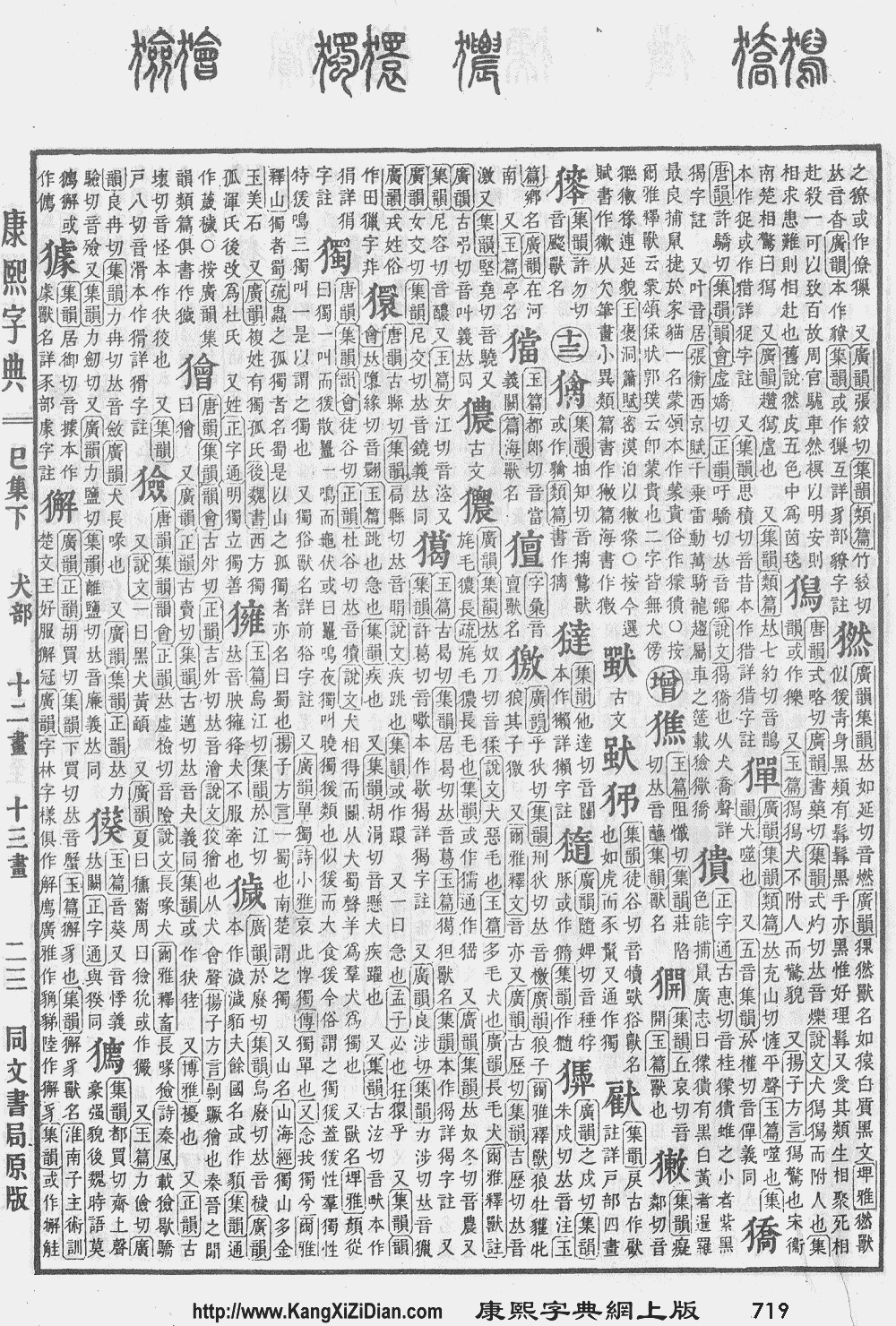
- Kangxi Dictionary: not present, would follow page 719, character 13
- Dai Kanwa Jiten: character 20714
- Dae Jaweon: page 1130, character 13
- Hanyu Da Zidian (first edition): not present, would follow volume 2, page 1369, character 7
- Unihan data for U+7363
Japanese
| 獣 | |
| 獸 |
Readings
Etymology 1
| Kanji in this term |
|---|
| 獣 |
| けだもの Grade: S |
| kun’yomi |
| Alternative spelling |
|---|
| 獸 (kyūjitai) |
Literally "thing of hair". Compound of 毛 (ke, “hair”) + だ (da, genitive marker) + 物 (mono, “thing”).[1][2] Medial -da- is a very rare genitive marker found in compounds, also seen in 果物 (kudamono, “fruit”).
Noun
獣 • (kedamono)
- an animal covered in fur, a beast
- 1079, Konkōmyō Saishōōkyō Ongi, page 6 (back):
- 獸 ケタモノ
- (please add an English translation of this quotation)
Etymology 2
| Kanji in this term |
|---|
| 獣 |
| けもの Grade: S |
| kun’yomi |
| Alternative spelling |
|---|
| 獸 (kyūjitai) |
Literally "hair thing". Compound of 毛 (ke, “hair”) + 物 (mono, “thing”).[1][2]
Noun
獣 • (kemono)
- an animal covered in fur, a beast
- 1999 February 4, “ダーク・グレイ [Dark Gray]”, in Vol.1, Konami:
- からだが灰色のけもの。あまり見かけない貴重ないきもの。
- Karada ga haīro no kemono. Amari mikakenai kichō na ikimono.
- A beast with a gray body. It is a rarely seen treasure of nature.
- からだが灰色のけもの。あまり見かけない貴重ないきもの。
- 1999 July 5, “モン・ラーバス [Mon Larvas]”, in BOOSTER 3, Konami:
- ラーバスがより進化したけもの。力がパワーアップしている。
- Rābasu ga yori shinka shita kemono. Chikara ga pawā-appu shite iru.
- A beast who evolved from Larvas and is now even more powerful.
- ラーバスがより進化したけもの。力がパワーアップしている。
Derived terms
Derived terms
- 獣耳 (kemonomimi): kemonomimi
- 獣道 (kemonomichi)
Etymology 3
| Kanji in this term |
|---|
| 獣 |
| しし Grade: S |
| irregular |
| Alternative spellings |
|---|
| 獸 (kyūjitai) 鹿 猪 |
From Old Japanese. First attested in the Kojiki of 712 CE.[4] From Proto-Japonic *sisi. Cognate with 肉 (shishi, “meat of a beast”).[4]
Idioms
- 獣食った報い (shishi kutta mukui)
Etymology 4
| Kanji in this term |
|---|
| 獣 |
| じゅう Grade: S |
| kan’yōon |
| Alternative spelling |
|---|
| 獸 (kyūjitai) |
/siu/ → /ɕiu/ → /d͡ʑiu/ → /d͡ʑuː/
From Middle Chinese 獸/兽 (syuwH, “(wild) animal”). Compare modern Mandarin reading shòu, Min Nan siù.
Derived terms
Derived terms
- 一角獣 (ikkakujū): a unicorn
- 益獣 (ekijū): beneficial animal
- 怪獣 (kaijū): a monster (generally a big animal monster, like Godzilla or Mothra)
- 害獣 (gaijū): harmful animal
- 麝香獣 (jakōjū): moschiferous animal (musk deer, civet, etc)
- 獣医 (jūi): a veterinarian
- 獣姦 (jūkan): bestiality (sexual activity)
- 尾獣 (bijū): tailed beast
- 雷獣 (raijū): a thunder beast
Idioms
- 獣を逐う者は目に太山を見ず (jū o ou mono wa me ni taizan o mizu)
References
- Shōgaku Tosho (1988) 国語大辞典(新装版) [Unabridged Dictionary of Japanese (Revised Edition)] (in Japanese), Tōkyō: Shogakukan, →ISBN
- Matsumura, Akira, editor (2006), 大辞林 [Daijirin] (in Japanese), Third edition, Tōkyō: Sanseidō, →ISBN
- NHK Broadcasting Culture Research Institute, editor (1998), NHK日本語発音アクセント辞典 [NHK Japanese Pronunciation Accent Dictionary] (in Japanese), Tōkyō: NHK Publishing, →ISBN
- “獣・猪・鹿”, in 日本国語大辞典 (Nihon Kokugo Daijiten, “Nihon Kokugo Daijiten”) (in Japanese), concise edition, Tōkyō: Shogakukan, 2000
- Tsukishima, Hiroshi (1079) Kojisho Ongi Shūsei 12: Konkōmyō Saishōōkyō Ongi (in Japanese), Tōkyō: Kyūko Shoin, published 1979, →ISBN.
This article is issued from Wiktionary. The text is licensed under Creative Commons - Attribution - Sharealike. Additional terms may apply for the media files.