羖
| ||||||||
Translingual
Han character
羖 (Kangxi radical 123, 羊+4, 10 strokes, cangjie input 廿手竹弓水 (TQHNE), four-corner 87547, composition ⿰羊殳)
References
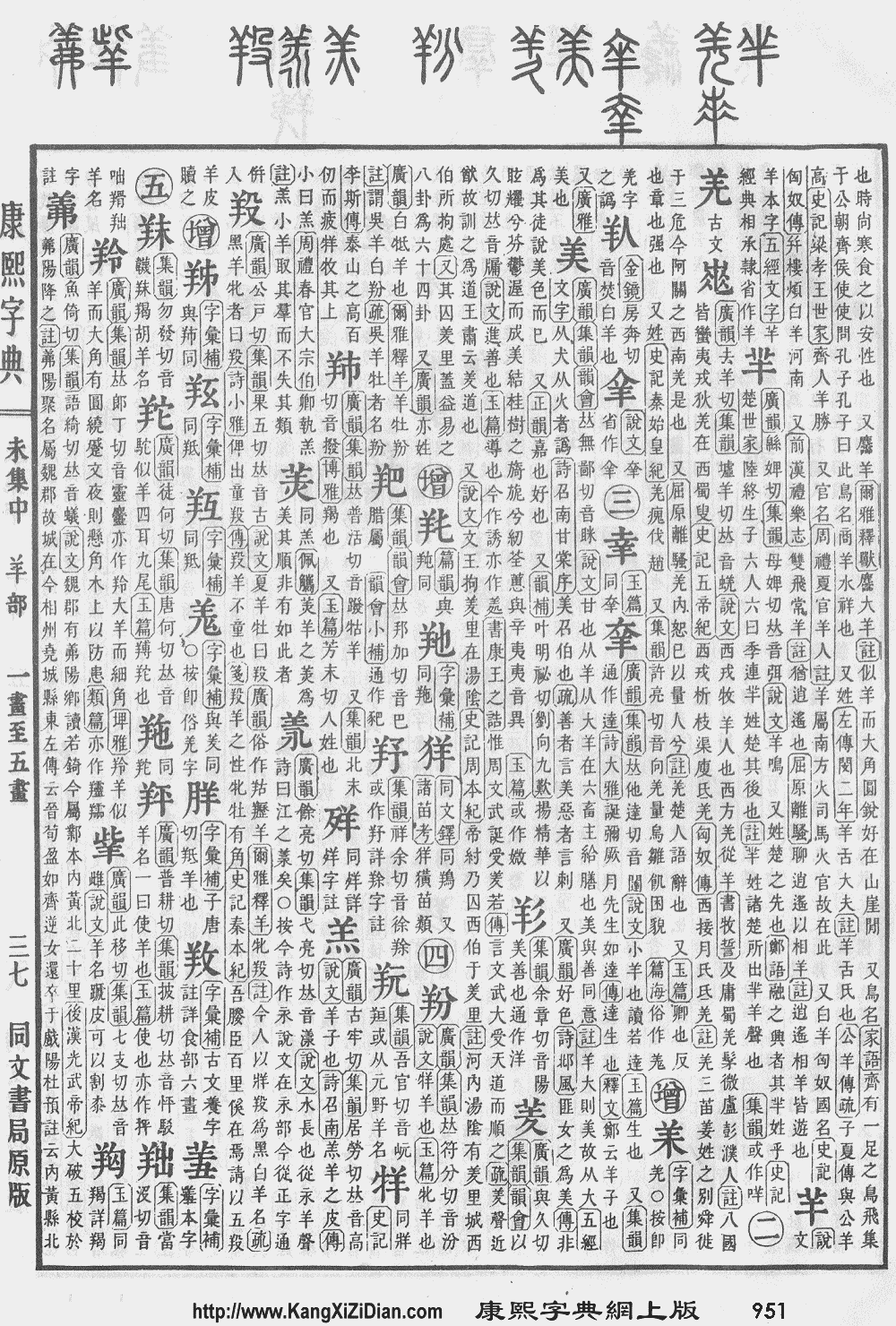
- Kangxi Dictionary: page 951, character 26
- Dai Kanwa Jiten: character 28450
- Dae Jaweon: page 1395, character 9
- Hanyu Da Zidian (first edition): volume 5, page 3128, character 3
- Unihan data for U+7F96
Chinese
| simp. and trad. |
羖 | |
|---|---|---|
Glyph origin
| Historical forms of the character 羖 | |
|---|---|
| Shuowen Jiezi (compiled in Han) | Liushutong (compiled in Ming) |
| Small seal script | Transcribed ancient scripts |
 |
 |
Phono-semantic compound (形聲/形声, OC *klaːʔ) : semantic 羊 + phonetic 夃 (OC *kaːʔ).
Etymology
Schuessler (2007) suggests that it is probably cognate with 羯 (OC *kad, “wether”), in which case it would be of Sino-Tibetan origin. Wang (1982) instead relates this word to 牯 (OC *kaːʔ, “male bovine”) and 豭 (OC *kraː, “boar”).
Pronunciation
Compounds
- 五羖大夫
Japanese
Kanji
羖
- This term needs a translation to English. Please help out and add a translation, then remove the text
{{rfdef}}.
Korean
Hanja
羖 • (go) (hangeul 고, revised go, McCune–Reischauer ko, Yale ko)
- This term needs a translation to English. Please help out and add a translation, then remove the text
{{rfdef}}.
This article is issued from Wiktionary. The text is licensed under Creative Commons - Attribution - Sharealike. Additional terms may apply for the media files.