薤
| ||||||||
Translingual
Han character
薤 (Kangxi radical 140, 艸+13, 19 strokes, cangjie input 廿一弓一 (TMNM), four-corner 44211, composition ⿱艹𩐁)
References
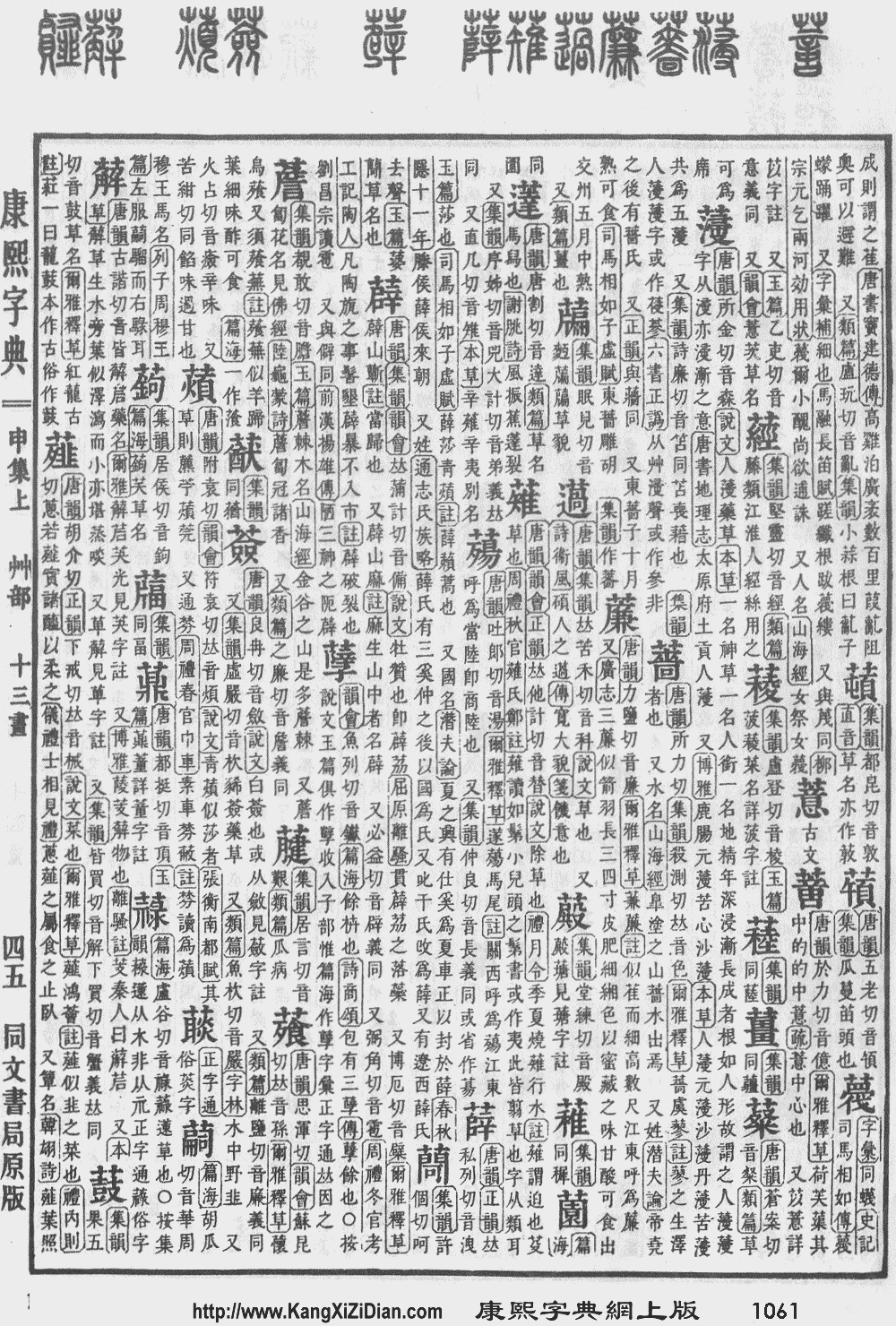
- Kangxi Dictionary: page 1061, character 40
- Dai Kanwa Jiten: character 32141
- Dae Jaweon: page 1526, character 7
- Hanyu Da Zidian (first edition): volume 5, page 3300, character 15
- Unihan data for U+85A4
Chinese
| trad. | 薤 | |
|---|---|---|
| simp. # | 薤 | |
Glyph origin
Pronunciation
Synonyms
Dialectal synonyms of 薤 (“Chinese onion”) [map]
Japanese
Etymology
| Kanji in this term |
|---|
| 薤 |
| らっきょう Hyōgaiji |
| kun’yomi |
| For pronunciation and definitions of 薤 – see the following entry. | ||
| ||
| (This term, 薤, is an alternative spelling of the above term.) |
Korean
Hanja
薤 • (hae) (hangeul 해, revised hae, McCune–Reischauer hae, Yale hay)
- This term needs a translation to English. Please help out and add a translation, then remove the text
{{rfdef}}.
This article is issued from Wiktionary. The text is licensed under Creative Commons - Attribution - Sharealike. Additional terms may apply for the media files.