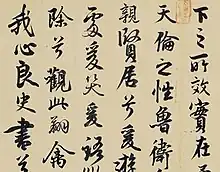
行書

See also: 行书

Chinese

 
to go; to do; capable
to go; to do; capable; all right; competent; OK; to travel; temporary; to walk; will do; behaviour; conduct; a row; profession; professional
book; letter
trad. (行書) 行 書
simp. (行书) 行 书
Manuscript in semi-cursive script (Li Longji, 719)

Pronunciation


Rime
Character 行 書
Reading # 2/4 1/1
Initial (聲) 匣 (33) 書 (26)
Final (韻) 庚 (109) 魚 (22)
Tone (調) Level (Ø) Level (Ø)
Openness (開合) Open Open
Division (等) II III
Fanqie 戸庚切 傷魚切
Baxter haeng syo
Reconstructions
Zhengzhang
Shangfang
/ɦˠæŋ/ /ɕɨʌ/
Pan
Wuyun
/ɦᵚaŋ/ /ɕiɔ/
Shao
Rongfen
/ɣaŋ/ /ɕiɔ/
Edwin
Pulleyblank
/ɦaɨjŋ/ /ɕɨə̆/
Li
Rong
/ɣɐŋ/ /ɕiɔ/
Wang
Li
/ɣɐŋ/ /ɕĭo/
Bernard
Karlgren
/ɣɐŋ/ /ɕi̯wo/
Expected
Mandarin
Reflex
héng shū
Expected
Cantonese
Reflex
hang4 syu1

Noun

行書

  1. (calligraphy) semi-cursive script; running hand; running script

Descendants

Sino-Xenic (行書):
  • → Japanese: 行書(ぎょうしょ) (gyōsho)
  • → Korean: 행서(行書) (haengseo)
  • → Vietnamese: hành thư (行書)

See also

Japanese

Kanji in this term
行 書
ぎょう
Grade: 2
しょ
Grade: 2
on’yomi

Pronunciation

  • (Tokyo) ぎょーしょ [gyòóshó] (Heiban – [0])[1]
  • IPA(key): [ɡʲo̞ːɕo̞]

Noun

行(ぎょう)書(しょ) • (gyōsho) ←ぎやうしよ (gyausyo)?

  1. semi-cursive script

See also

References

  1. Matsumura, Akira, editor (2006), 大辞林 [Daijirin] (in Japanese), Third edition, Tōkyō: Sanseidō, →ISBN

Korean

Hanja in this term
行書

Noun

行書 • (haengseo) (hangeul 행서)

  1. Hanja form? of 행서 (“semi-cursive script”).

Vietnamese

chữ Hán Nôm in this term
行書

Noun

行書

  1. chữ Hán form of hành thư (“semi-cursive script”).
This article is issued from Wiktionary. The text is licensed under Creative Commons - Attribution - Sharealike. Additional terms may apply for the media files.