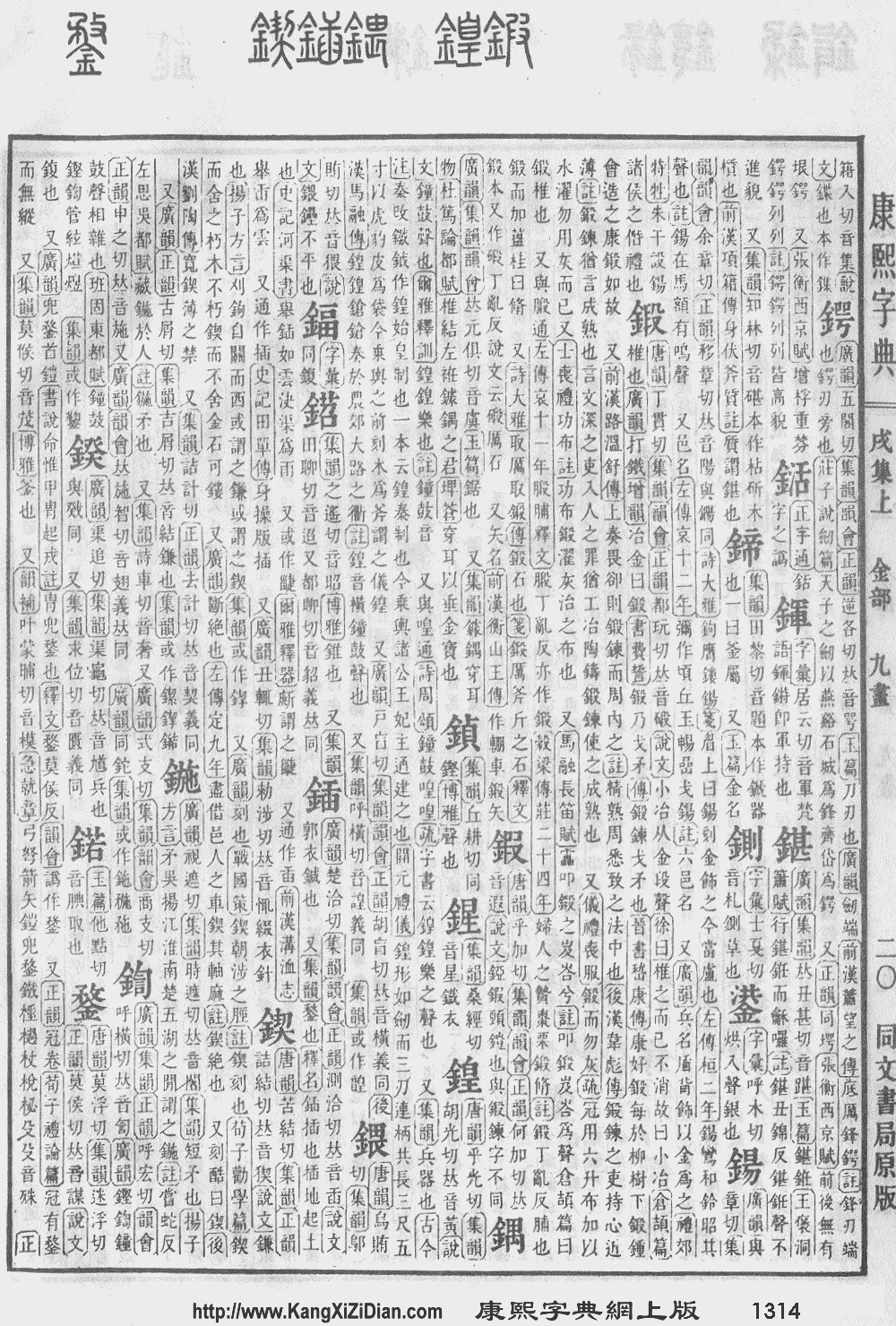
鍛

See also: 煅 and 锻
鍛 U+935B, 鍛
CJK UNIFIED IDEOGRAPH-935B
← 鍚
[U+935A]
CJK Unified Ideographs 鍜 →
[U+935C]

Translingual

Han character

鍛 (Kangxi radical 167, 金+9, 17 strokes, cangjie input 金竹十水 (CHJE), four-corner 87147, composition ⿰釒段)

References

  • Kangxi Dictionary: page 1314, character 9
  • Dai Kanwa Jiten: character 40625
  • Dae Jaweon: page 1814, character 26
  • Hanyu Da Zidian (first edition): volume 6, page 4233, character 1
  • Unihan data for U+935B

Chinese

trad. 鍛
simp. 锻
2nd round simp. 煅

Glyph origin

Phono-semantic compound (形聲/形声, OC *toːns) : semantic 釒/钅 (“metal”) + phonetic 段 (OC *doːns).

Pronunciation


Note:
  • duêng3 - Chaozhou;
  • duang3 - Shantou.

    Rime
    Character 鍛
    Reading # 1/1
    Initial (聲) 端 (5)
    Final (韻) 桓 (62)
    Tone (調) Departing (H)
    Openness (開合) Closed
    Division (等) I
    Fanqie 丁貫切
    Baxter twanH
    Reconstructions
    Zhengzhang
    Shangfang
    /tuɑnH/
    Pan
    Wuyun
    /tʷɑnH/
    Shao
    Rongfen
    /tuɑnH/
    Edwin
    Pulleyblank
    /twanH/
    Li
    Rong
    /tuɑnH/
    Wang
    Li
    /tuɑnH/
    Bernard
    Karlgren
    /tuɑnH/
    Expected
    Mandarin
    Reflex
    duàn
    Expected
    Cantonese
    Reflex
    dyun3
    Zhengzhang system (2003)
    Character 鍛
    Reading # 1/1
    No. 2529
    Phonetic
    component
    段
    Rime
    group
    元
    Rime
    subdivision
    3
    Corresponding
    MC rime
    鍛
    Old
    Chinese
    /*toːns/

    Definitions

    鍛

    1. to forge; to shape metal
      鍛造/锻造  ―  duànzào  ―  to forge
    2. to temper; to refine

    Compounds

    • 日鍛月煉/日锻月炼
    • 月鍛季煉/月锻季炼
    • 百鍛千練/百锻千练
    • 鍛件/锻件 (duànjiàn)
    • 鍛冶/锻冶 (duànyě)
    • 鍛壓/锻压
    • 鍛工/锻工
    • 鍛打/锻打
    • 鍛接/锻接
    • 鍛模/锻模
    • 鍛焊/锻焊
    • 鍛燒/锻烧
    • 鍛矢/锻矢
    • 鍛造/锻造 (duànzào)
    • 鍛錘/锻锤
    • 鍛鍊/锻炼 (duànliàn)
    • 鍛鐵/锻铁 (duàntiě)

    Japanese

    Kanji

    鍛

    (common “Jōyō” kanji)

    1. to forge
    2. to toughen
    3. workout, discipline, training

    Readings

    Compounds

    Etymology 1

    Kanji in this term
    鍛
    たん
    Grade: S
    on’yomi

    From Middle Chinese 鍛 (MC twanH).

    Affix

    鍛(たん) • (tan) 

    1. forging, smithing
    2. (by extension) refining, disciplining (of the mind, body, etc.)
    Derived terms

    Etymology 2

    Kanji in this term
    鍛
    きた(え)
    Grade: S
    kun’yomi

    Nominalization of 鍛え (kitae, “forging”).

    Proper noun

    鍛(きたえ) • (Kitae) ←きたへ (kitafe)?

    1. a male given name

    Korean

    Hanja

    鍛 (eumhun 불릴 단 (bullil dan))

    1. This term needs a translation to English. Please help out and add a translation, then remove the text {{rfdef}}.

    Compounds

    Old Japanese

    Etymology

    ⟨kana uti⟩ → ⟨kanuti⟩

    Originally a compound of 金 (kana, combining form of kane, “metal”) +‎ 打ち (uti, the 連用形 (ren'yōkei, “stem or continuative form”) of verb 打つ (utu), “to strike”).

    Noun

    鍛 (kanuti) (kana かぬち)

    1. the forging of metal; also such a person who forges metal: a metalsmith, smith

    Derived terms

    • 鍛部 (kanutibe2)
    • 鍛冶司 (kanuti no2 tukasa)
    • 韓鍛 (Kara kanuti)

    Descendants

    • Japanese: 鍛冶 (kaji)

    Vietnamese

    Han character

    鍛: Hán Nôm readings: đoán, đoàn

    1. This term needs a translation to English. Please help out and add a translation, then remove the text {{rfdef}}.
    This article is issued from Wiktionary. The text is licensed under Creative Commons - Attribution - Sharealike. Additional terms may apply for the media files.