降
See also: 隆
| ||||||||
| ||||||||
Translingual
Han character
降 (Kangxi radical 170, 阜+6 in Chinese, 阜+7 in Japanese, 9 strokes in Chinese in traditional Chinese, 8 strokes in mainland China, 10 strokes in Japanese, cangjie input 弓中竹水手 (NLHEQ), four-corner 77254, composition ⿰阝夅)
Derived characters
- 𭉓, 𤌅, 𧌰, 𡲣, 𡹷, 𫁫, 𩄐, 𤯲
References
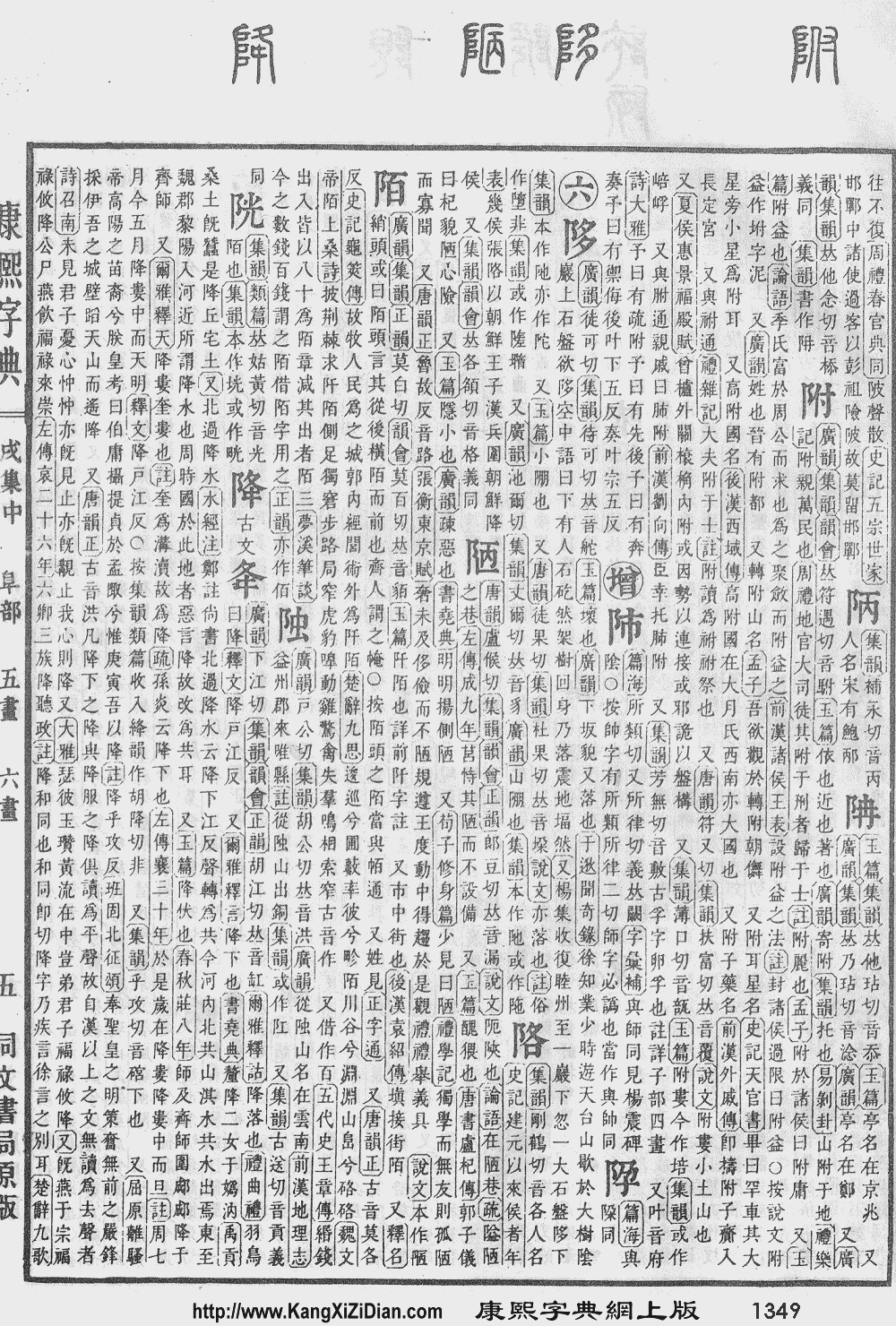
- Kangxi Dictionary: page 1349, character 12
- Dai Kanwa Jiten: character 41620
- Dae Jaweon: page 1852, character 4
- Hanyu Da Zidian (first edition): volume 6, page 4126, character 18
- Unihan data for U+964D
- Unihan data for U+FA09
Chinese
| trad. | 降 | |
|---|---|---|
| simp. # | 降 | |
| alternative forms | 夅 𨹓 𡲣 𡲛 𫱔 (kiung) Hakka | |
Glyph origin
| Historical forms of the character 降 | |
|---|---|
| Shang | Western Zhou |
| Oracle bone script | Bronze inscriptions |
 |
 |
Characters in the same phonetic series (夅) (Zhengzhang, 2003)
Phono-semantic compound (形聲/形声, OC *kruːŋs, *ɡruːŋ) and ideogrammic compound (會意/会意) : semantic 阝 (“hill, wall”) + phonetic 夅 (OC *ɡruːŋ, “to descend”) – descending a hill.
Etymology
Definitions
降
- to fall; to drop; to descend; to come down
- 降落 ― jiàngluò ― to fall; to land
- (honorific) to visit; to honor with one's presence
- to bestow; to confer
- 天降喪亂,饑饉薦臻。 [Pre-Classical Chinese, trad.]
- From: The Classic of Poetry, c. 11th – 7th centuries BCE, translated based on James Legge's version
- Tiān jiàng sāngluàn, jījǐn jiànzhēn. [Pinyin]
- That Heaven [thus] sends down death and disorder?
Famine comes again and again.
天降丧乱,饥馑荐臻。 [Pre-Classical Chinese, simp.]
- to reduce; to decrease; to lower
- (music) flat (♭)
- 降A大調/降A大调 ― jiàngēidàdiào ― A-flat major
- to be born
- (Hakka) to give birth
- a surname
Compounds
- 下降 (xiàjiàng)
- 以降 (yǐjiàng)
- 光降
- 升降 (shēngjiàng)
- 升降機 (shēngjiàngjī)
- 升降舵 (shēngjiàngduò)
- 名降
- 喜從天降/喜从天降
- 崧生嶽降/崧生岳降
- 嵩嶽降神/嵩岳降神
- 左降
- 強迫降落/强迫降落
- 從天而降/从天而降 (cóngtiān'érjiàng)
- 打降
- 技術降落/技术降落
- 明降
- 昴降
- 星降
- 普降甘霖
- 牛筋牛降
- 禍從天降/祸从天降
- 空降 (kōngjiàng)
- 空降作戰/空降作战
- 空降兵 (kōngjiàngbīng)
- 空降部隊/空降部队
- 紆尊降貴/纡尊降贵 (yūzūnjiàngguì)
- 調降/调降 (tiáojiàng)
- 謫降/谪降
- 貴降/贵降
- 賤降/贱降 (jiànjiàng)
- 迫降
- 降下 (jiàngxià)
- 降世 (jiàngshì)
- 降乩
- 降交點/降交点
- 降低 (jiàngdī)
- 降價/降价 (jiàngjià)
- 降元音
- 降冪/降幂 (jiàngmì)
- 降冪排列/降幂排列
- 降凡
- 降升調
- 降半旗 (jiàngbànqí)
- 降咎
- 降壓器/降压器
- 降席
- 降幅 (jiàngfú)
- 降心相從/降心相从
- 降志辱身
- 降情
- 降旗 (jiàngqí)
- 降旨 (jiàngzhǐ)
- 降格 (jiànggé)
- 降格以求
- 降格仿諷/降格仿讽
- 降水 (jiàngshuǐ)
- 降水量 (jiàngshuǐliàng)
- 降溫/降温 (jiàngwēn)
- 降火 (jiànghuǒ)
- 降災/降灾
- 降生 (jiàngshēng)
- 降真香
- 降神 (jiàngshén)
- 降祥
- 降福
- 降級/降级 (jiàngjí)
- 降級數/降级数
- 降罪
- 降職/降职 (jiàngzhí)
- 降臨/降临 (jiànglín)
- 降落 (jiàngluò)
- 降落傘/降落伞 (jiàngluòsǎn)
- 降薪 (jiàngxīn)
- 降詔/降诏 (jiàngzhào)
- 降調/降调 (jiàngdiào)
- 降貴紆尊/降贵纡尊
- 降降的
- 降階/降阶
- 降雨 (jiàngyǔ)
- 降霜
- 降香 (jiàngxiāng)
- 陟降
- 霜降 (Shuāngjiàng)
- 頻頻貶降/频频贬降
- 驟降/骤降 (zhòujiàng)
- 黜降
Descendants
Pronunciation 2
Definitions
降
Compounds
Descendants
Japanese
| Shinjitai | 降 |  |
| Kyūjitai [1] |
降󠄃 降+ 󠄃?(Hanyo-Denshi) (Moji_Joho) |
 |
| The displayed kanji may be different from the image due to your environment. See here for details. | ||
Readings
- Go-on: こう (kō, Jōyō)←こう (kou, historical); ごう (gō)←ごう (gou, historical)
- Kan-on: こう (kō, Jōyō)←かう (kau, historical)
- Kun: おりる (oriru, 降りる, Jōyō)←おる (oru, 降る, historical); おろす (orosu, 降ろす, Jōyō); ふる (furu, 降る, Jōyō); くだす (kudasu, 降す); くだる (kudaru, 降る); ふらす (furasu, 降らす); ふり (furi, 降り)
- Nanori: ふり (furi); ふる (furu)
Compounds
References
- “降”, in 漢字ぺディア (Kanjipedia) (in Japanese), 日本漢字能力検定協会, 2015–2024
Korean
Etymology 1
From Middle Chinese 降 (MC kaewngH).
| Historical Readings | ||
|---|---|---|
| Dongguk Jeongun Reading | ||
| Dongguk Jeongun, 1448 | Recorded as Middle Korean 가ᇰ〮 (Yale: káng) in Dongguk Jeongun (東國正韻 / 동국정운), 1448. | |
| Middle Korean | ||
| Text | Eumhun | |
| Gloss (hun) | Reading | |
| Hunmong Jahoe, 1527 | ᄂᆞ릴 강 | Recorded as Middle Korean 강 (kang) (Yale: kang) in Sinjeung Yuhap (新增類合 / 신증유합), 1576. |
Pronunciation
- (SK Standard/Seoul) IPA(key): [ka̠(ː)ŋ]
- Phonetic hangul: [강(ː)]
- Though still prescribed in Standard Korean, most speakers in both Koreas no longer distinguish vowel length.
Compounds
Compounds
- 강단 (降壇, gangdan)
- 강등 (降等, gangdeung)
- 강림 (降臨, gangnim)
- 강설 (降雪, gangseol)
- 강쇄 (降殺, gangswae)
- 강수 (降水, gangsu)
- 강신 (降神, gangsin)
- 강우 (降雨, gang'u)
- 강탄 (降誕, gangtan)
- 강하 (降下, gangha)
- 낙강/락강 (落降, nakgang/rakgang)
- 등강 (登降, deunggang)
- 상강 (霜降, sanggang)
- 승강 (昇降, seunggang)
- 적강 (謫降, jeokgang)
- 척강 (陟降, cheokgang)
- 침강 (沈降, chimgang)
- 탄강 (誕降, tan'gang)
- 하강 (下降, hagang)
- 활강 (滑降, hwalgang)
- 강수량 (降水量, gangsuryang)
- 강신술 (降神術, gangsinsul)
- 승강기 (昇降機, seungganggi)
Etymology 2
From Middle Chinese 降 (MC haewng).
| Historical Readings | ||
|---|---|---|
| Dongguk Jeongun Reading | ||
| Dongguk Jeongun, 1448 | Recorded as Middle Korean ᅘᅡᇰ (Yale: hhàng) in Dongguk Jeongun (東國正韻 / 동국정운), 1448. | |
| Middle Korean | ||
| Text | Eumhun | |
| Gloss (hun) | Reading | |
| Hunmong Jahoe, 1527 | 항복 항[1] | Recorded as Middle Korean 항 (hang) (Yale: hang) in Sinjeung Yuhap (新增類合 / 신증유합), 1576. |
| ||
Pronunciation
- (SK Standard/Seoul) IPA(key): [ha̠ŋ]
- Phonetic hangul: [항]
Compounds
Vietnamese
Han character
降: Hán Việt readings: giáng[1][2][3][4][5], hàng (
降: Nôm readings: hàng[1][2][6][4][7], giáng[2][4][7], dán[1][2], nháng[3], giuống[6]
Compounds
- 降級 (giáng cấp)
- 降禍 (giáng họa/giáng hoạ)
- 降福 (giáng phúc)
- 降生 (giáng sinh/Giáng sinh)
- 降世 (giáng thế)
- 降秩 (giáng trật)
References
- Nguyễn (2014).
- Nguyễn et al. (2009).
- Trần (2004).
- Bonet (1899).
- Génibrel (1898).
- Hồ (1976).
- Taberd & Pigneau de Béhaine (1838).
This article is issued from Wiktionary. The text is licensed under Creative Commons - Attribution - Sharealike. Additional terms may apply for the media files.