鞬
| ||||||||
Translingual
Han character
鞬 (Kangxi radical 177, 革+9, 18 strokes, cangjie input 廿十弓大手 (TJNKQ), four-corner 45044, composition ⿰革建)
- a leather case for bow and arrow
References
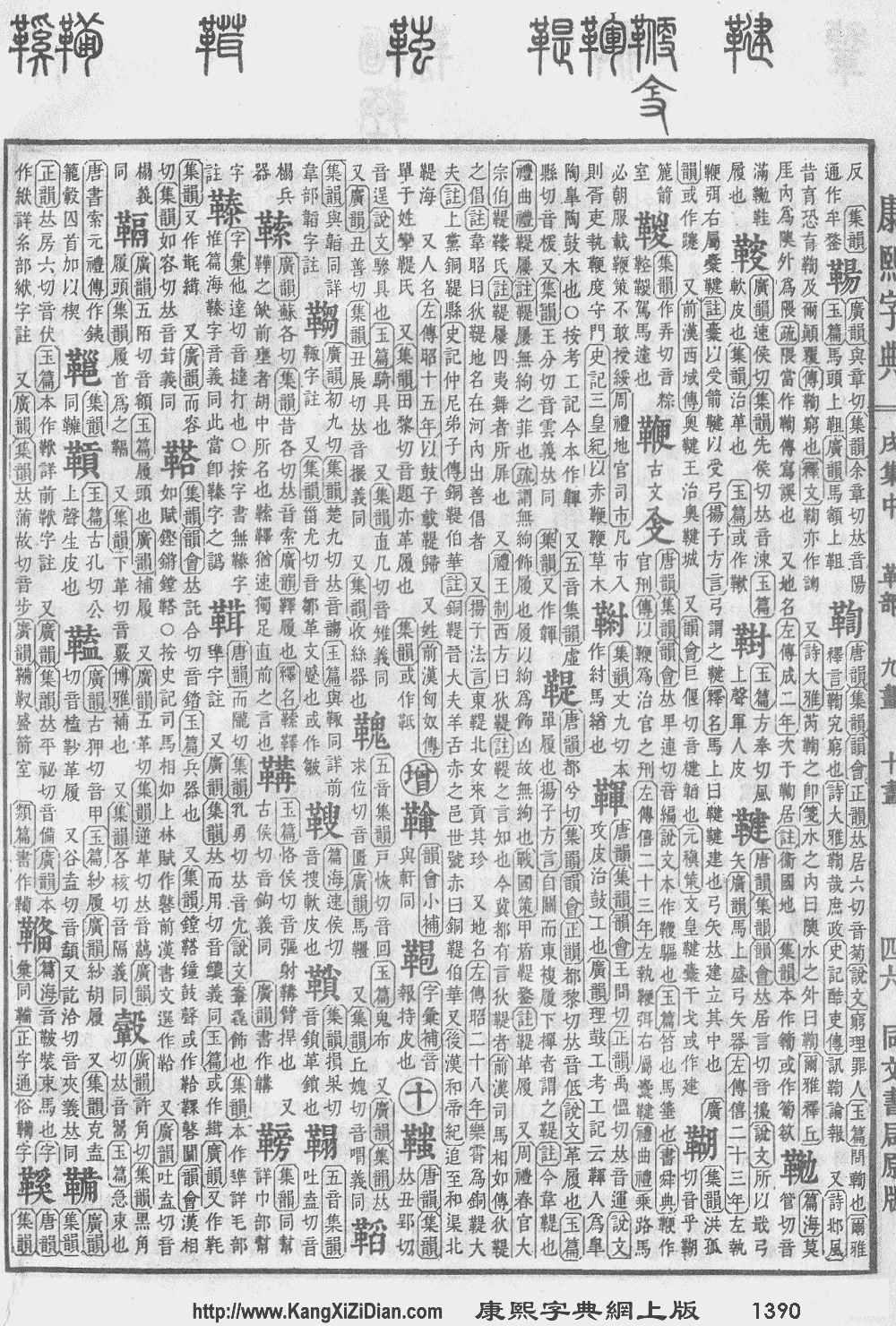
- Kangxi Dictionary: page 1390, character 6
- Dai Kanwa Jiten: character 42934
- Dae Jaweon: page 1904, character 28
- Hanyu Da Zidian (first edition): volume 7, page 4341, character 5
- Unihan data for U+97AC
Baekje
Etymology
Probably inflecting stem *k(j)ə- + gerundive *-n, the latter being attested as Old Korean 隱 (*-n).
Connected to Middle Korean 하 (ha-, “to be many, to be great”), Old Korean *흐그 (*huku-) > Middle Korean 크〮 (khú, “to be large”).
Reconstruction notes
Attested as 鞬 (MC kjon) in Book of Zhou, as part of a compound word.
Attested primarily in compounds as コニ (*koni) or sometimes コ (*ko) in kana glosses to the Nihon Shoki. コニ (*koni) may be a transcription of *k(j)ə-n because Old Japanese lacked coda *-n, or alternatively a transcription of the sequence *k(j)ə-n i "the great one"; compare Middle Korean 크〮니〮 (khún í, “id.”). Also attested in the original text as 琨 (MC kwon).
Perhaps also attested as 近 (MC gj+nX|gj+nH), an element in the titles of several Baekje kings: 近肖古王 (Geun-Chogo-wang), 近仇首王 (Geun-Gusu-wang), etc. These titles are also attested in forms that lack 近, showing that it is a separate, detachable element.
Derived terms
- 鞬吉支 (*kən-kici, “king (of Baekje)”)
References
- John Bentley (2000) “New Look at Paekche and Korean: Data from Nihon shoki”, in Language Research, volume 36, number 2, Seoul National University, pages 417—443
- Alexander Vovin (2013) “From Koguryo to T'amna”, in Korean Linguistics, volume 15, number 2, John Benjamins Publishing Company, pages 222—240
Chinese
Glyph origin
Phono-semantic compound (形聲/形声, OC *kan) : semantic 革 + phonetic 建 (OC *kans).
Pronunciation
Definitions
鞬
- This term needs a translation to English. Please help out and add a translation, then remove the text
{{rfdef}}.
Compounds
- 弓鞬
- 櫜鞬
- 鞬服
Pronunciation
Definitions
鞬
- This term needs a translation to English. Please help out and add a translation, then remove the text
{{rfdef}}.
References
- Dictionary of Chinese Character Variants (教育部異體字字典), B05631
- “鞬”, in 漢語多功能字庫 (Multi-function Chinese Character Database), 香港中文大學 (the Chinese University of Hong Kong), 2014–