餌

See also: 饵
餌 U+990C, 餌
CJK UNIFIED IDEOGRAPH-990C
← 餋
[U+990B]
CJK Unified Ideographs 餍 →
[U+990D]

Translingual

Han character

餌 (Kangxi radical 184, 食+6, 15 strokes, cangjie input 人戈尸十 (OISJ), four-corner 81740, composition ⿰飠耳)

References

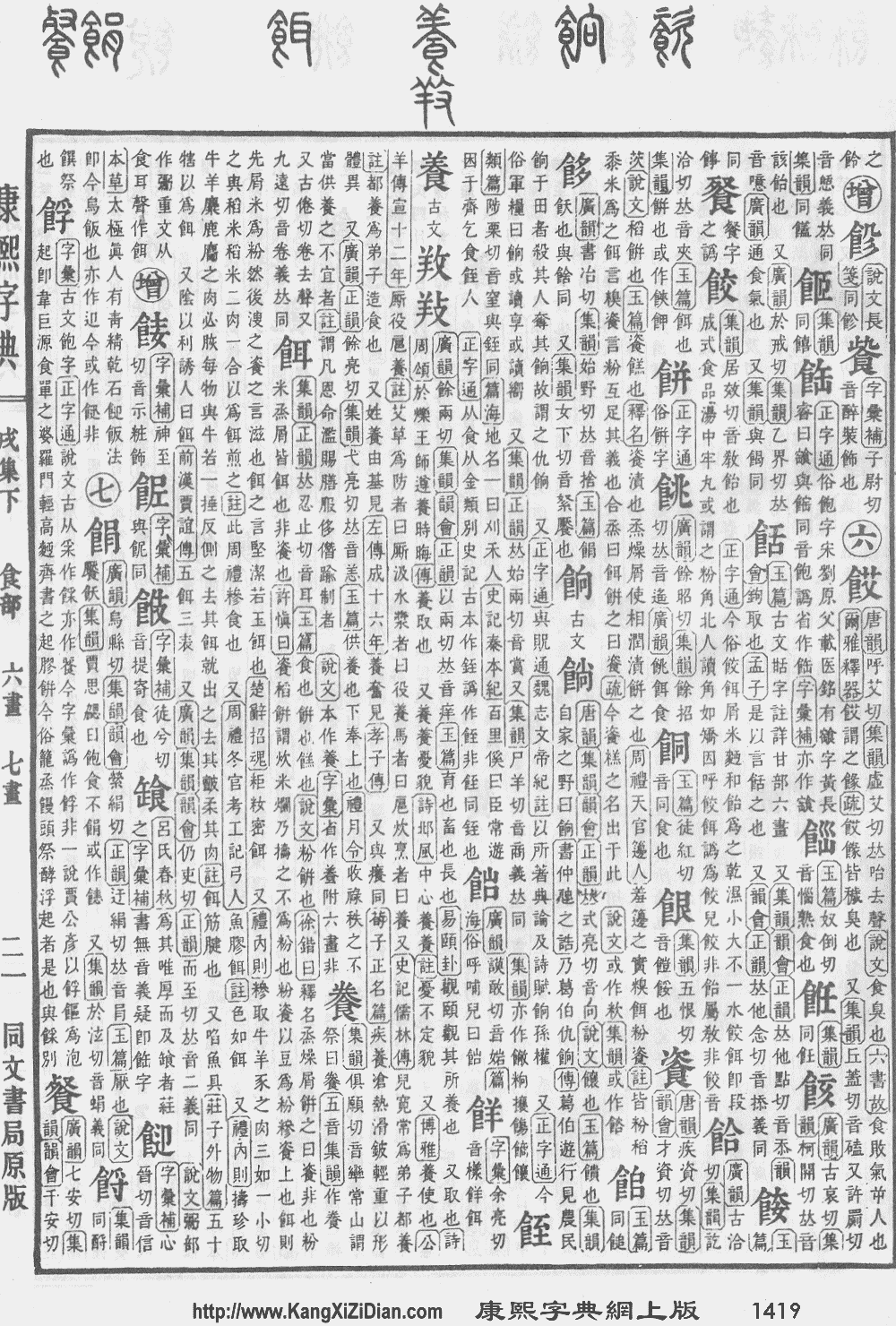
  • Kangxi Dictionary: page 1419, character 30
  • Dai Kanwa Jiten: character 44146
  • Dae Jaweon: page 1944, character 2
  • Hanyu Da Zidian (first edition): volume 7, page 4449, character 13
  • Unihan data for U+990C

Chinese

trad. 餌
simp. 饵
alternative forms 𩱓
㢽
𧊗 bait
𩚪
𩛣

Glyph origin

Phono-semantic compound (形聲/形声, OC *njɯs) : semantic 食 (“to eat”) + phonetic 耳 (OC *njɯʔ).

Etymology

An area word. Compare Khmer នុយ (nuy, “bait; lure (especially for catching fish)”), Thai เหยื่อ (yʉ̀ʉa, “bait”) (Schuelsser, 2007).

Pronunciation


Note:
  • lī/jī - vernacular;
  • ní/jíⁿ - literary.

Rime
Character 餌
Reading # 1/1
Initial (聲) 日 (38)
Final (韻) 之 (19)
Tone (調) Departing (H)
Openness (開合) Open
Division (等) III
Fanqie 仍吏切
Baxter nyiH
Reconstructions
Zhengzhang
Shangfang
/ȵɨH/
Pan
Wuyun
/ȵɨH/
Shao
Rongfen
/ȵʑieH/
Edwin
Pulleyblank
/ȵɨH/
Li
Rong
/ȵiəH/
Wang
Li
/ȵʑĭəH/
Bernard
Karlgren
/ȵʑiH/
Expected
Mandarin
Reflex
èr
Expected
Cantonese
Reflex
ji6
Baxter–Sagart system 1.1 (2014)
Character 餌
Reading # 1/1
Modern
Beijing
(Pinyin)
ěr
Middle
Chinese
‹ nyiH ›
Old
Chinese
/*[C.]nə(ʔ)-s/
English bait

Notes for Old Chinese notations in the Baxter–Sagart system:

* Parentheses "()" indicate uncertain presence;
* Square brackets "[]" indicate uncertain identity, e.g. *[t] as coda may in fact be *-t or *-p;
* Angle brackets "<>" indicate infix;
* Hyphen "-" indicates morpheme boundary;

* Period "." indicates syllable boundary.
Zhengzhang system (2003)
Character 餌
Reading # 1/1
No. 2786
Phonetic
component
耳
Rime
group
之
Rime
subdivision
0
Corresponding
MC rime
餌
Old
Chinese
/*njɯs/

Definitions

餌

  1. food made of rice dough
  2. food
  3. medicine
  4. to eat
  5. to feed
  6. bait (either for fish or for other animals)
  7. to lure

Compounds

  • 以狸餌鼠/以狸饵鼠
  • 抑威餌敵/抑威饵敌
  • 服餌/服饵
  • 果餌/果饵
  • 毒餌/毒饵 (dú'ěr)
  • 祿餌/禄饵
  • 芳餌/芳饵
  • 藥餌/药饵 (yào'ěr)
  • 虜餌/虏饵
  • 誘餌/诱饵 (yòu'ěr)
  • 針餌莫減/针饵莫减
  • 釣餌/钓饵 (diào'ěr)
  • 餌名釣祿/饵名钓禄
  • 餌料生物/饵料生物
  • 餌藥/饵药
  • 餌誘/饵诱 (ěryòu)
  • 餌釣/饵钓
  • 餅餌/饼饵 (bǐng'ěr)
  • 香餌/香饵
  • 魚餌/鱼饵 (yú'ěr)

Japanese

Kanji

餌

(common “Jōyō” kanji)

Readings

Compounds

Etymology 1

Kanji in this term
餌
えさ
Grade: S
kun’yomi

Pronunciation

Noun

餌(えさ) • (esa) ←ゑさ (wesa)?

  1. animal food, feed
    犬(いぬ)に毎日(まいにち)餌(えさ)を上(あ)げて下(くだ)さい。
    Inu ni mainichi esa o agete kudasai.
    Please feed the dog every day.
    トンビにエサをあたえないでください。
    Tonbi ni esa o ataenaide kudasai.
    Please do not feed the black kites.
    (literally, “Please do not give food to the black kites.”)
  2. bait
Derived terms

Etymology 2

Kanji in this term
餌
え
Grade: S
kun’yomi

Pronunciation

Noun

餌(え) • (e) ←ゑ (we)?

  1. animal food, feed
  2. bait
Derived terms

References

  1. Matsumura, Akira, editor (2006), 大辞林 [Daijirin] (in Japanese), Third edition, Tōkyō: Sanseidō, →ISBN

Korean

Hanja

餌 • (i) (hangeul 이, revised i, McCune–Reischauer i, Yale i)

  1. This term needs a translation to English. Please help out and add a translation, then remove the text {{rfdef}}.

Vietnamese

Han character

餌: Hán Nôm readings: nhị, nhĩ

  1. This term needs a translation to English. Please help out and add a translation, then remove the text {{rfdef}}.
This article is issued from Wiktionary. The text is licensed under Creative Commons - Attribution - Sharealike. Additional terms may apply for the media files.