게
(see here for particles and suffixes)
| ||||||||||
| 게겍겎겏겐겑겒 겓겔겕겖겗겘겙 겚겛겜겝겞겟겠 겡겢겣겤겥겦겧 | |
| 거 ← | → 겨 |
|---|---|
See also: -게
Korean
Pronunciation
- (SK Standard/Seoul) IPA(key): [ke̞]
- Phonetic hangul: [게]
| Romanizations | |
|---|---|
| Revised Romanization? | ge |
| Revised Romanization (translit.)? | ge |
| McCune–Reischauer? | ke |
| Yale Romanization? | key |
Dependent noun
게 • (ge)
Etymology 2
First attested in the Gugeupbang eonhae (救急方諺解 / 구급방언해), 1466, as Middle Korean 게〯 (Yale: kěy).
Middle Korean rising pitch implies an earlier bisyllabic form; Japanese 蟹 (kani) is a possible parallel.
Consider also Pyongan Korean 궝이 (gwong'i, “crab”) and Jeju 깅이 (ging'i, “crab”), although both could be secondary developments because Koreanic varieties sometimes insert /ŋ/ to break hiatus between vowels.
Pronunciation
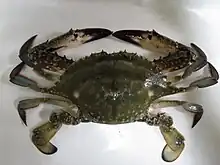
- (SK Standard/Seoul) IPA(key): [ke̞(ː)]
- Phonetic hangul: [게(ː)]
- Though still prescribed in Standard Korean, most speakers in both Koreas no longer distinguish vowel length.
| Romanizations | |
|---|---|
| Revised Romanization? | ge |
| Revised Romanization (translit.)? | ge |
| McCune–Reischauer? | ke |
| Yale Romanization? | kēy |
Usage notes
- In contemporary Seoul pronunciation, this word is homophonous with 개 (gae, “dog”). Speakers may resort to circumlocutions in ambiguous situations, e.g. 멍멍 개 (meongmeong gae, “dog that goes meong-meong”), 따각따각 게 (ttagakttagak ge, “crab that goes ttagak-ttagak”), or '꽃게' 할 때 게 (kkotge hal ttae ge, “'crab' as in 'horse crab'”).
Derived terms
Etymology 3
From Middle Korean 그ᅌᅦ (Yale: ku.ngey), contraction of 그ᅌᅥ긔 (Yale: ku.ngekuy).
Pronunciation
- (SK Standard/Seoul) IPA(key): [ke̞]
- Phonetic hangul: [게]
| Romanizations | |
|---|---|
| Revised Romanization? | ge |
| Revised Romanization (translit.)? | ge |
| McCune–Reischauer? | ke |
| Yale Romanization? | key |
Pronoun
게 • (ge)
Etymology 4
Korean reading of various Chinese characters.
Syllable
게 (ge)
| Extended content |
|---|
References
- Supreme Court of the Republic of Korea (대한민국 대법원, Daehanmin'guk Daebeobwon) (2018). Table of hanja for personal names (인명용 한자표 / 人名用漢字表, Inmyeong-yong hanja-pyo).
This article is issued from Wiktionary. The text is licensed under Creative Commons - Attribution - Sharealike. Additional terms may apply for the media files.