떡
| ||||||||||
| 떠떡떢떣떤떥떦 떧떨떩떪떫떬떭 떮떯떰떱떲떳떴 떵떶떷떸떹떺떻 | |
| 떄 ← | → 떼 |
|---|---|
Korean
Etymology 1
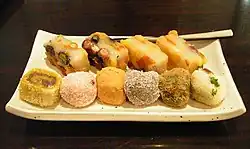
First attested in the Worin seokbo (月印釋譜 / 월인석보), 1459, as Middle Korean ᄯᅥᆨ〮 (Yale: sték). Japanese 粢 (shitogi, “sacrificial Shinto rice cake”) is often given as a Koreanic borrowing into Japanese;[1][2] also compare Ainu シト (sito, “dumpling made from rice or millet”).
Pronunciation
- (SK Standard/Seoul) IPA(key): [t͈ʌ̹k̚]
- Phonetic hangul: [떡]
| Romanizations | |
|---|---|
| Revised Romanization? | tteok |
| Revised Romanization (translit.)? | tteog |
| McCune–Reischauer? | ttŏk |
| Yale Romanization? | ttek |
- South Gyeongsang (Busan) pitch accent: 떡의 / 떡에 / 떡까지
Syllables in red take high pitch. This word always takes high pitch and also heightens the next suffixed syllable, unless it is 에.
Derived terms
- 가래떡 (garaetteok)
- 개떡 (gaetteok)
- 떡가래 (tteokgarae)
- 떡가루 (tteokgaru)
- 떡갈비 (tteokgalbi)
- 떡고물 (tteokgomul)
- 떡국 (tteokguk)
- 떡메 (tteongme)
- 떡밥 (tteokbap)
- 떡방아 (tteokbang'a)
- 떡보 (tteokbo)
- 떡볶이 (tteokbokki)
- 떡살 (tteoksal)
- 떡소 (tteokso)
- 떡시루 (tteoksiru)
- 떡쌀 (tteokssal)
- 떡치다 (tteokchida)
- 떡판 (tteokpan)
- 시루떡 (sirutteok)
- 쑥떡 (ssuktteok)
- 찰떡 (chaltteok)
- 호떡 (hotteok)
Related terms
- 시더구 (sideogu)

Pronunciation
- (SK Standard/Seoul) IPA(key): [t͈ʌ̹k̚]
- Phonetic hangul: [떡]
| Romanizations | |
|---|---|
| Revised Romanization? | tteok |
| Revised Romanization (translit.)? | tteog |
| McCune–Reischauer? | ttŏk |
| Yale Romanization? | ttek |
References
- Martin, Samuel E. (1996) Consonant Lenition in Korean and the Macro-Altaic Question, Honolulu: University of Hawaiʻi Press, →ISBN, page 45
- Frellesvig, Bjarke (2010) A History of the Japanese Language, Cambridge: Cambridge University Press, →ISBN, page 147
This article is issued from Wiktionary. The text is licensed under Creative Commons - Attribution - Sharealike. Additional terms may apply for the media files.