匠
| ||||||||
Translingual
Han character
匠 (Kangxi radical 22, 匚+4, 6 strokes, cangjie input 尸竹一中 (SHML), four-corner 71712, composition ⿷匚斤)
Derived characters
- 𰁳
References
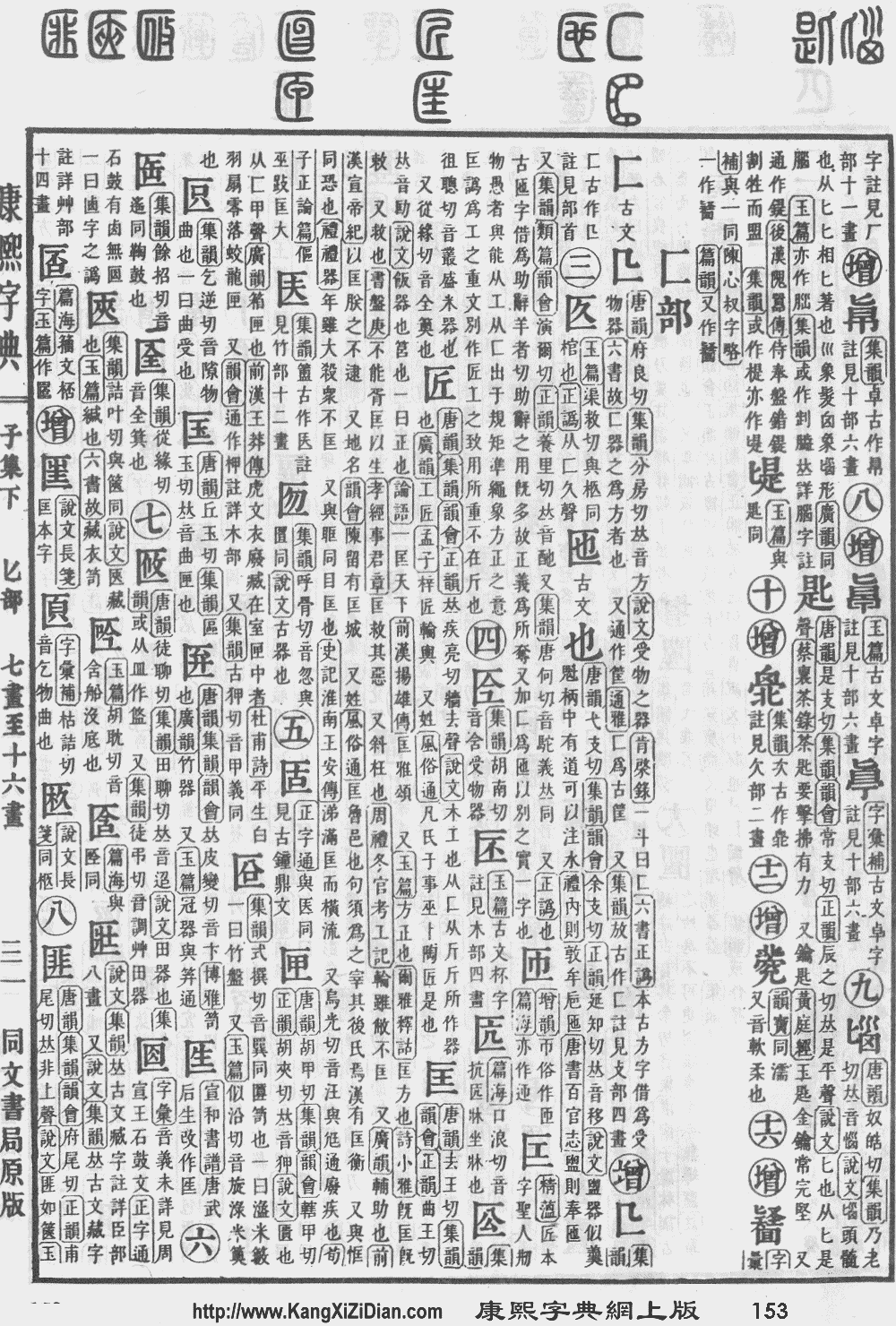
- Kangxi Dictionary: page 153, character 22
- Dai Kanwa Jiten: character 2605
- Dae Jaweon: page 345, character 11
- Hanyu Da Zidian (first edition): volume 1, page 83, character 5
- Unihan data for U+5320
Chinese
| simp. and trad. |
匠 | |
|---|---|---|
| alternative forms | 匞 | |
Glyph origin
| Historical forms of the character 匠 | ||
|---|---|---|
| Warring States | Shuowen Jiezi (compiled in Han) | Liushutong (compiled in Ming) |
| Qin slip script | Small seal script | Transcribed ancient scripts |
 |
 |
 |
Traditionally thought to be an ideogrammic compound (會意/会意) : 匚 (“box”) + 斤 (“axe”) (e.g. Shuowen).
In more recent scholarship (e.g. Zhengzhang, 2003; Baxter and Sagart, 2014), an alternative glyph origin has been proposed, suggesting that it is a phono-semantic compound (形聲/形声, OC *sbaŋs) : phonetic 匚 (OC *paŋ) + semantic 斤 (“axe”).
Etymology
Several etymologies have been proposed:
- Related to Tibetan བྱང (byang, “skilled”) (Bodman, 1980) or སྤྱང (spyang, “skilful; clever”) (Sagart and Baxter, 2012). These comparisons would require the Old Chinese reconstruction to have a *sb- initial, which is possible if 匚 (OC *paŋ) is considered to be the phonetic component. The Middle Chinese initial would be derived as such: *s.b- > *zb- > *bz- > *dz- (Baxter and Sagart, 2014).
- Schuessler (2007), who reconstructs the Old Chinese minimally as *dzaŋh, deems it more likely to be from Mon-Khmer, comparing it to Khmer ចាំង (cang, “to dress; to trim (wood)”) (Schuessler, 2007).
- Jacques (2015) proposes another Sino-Tibetan etymology, comparing it to Tibetan མཛངས (mdzangs, “wise; intelligent”), which is derived from བཟང (bzang, “good”). Under this hypothesis, it can be derived from 臧 (OC *[ts]ˤaŋ, “good”), which has been connected to the Tibetan word. He postulates the derivation to consist of the nominalizing circumfix *k- -s and the applicative prefix *N-, yielding *k-N-tsaŋ-s > *k-dzaŋ-s.
Pronunciation
Compounds
- 一代宗匠
- 丁匠
- 刀匠
- 剃頭匠/剃头匠 (tìtóujiàng)
- 劣匠
- 匠人 (jiàngrén)
- 匠作
- 匠伯
- 匠師/匠师
- 匠心 (jiàngxīn)
- 匠意
- 匠成
- 匠戶/匠户
- 匠氏
- 匠氣/匠气 (jiàngqì)
- 匠石 (jiàngshí)
- 匣匠
- 哲匠
- 大匠
- 大匠不斲
- 字匠
- 宗匠 (zōngjiàng)
- 將作大匠/将作大匠
- 將匠/将匠
- 小爐兒匠/小炉儿匠
- 工匠 (gōngjiàng)
- 巨匠 (jùjiàng)
- 巧匠 (qiǎojiàng)
- 帖匠
- 帽匠
- 弓匠
- 心匠
- 意匠 (yìjiàng)
- 把式匠
- 接骨匠
- 摟包兒匠/搂包儿匠
- 教書匠/教书匠 (jiāoshūjiàng)
- 木匠 (mùjiàng)
- 桶匠
- 梓匠
- 梓匠輪輿/梓匠轮舆
- 棚匠 (péngjiang)
- 機匠/机匠
- 毛毛匠
- 法匠
- 泥水匠 (níshuǐjiàng)
- 油漆匠
- 泥瓦匠 (níwǎjiàng)
- 漆匠
- 理髮匠/理发匠
- 瓦匠 (wǎjiàng)
- 甕子匠/瓮子匠 (wèngzǐjiàng)
- 畫匠/画匠 (huàjiàng)
- 皮匠 (píjiàng)
- 石匠
- 筆匠/笔匠
- 篾匠 (mièjiàng)
- 繡匠/绣匠
- 臭皮匠 (chòupíjiàng)
- 船匠 (chuánjiàng)
- 良匠 (liángjiàng)
- 花匠 (huājiàng)
- 衣匠
- 裱糊匠
- 解匠
- 譯匠/译匠 (yìjiàng)
- 車匠/车匠 (chējiàng)
- 軍匠/军匠
- 郢匠
- 郢匠揮斤/郢匠挥斤
- 都料匠
- 醫匠/医匠
- 金匠 (jīnjiàng)
- 針筆匠/针笔匠
- 銅匠/铜匠 (tóngjiàng)
- 銀匠/银匠 (yínjiàng)
- 錫匠/锡匠 (xījiàng)
- 鎖匠/锁匠 (suǒjiàng)
- 鐵匠/铁匠 (tiějiàng)
- 陶匠 (táojiàng)
- 雕刻匠
- 靴匠 (xuējiàng)
- 鞋匠 (xiéjiàng)
- 香匠
Descendants
References
- Dictionary of Chinese Character Variants (教育部異體字字典), A00420
- “匠”, in 漢語多功能字庫 (Multi-function Chinese Character Database), 香港中文大學 (the Chinese University of Hong Kong), 2014–
Korean
Etymology
From Middle Chinese 匠 (MC dzjangH). Recorded as Middle Korean 쟈ᇰ〯 (cyǎng) (Yale: cyang) in Hunmong Jahoe (訓蒙字會 / 훈몽자회), 1527.
Compounds
Vietnamese
This article is issued from Wiktionary. The text is licensed under Creative Commons - Attribution - Sharealike. Additional terms may apply for the media files.